To turn off 5G on an iPhone, go to Settings > Cellular > Cellular Data Options > Voice & Data and choose LTE. To turn 5G back on, return to the same screen and choose 5G Auto (balances speed and battery) or 5G On (uses 5G whenever it’s available).
These steps work on every 5G iPhone, which means iPhone 12 or later, including iPhone 13 and iPhone SE (3rd generation), on current iOS. The path has stayed the same since the first 5G iPhones, so older iOS versions match too. You also need a carrier and a plan that include 5G. The options below come from Apple’s Use 5G with your iPhone article.
How to Turn Off 5G on iPhone
- Open Settings.
- Tap Cellular. In some regions this is called Mobile Data.
- If you have two lines (Dual SIM), tap the line you want to change under SIMs. With one line, skip this step.
- Tap Cellular Data Options (or Mobile Data Options). You’ll see Voice & Data, Data Mode and Data Roaming.
- Tap Voice & Data. A checkmark shows which of 5G Auto, 5G On and LTE is selected.
- Tap LTE. The checkmark moves to LTE right away, and there’s nothing to save.
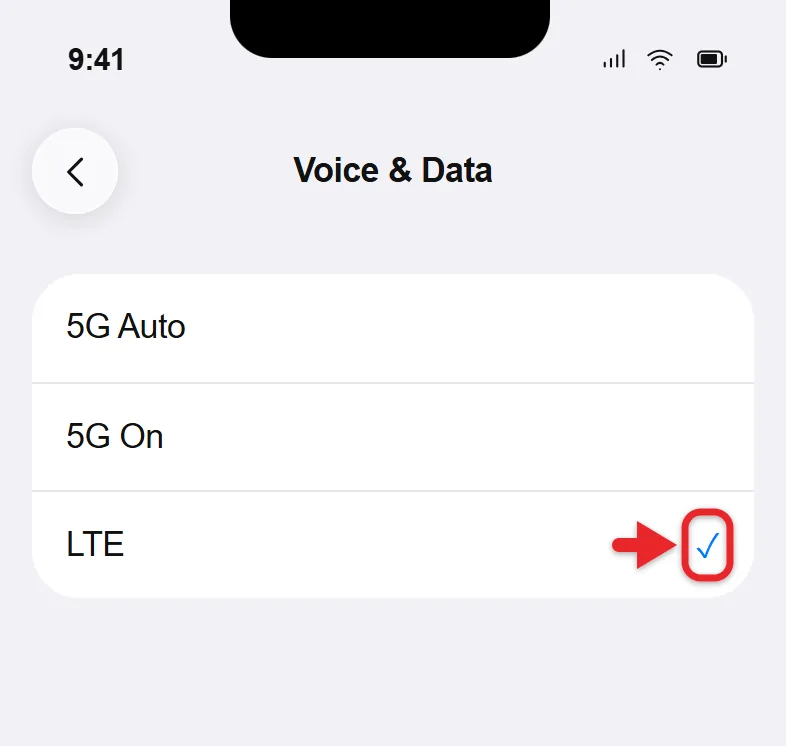
Your iPhone now uses only LTE on that line, even where 5G is available. Within a few seconds the 5G label in the status bar changes to LTE. Calls, texts and cellular data keep working; only the network type changes.
If battery life is still short on LTE, check your iPhone 13 battery health to see whether the battery itself has worn down.
With Dual SIM, each line has its own Voice & Data setting, so change every line you want off 5G. If you’re adding a separate work or travel number, read about adding a second phone number to an iPhone. It explains carrier SIM and eSIM activation, line labels, and choosing the data line before you adjust that line’s 5G settings.
How to Turn 5G Back On
- Open Settings > Cellular, and tap the line under SIMs if you have two.
- Tap Cellular Data Options > Voice & Data.
- Choose 5G Auto or 5G On.
5G is allowed again on that line wherever your carrier, plan and coverage support it. With 5G Auto, the phone may still pick LTE when 5G wouldn’t be noticeably better. Apple says its default 5G settings are tuned for battery life and data use based on your plan, so 5G Auto is the right choice for most people.
How to Check That It Worked
Look at the network label next to the signal bars at the top of the screen:
| Status bar shows | What it means |
|---|---|
| LTE or 4G | You’re on LTE. This is what you should see after choosing LTE. |
| 5G | Your carrier’s 5G network is available and your iPhone can use it. |
| 5G+, 5G UW, 5G UC or 5GA | A faster version of your carrier’s 5G, such as higher-frequency 5G. On iPhone, higher-frequency 5G works only in the US, on iPhones bought in the US. |
If you’re connected to Wi-Fi, the status bar can show the Wi-Fi icon where the network type usually appears. Swipe down from the top-right corner to open Control Center, which shows the full set of status icons. To learn the rest of them, read what the icons at the top of an iPhone screen mean.
With 5G Auto, the 5G icon can appear in rare cases even when you don’t have 5G coverage.
The 5G Choices Explained
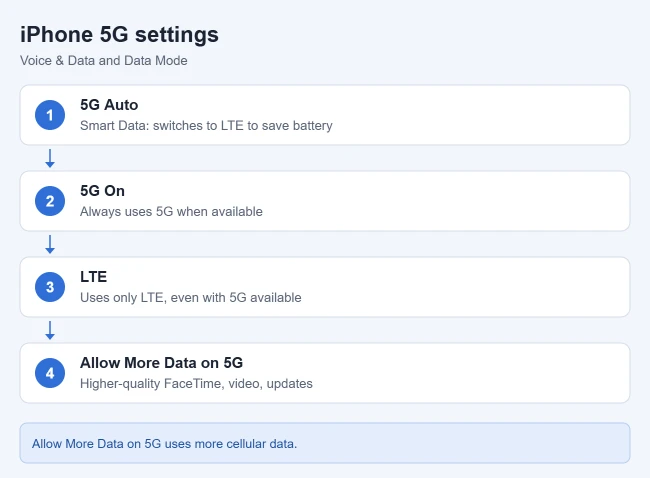
- 5G Auto: Apple’s Smart Data mode. When 5G speeds wouldn’t give a noticeably better experience, your iPhone switches to LTE, which saves battery life. This is a good fit for most people.
- 5G On: always uses the 5G network when it’s available, even when it isn’t faster. It might reduce battery life. Pick it if you have strong 5G where you spend most of your time and want the fastest speeds.
- LTE: uses only the LTE network, even when 5G is available. Pick it if 5G is weak or unreliable where you are, or if you want the most predictable battery use.
Settings such as 5G Standalone and Voice Over 5G Standalone may also appear in some markets. Those are carrier features, so ask your carrier what they do on your plan before you change them.
There is no 5G switch in Control Center. The Cellular Data button there turns cellular data off completely; it doesn’t switch between 5G and LTE. Use the Voice & Data screen in Settings instead.
Use More (or Less) Data on 5G
Data Mode controls how much data your iPhone uses, not which network it connects to. Find it in Settings > Cellular > Cellular Data Options > Data Mode. Apple offers three choices:
- Allow More Data on 5G: turns on higher data-use features such as higher-quality FaceTime, HD content on Apple TV, Apple Music songs and videos, iOS updates over cellular, and automatic iCloud backups. It also lets third-party apps use more cellular data, and it’s the default on some unlimited plans.
- Standard: allows automatic updates and background tasks on cellular with standard video and FaceTime quality. This is generally the default.
- Low Data Mode: pauses automatic updates and background tasks to reduce data use.
With Allow More Data on 5G, your iPhone may also use 5G instead of Wi-Fi when the Wi-Fi is slow or insecure on a network you only visit occasionally. To stop that for a specific network, go to Settings > Wi-Fi, tap the info button next to the network, and turn Use Wi-Fi for Internet back on.
If you’re trying to save data rather than battery, here are some ways to reduce cellular data use on iPhone.
Long movies are a common data drain, so it helps to download movies in the Prime Video app over Wi-Fi before you leave home.
Why Turn Off 5G?
- Battery life: 5G On may reduce battery life. If you’re on 5G On, try 5G Auto first. If battery still drains faster than you’d like, try LTE for a few days and compare your usage in Settings > Battery.
- Weak or patchy 5G: if 5G keeps dropping or feels slower than LTE where you live or work, LTE can give a steadier connection. If calls or data work fine on LTE, the problem is likely the local 5G signal, not your iPhone. LTE can’t create coverage where your carrier has none.
- Low Power Mode: you may not need to change anything. Low Power Mode turns off 5G on iPhone 12 and iPhone 13 models, except in some cases such as video streaming and large downloads. On iPhone 15 and later, Low Power Mode is under Settings > Battery > Power Mode, according to Apple’s Low Power Mode guide. See also how to turn on Low Power Mode on iPhone.
Don’t See 5G Options?
- Check that your iPhone supports 5G: iPhone 12 or later, including iPhone SE (3rd generation). If the Cellular Data Options screen shows the 5G choices, your iPhone is 5G capable.
- Make sure you opened the right line. With Dual SIM, tap the line under SIMs first, then Cellular Data Options.
- Confirm with your carrier that it supports 5G on iPhone and that your plan includes it. Some carriers charge an activation fee.
- Make sure you’re in an area with 5G coverage. Your carrier’s coverage map can tell you.
- Install any carrier settings update. Connect to Wi-Fi, go to Settings > General > About, and follow the prompt if one appears, as described in Apple’s carrier settings article.
- Turn Airplane Mode on, then off. If you’re not sure where that switch is, see what the airplane icon at the top of an iPhone screen means.
- If you still don’t have 5G, contact your carrier.
If you moved your SIM from an older iPhone, your carrier may need to set up that SIM for 5G. For Dual SIM with 5G on iPhone 12 models, you need iOS 14.5 or later. If the status bar shows SOS instead of LTE or 5G, that’s a different problem. Here is how to get the iPhone out of SOS mode.
iPhone 5G Questions
Does turning off 5G turn off cellular data?
No. Choosing LTE only switches the network type. To stop using cellular data entirely, turn off Cellular Data on the main Cellular screen. To limit one app, use the same per-app switches that turn off cellular data for Safari.
Will my iPhone switch back to 5G on its own?
It shouldn’t. The LTE choice stays in place until you go back to Voice & Data and pick 5G Auto or 5G On. If you ever see 5G again after an iOS or carrier settings update, open Voice & Data and check which option is selected.
Will 5G work when I travel?
Many carriers support 5G roaming. If yours doesn’t, you can use 4G or LTE, or get a local SIM or eSIM with 5G where available. Check your plan before you turn on Data Roaming in Cellular Data Options, since roaming charges depend on your carrier.
Older Verizon iPhones had their own travel switch for CDMA networks. Here is how the International CDMA setting on iPhone works.
Next step: choose LTE now, use your iPhone normally for a few days, then check Settings > Battery and decide whether to stay on LTE or go back to 5G Auto.

Matthew Burleigh is the founder, head writer, and editor of Solve Your Tech, which he launched in 2012. He has written technology tutorials since 2008 and worked in IT since 2003, including small-business support, IT management, and consulting. He holds Bachelor’s and Master’s degrees in Computer Science from Arizona State University.
Matthew writes practical guides for Windows, iPhone and iPad, Microsoft Office, Outlook, Google apps, and Android. Solve Your Tech’s guides are checked step by step against the device or app maker’s own documentation and tested on his own devices whenever he has the hardware or software, with clear steps, sources, and update dates.
Read more about Matthew and how Solve Your Tech writes and updates its guides, or report a correction.