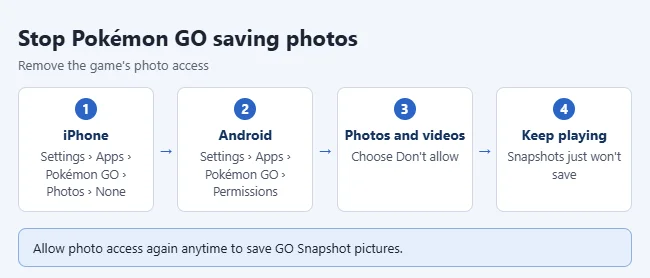
Pokémon GO saves your GO Snapshot pictures to your phone, and Niantic says photo permission must be on for that to happen. To stop it, take away the app’s photo access: on an iPhone, open Settings > Apps > Pokémon GO > Photos and choose None. On Android, open Settings > Apps > Pokémon GO > Permissions > Photos and videos and choose Don’t allow.
These steps match iOS 27 and iOS 18 (older iOS versions list apps at the bottom of Settings instead of under Apps) and current Android phones, where menu names vary a little by phone maker.
What this covers and what you need
GO Snapshot is the game’s photo mode. It places up to three Pokémon in a picture, either through your camera in AR (augmented reality, where the Pokémon appears over the live camera view) or against a still background on phones that do not support AR. This guide covers the pictures that mode saves to your photo library.
- A phone with Pokémon GO installed. There is no switch for this inside the game, so you change it in the phone’s Settings app.
- Permission to change settings. If a parent or an organization manages the phone, some permission settings may be locked.
- A decision about old pictures. Changing the permission only affects new snapshots. Pictures already saved stay where they are until you delete them.
Screenshots are different. A screenshot you take with the phone’s buttons is saved by the phone, not by Pokémon GO, so this permission does not stop those.
Turn off photo access on iPhone
Niantic’s app permissions page gives this route for iOS:
- Open the Settings app.
- Scroll down and tap Apps.
- Tap Pokémon GO. A screen opens with the permissions the game has asked for, such as Location, Camera and Photos. If the list of apps is long, use the search field at the top.
- Tap Photos.
- Choose None, the option that gives the game no access to your photo library. The change is saved as soon as you tap it, and the Pokémon GO screen now shows None next to Photos.
The Photos screen can list None, Limited Access, Add Photos Only, and Full Access. You only see the options the game has asked for. Add Photos Only is the level that lets an app save new pictures without seeing the rest of your library, which is why it still lets snapshots through. None is the only choice that stops the saves.
There is a second route that reaches the same setting. Apple’s guide to controlling access to information in apps says to go to Settings > Privacy & Security and tap a category. Tap Photos, then Pokémon GO, and pick None there. This screen is also useful for checking which apps can access your photos on iPhone.
Turn off photo access on Android
These steps follow Niantic’s Android instructions and Google’s Change app permissions on your Android phone page:
- Open the Settings app.
- Tap Apps.
- Tap Pokémon GO. If it is not in the short list, tap See all apps and find it there.
- Tap Permissions. Permissions you have allowed and denied are listed separately.
- Tap Photos and videos. Some phones and older Android versions use a different name, such as Files and media or Storage.
- Choose Don’t allow. The permission moves to the not-allowed list.

Google also describes a route that starts from the permission instead of the app: Settings > Security & Privacy > Privacy > Permission manager, then the permission type, then the app. Samsung and other phone makers arrange these menus a little differently, so use the Settings search box if you cannot find Permission manager.
Android apps ask for a permission when they need it. If Pokémon GO asks for photo access again after your next snapshot, choose Don’t allow.
Photo access and camera access are not the same
It is easy to switch off the wrong one. The Photos permission decides whether the game can put pictures in your library. The Camera permission decides whether the game can show the live camera view.
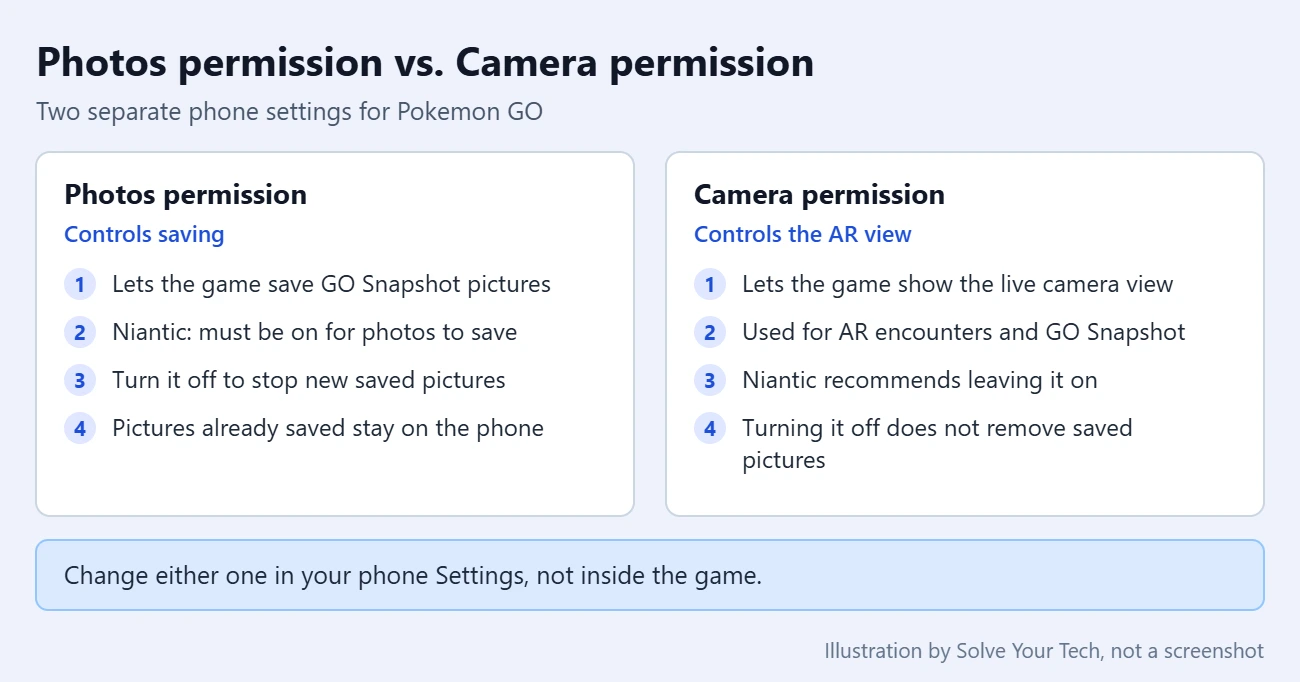
Niantic recommends keeping permissions such as Camera and Location on to get the full game, so leave Camera alone unless you want to stop the camera view too. The switch is covered in turning camera permission on or off for Pokémon GO. You can also keep the camera permission and play without the camera view if you turn off AR in Pokémon GO.
Privacy inside the game itself is a separate setting, and you can stop sharing recently caught Pokémon with friends.
Turning AR off does not stop saved pictures. Niantic says GO Snapshot still works on phones without AR, using a still background, and those pictures are saved the same way. For AR itself, Niantic lists iOS 15 or later on iPhone, and on Android a 64-bit phone that supports ARCore.
Why Pokémon GO saves so many pictures
Niantic’s GO Snapshot help article explains what the game does when you tap the camera button:
- Every shot is saved. Photos go to your device’s memory, even when you take several in one session.
- Burst Mode triples them. With this setting on, each tap of the shutter takes three pictures.
- Surprise appearances add a copy. When a Pokémon unexpectedly shows up in your picture, the game saves two versions, one with it and one without.
You can start a snapshot from a wild encounter, from a Pokémon’s page in your storage, or by tapping your Buddy and then Play!, so pictures can pile up from several places.
If you want to keep saving pictures but have fewer of them, leave the permission on and turn off Burst Mode. Niantic says it is in the three-dot menu at the top right of the GO Snapshot screen, next to Reality Blending and Self Timer.
The Save and Don’t Save choice you may see when leaving a session belongs to Flair, the stickers you can add right after taking pictures. Niantic describes it only for stickers, so it is not a way to stop the regular saves.
Check that it worked, or undo it
- Open your photo library and note the newest picture.
- Open Pokémon GO and take a snapshot of your Buddy or a Pokémon from your storage.
- If the game asks for photo access, decline.
- Go back to your photo library. No new Pokémon GO picture should be there.
Niantic’s pages do not say whether a snapshot still counts toward research tasks, Buddy activities or surprise encounters when it is not saved. If a task does not register, allow photo access, take the picture, and turn access off again.
To undo the change, return to the same screen and choose Add Photos Only or Full Access on iPhone, or Allow on Android. New snapshots are saved again from then on. Pictures taken while access was off are not recovered.
Delete snapshots you already saved
Before you delete: if your library syncs to the cloud, deleting a picture on your phone removes it everywhere. With iCloud Photos, a photo deleted on one device is deleted on your other devices signed in to the same Apple Account. With Google Photos backup on, deleting in the app removes the item from every device that backs up to the same account.
- iPhone: open Photos, tap Select, tap the Pokémon GO pictures (or slide your finger across a row of them), tap the Trash button, and confirm. Apple’s Delete photos on your iPhone or iPad page says they stay in the Recently Deleted album for 30 days. To free the space sooner, open Collections, tap Recently Deleted under Utilities, unlock it with Face ID or Touch ID, and delete them there. Items deleted from that album cannot be recovered.
- Android: open Google Photos, touch and hold a picture, select the others, and tap Trash. Google’s Delete photos & videos page says items stay in the trash for 30 days. Google also notes that copies on a removable SD card may stay behind, so check your phone’s gallery app for those.
Deleted one by mistake? On iPhone, open Recently Deleted, tap Select, choose the picture, tap the More button and tap Recover. In Google Photos, open the trash and restore it within the 30 days.
Clearing old snapshots helps if the phone is short on space. For the game’s own storage use, see how much storage Pokémon GO needs on iPhone.
If There’s No Photos Row
- There is no Photos row for Pokémon GO. An app only appears in a privacy category after it has requested access. If the game has never asked, there is nothing to turn off. Deny the request if it appears later.
- There is no Apps menu in iPhone Settings. On older iOS versions, scroll to the bottom of the main Settings screen and tap Pokémon GO there, or use Privacy & Security > Photos.
- Android does not show Photos and videos. Look for Files and media or Storage in the same Permissions list. Check the not-allowed section too, because the permission may already be off.
- The setting is gray or cannot be changed. The phone may be managed with parental controls or a work profile. Ask the person who manages it.
- Pictures still appear. Check whether they are screenshots, which the phone saves on its own. Then close Pokémon GO completely, reopen it, and confirm the permission is still off. If new snapshots keep appearing with the permission off, report it to Niantic through the game’s in-app Help.
- Photo access turned itself off after you allowed it again. On Android, the Pause app activity if unused option removes permissions from apps you have not opened for a while. Turn it off on the game’s App info screen if you want the permission to stay.
- The game keeps asking for access. Decline each time. If you would like to keep some pictures, allow access and turn off Burst Mode instead.
Turn off photo access for Pokémon GO in your phone’s Settings, take one test snapshot, and check your photo library. Then delete the old snapshots you no longer want.
Pokémon GO Photo Saving Questions
Is there a setting inside Pokémon GO to stop saving photos?
Niantic’s help pages do not describe one. The GO Snapshot article says only that photo permissions must be on for photos to be saved, and photo permission is a phone setting. The in-game camera options are Reality Blending, Burst Mode and Self Timer.
Will turning off photo access break the game?
No. Niantic names Camera and Location as the permissions it recommends for the full game, and Photos is not one of them. Catching, battling and raiding carry on as before. Features that save a picture to your library, or that pick one from it, will not work until you allow access again.
Can I save just one picture and skip the rest?
Not with a setting. The game saves every shot while photo access is on. The practical route is to keep access off, turn it on before a session you want to keep, and turn it off afterward.
Does this delete the pictures I already have?
No. Removing photo access only stops new pictures from being saved. Existing snapshots stay in your library until you delete them yourself.
Can I still catch Pokémon that appear in snapshots?
Niantic says a surprise Pokémon appears on the map after you view the photo in the session gallery, and that some Pokémon are only found this way. Its help pages do not say whether that needs the picture to be saved. If you are chasing one, allow photo access for that session.
Can I use this to limit what a child does in the game?
It stops saved pictures, and that is all. Spending is controlled elsewhere, and you can block in-app purchases in Pokémon GO separately.

Matthew Burleigh is the founder, head writer, and editor of Solve Your Tech, which he launched in 2012. He has written technology tutorials since 2008 and worked in IT since 2003, including small-business support, IT management, and consulting. He holds Bachelor’s and Master’s degrees in Computer Science from Arizona State University.
Matthew writes practical guides for Windows, iPhone and iPad, Microsoft Office, Outlook, Google apps, and Android. Solve Your Tech’s guides are checked step by step against the device or app maker’s own documentation and tested on his own devices whenever he has the hardware or software, with clear steps, sources, and update dates.
Read more about Matthew and how Solve Your Tech writes and updates its guides, or report a correction.