To hide the frequently visited sites on the Microsoft Edge New Tab page, open a new tab, click the Page settings gear icon in the top-right corner, and set Quick links to Off. To get rid of just one site, hover over its tile, click the three dots, and choose Remove.
These steps are for the current desktop Edge on Windows 11, Windows 10, and macOS. The old “Top sites” setting is gone; the tiles are now quick links controlled from the New Tab page, with a Settings route further down if your layout looks different.
What Quick Links Are
Quick links are the row of small site icons near the top of a new tab. Edge fills them from three places:
- Sites you visit often. Edge adds these from your browsing history. This is the part that can show other people where you spend your time.
- Sites you add yourself. You can click the + tile to add any web address.
- Sponsored links. Some tiles are paid placements from Microsoft partners. They’re marked as sponsored and have their own on/off switch.
You have two choices. Turn the whole row off if you don’t use it, or remove individual tiles if you like the shortcuts but don’t want certain sites showing.
If you want your own shortcuts on every page, not just new tabs, you can show the favorites bar in Microsoft Edge instead.
Hide All Frequently Visited Sites on the New Tab Page
- Open Microsoft Edge and press Ctrl + T (Command + T on a Mac), or click the + next to your open tabs. The New Tab page opens with the search box and the row of quick links.
- Click the Page settings button, the gear icon in the upper-right corner of the page. A settings panel slides open.
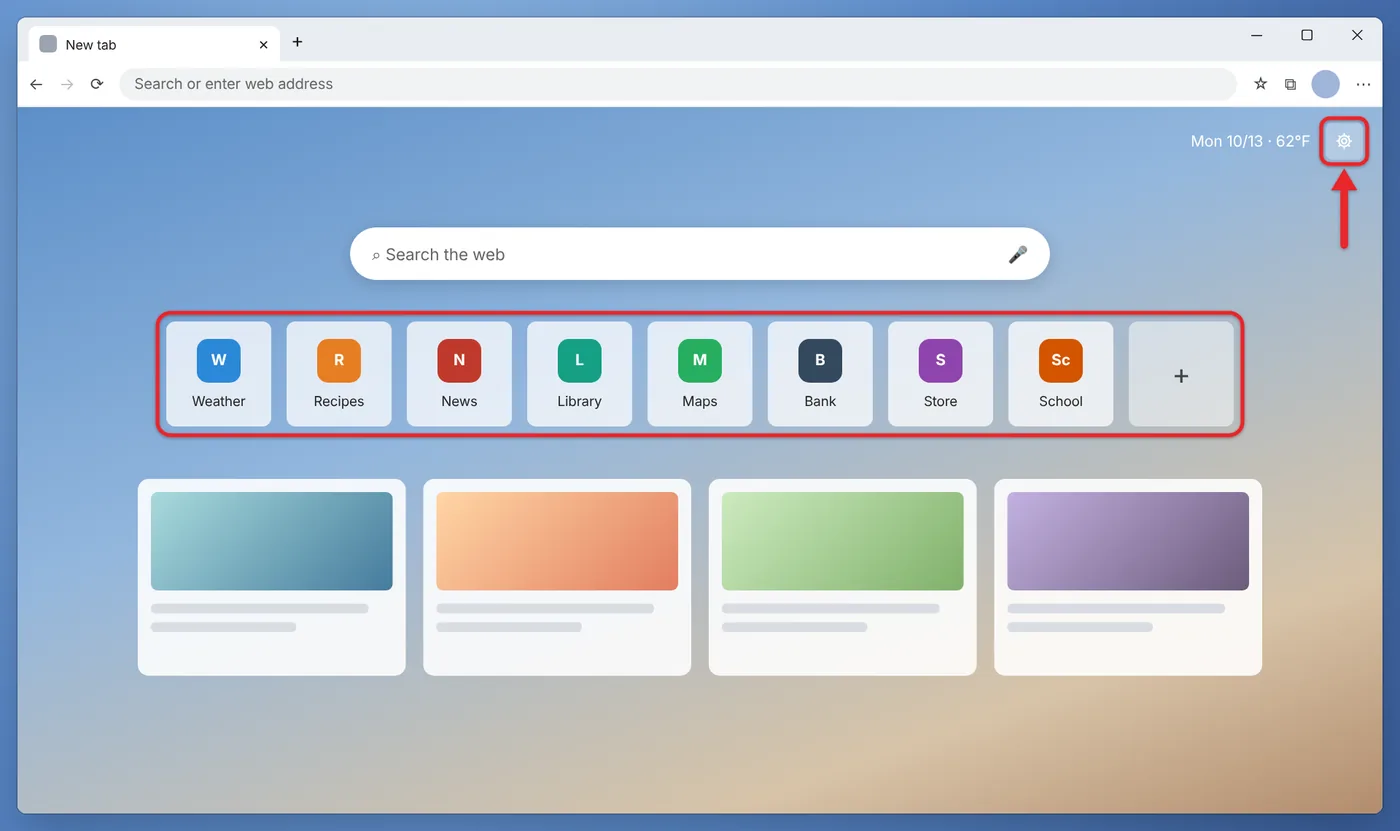
- If you see layout choices at the top of the panel, such as Focused, Inspirational, or Custom, select Custom. The other layouts may lock some options.
- Find Quick links and open its drop-down menu. The choices are Off, 1 row, and 2 rows. Some Edge builds show a Show quick links switch here instead of a drop-down.
- Select Off, or turn the Show quick links switch off. The quick links row disappears from the page right away.
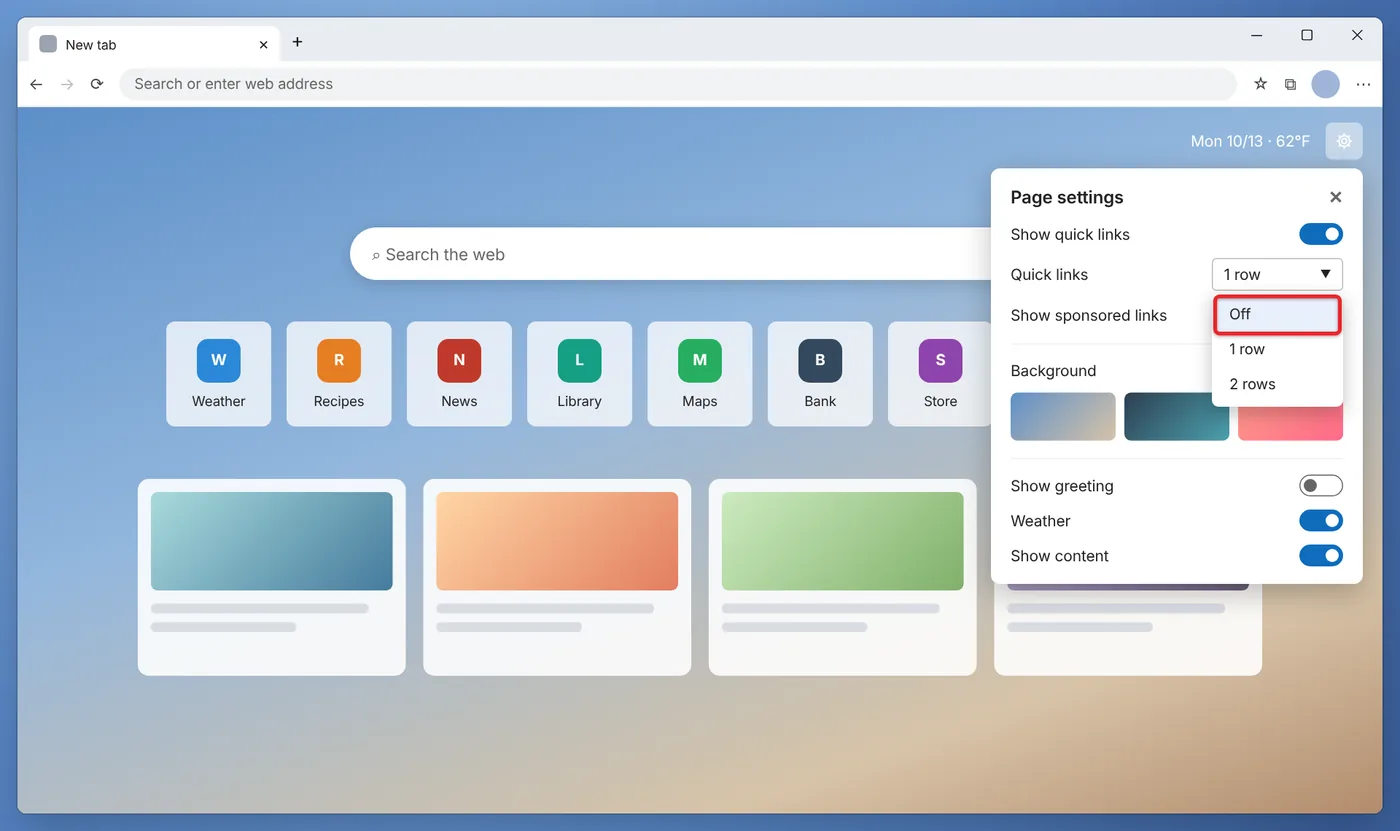
- Click anywhere outside the panel to close it. There’s no save button.
Open another new tab to confirm the change. You should see the search box but no site icons. To bring them back, repeat the steps and choose 1 row or 2 rows.
The search box on that page uses Bing, but you can make Edge search with Google instead.
Remove One Frequently Visited Site
If you want to keep the shortcuts but hide a particular site, remove that tile instead.
- Open a new tab in Edge.
- Hover your mouse over the tile you want to remove. A small three-dot button appears in the corner of the tile.
- Click the three dots and select Remove. The tile disappears and the remaining tiles shift over.
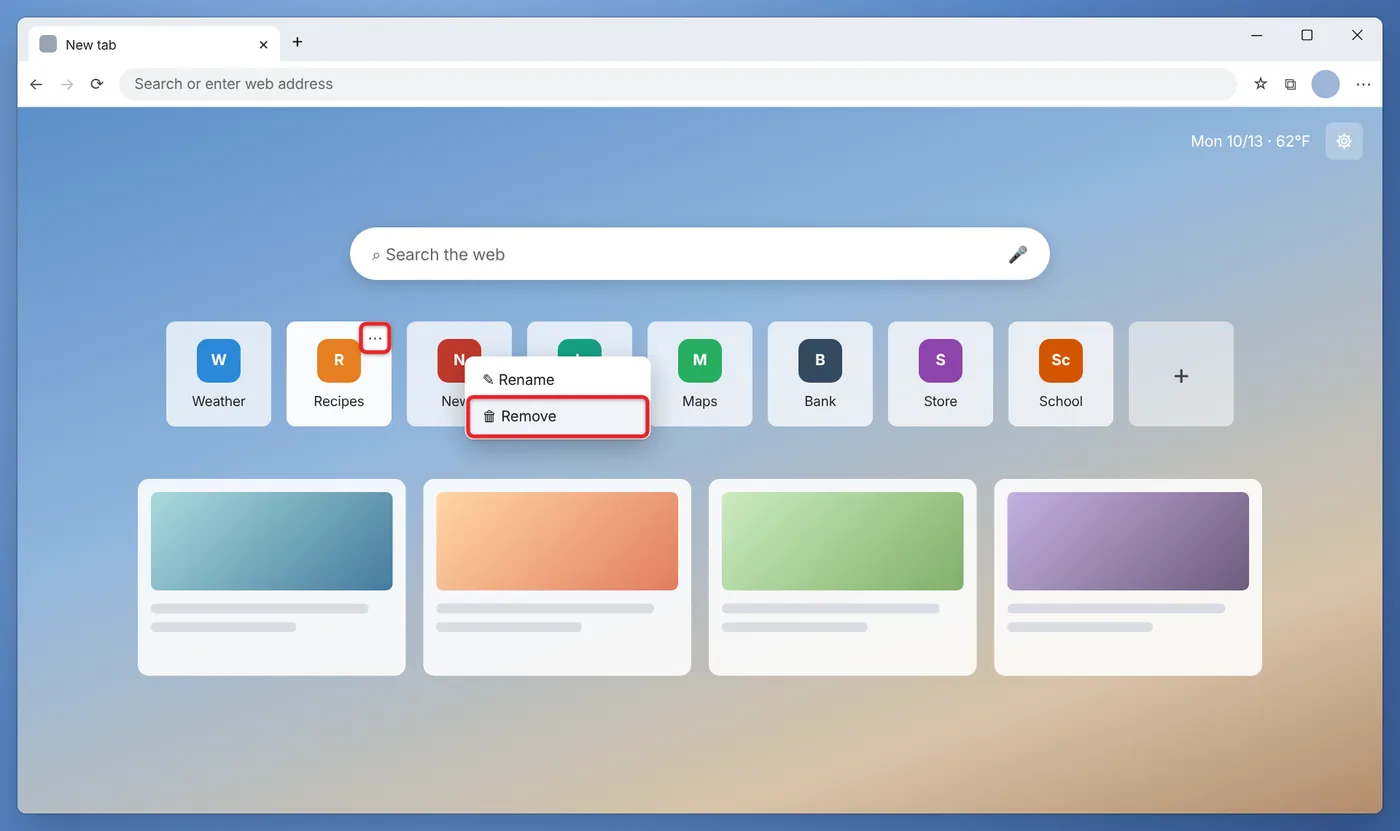
This matches the method a Microsoft Q&A moderator gives in Microsoft’s answer on deleting a quick link. Keep in mind that Edge fills the empty space with another site from your history. If you keep visiting a site you removed, it can come back later. If that happens often, either turn quick links off completely or add your own sites with the + tile so the row is filled with links you chose.
Turn Off Sponsored Quick Links
You can keep your own quick links and hide only the paid ones.
- Open a new tab and click the Page settings gear icon.
- Under Quick links, turn off Show sponsored links.
- Close the panel. Sponsored tiles are removed from the row, and the switch stays off until you change it.
Use Edge Settings Instead
If the gear icon is missing or you’d rather start from the main menu, you can reach the same panel from Edge’s settings.
- Click Settings and more (the three dots in the top-right corner of the Edge window) and select Settings.
- Select Start, home, and new tabs in the left pane. You can also type
edge://settings/startHomeNTPinto the address bar and press Enter. - Under New tab page, click Customize next to “Customize your new tab page layout and content.” Edge opens a new tab with the Page settings panel already open.
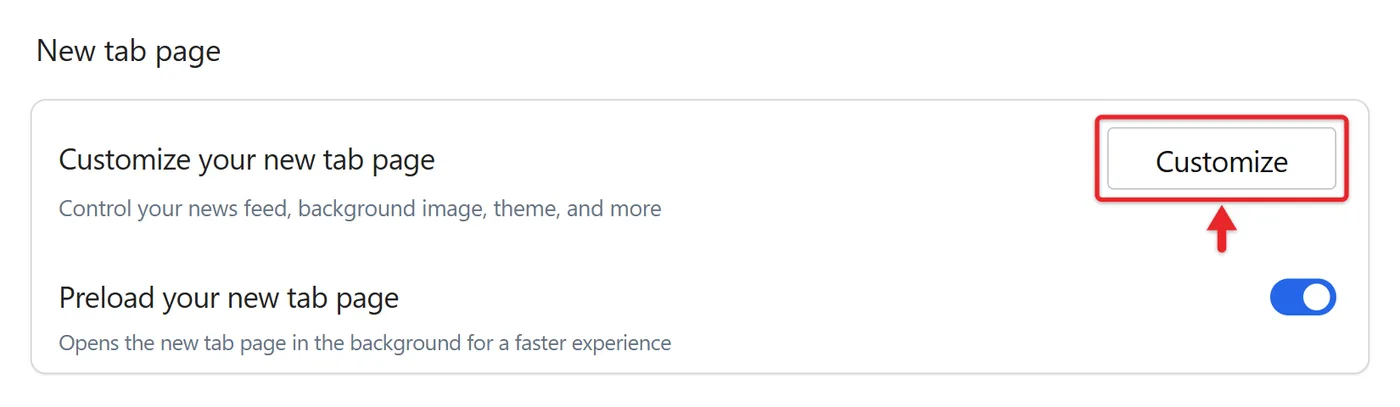
- Set Quick links to Off, or turn off Show sponsored links, as described above.
The same settings page is where you choose what Edge shows when it starts and whether a Home button appears. If you’d rather open a search page than the New Tab page, you can make Google your homepage in Microsoft Edge.
Edge can also launch with your own sites or reopen your last tabs once you set it to open to a specific page.
Edge on iPhone and Android
The Edge mobile apps have their own set of site tiles on the New Tab page, and they don’t follow your desktop settings. On an iPhone, you remove them one at a time from the app. Here’s how to delete a site icon from the New Tab page in the Edge iPhone app.
If Quick Links Won’t Turn Off
- The Quick links option is grayed out or missing. On a work or school computer, your organization can control the New Tab page with the NewTabPageQuickLinksEnabled policy. When an admin sets it to disabled, quick links are hidden and the control in the Page settings panel is turned off. If quick links are forced on, ask your IT department. You can type
edge://policyin the address bar to see which policies are applied. - A tile has no Remove option. An organization can also pin up to three tiles with the NewTabPageManagedQuickLinks policy. When that policy is mandatory, you can’t delete those tiles.
- Your New Tab page looks completely different. Work and school profiles signed in with a Microsoft Entra (formerly Azure AD) account can use the Microsoft 365 New Tab page, which an organization manages. Try a personal profile if you need the standard options.
- There’s no Off choice in the drop-down. Select Custom at the top of the Page settings panel first. Some layouts limit the choices.
- Removed sites keep coming back. That’s Edge refilling the row from your history. Turn quick links off, or clear your Edge browsing history so it has fewer sites to pull from.
- The tiles are back after an update. Edge updates occasionally reset or move New Tab page settings. Repeat the steps above, and keep Edge current by updating Microsoft Edge.
Edge New Tab Questions
Does turning off quick links delete my browsing history?
No. It only hides the tiles on the New Tab page. Your history, favorites, and saved passwords stay as they were, and the sites come back if you turn quick links on again.
Where did the “Show sites I frequently visit in Top sites” setting go?
Older versions of Edge had that toggle in the main settings. Microsoft replaced the Top sites section with quick links, so the current control is the Quick links setting in the New Tab page’s Page settings panel.
Can I hide quick links without turning them off?
Yes, by removing the tiles you don’t want and adding your own with the + tile. If every slot holds a site you added, Edge has less room to show sites from your history.
Can I show more quick links instead of fewer?
Yes. In the same Quick links drop-down, choose 2 rows to show a second row of tiles. That’s handy if you add your own shortcuts and want room for more of them.
Will this stop other people from seeing the sites I visit?
It hides the most obvious list, but anyone using your Edge profile can still open your history with Ctrl + H. For browsing you don’t want saved, use an InPrivate window by pressing Ctrl + Shift + N.

Matthew Burleigh is the founder, head writer, and editor of Solve Your Tech, which he launched in 2012. He has written technology tutorials since 2008 and worked in IT since 2003, including small-business support, IT management, and consulting. He holds Bachelor’s and Master’s degrees in Computer Science from Arizona State University.
Matthew writes practical guides for Windows, iPhone and iPad, Microsoft Office, Outlook, Google apps, and Android. Solve Your Tech’s guides are checked step by step against the device or app maker’s own documentation and tested on his own devices whenever he has the hardware or software, with clear steps, sources, and update dates.
Read more about Matthew and how Solve Your Tech writes and updates its guides, or report a correction.