To make every period in a Word document bigger, press Ctrl + H, type a period in both Find what and Replace with, click in Replace with, then click More >> > Format > Font and pick a larger size. Click OK, then Replace All. To enlarge just one period, select it and press Ctrl + ] until it’s the size you want.
These steps are for Word for Microsoft 365, Word 2024, 2021, 2019, and 2016 on Windows, and they also work in Word 2013. Word for Mac uses a slightly different menu, covered below. Word for the web can resize a period you select, but its replace tool can’t change formatting, so the all-at-once method needs the desktop app. There’s no setting that makes periods bigger by default, so you apply the change to each document.
Make All Periods Bigger With Find and Replace
Find and Replace can search for a character and swap it for the same character with new formatting. That’s how you resize every period at once without touching the words around them. If you haven’t used the Replace window before, our guide to replacing all occurrences of a word in Word walks through its buttons and options.
- Open the document and click the Home tab. The Replace button is in the Editing group at the right end of the ribbon.
- Click Replace, or press Ctrl + H. The Find and Replace window opens on the Replace tab.
- Type a period (.) in the Find what box.
- Click in the Replace with box and type a period there too. Leave your cursor in this box. Word applies the formatting from the next steps to whichever box has the cursor, and you want it on the replacement.
- Click More >> at the bottom left of the window. The search options open, with a Format button underneath.
- Click Format and choose Font. The Replace Font window opens. If it says Find Font instead, close it, click in the Replace with box, and try again.
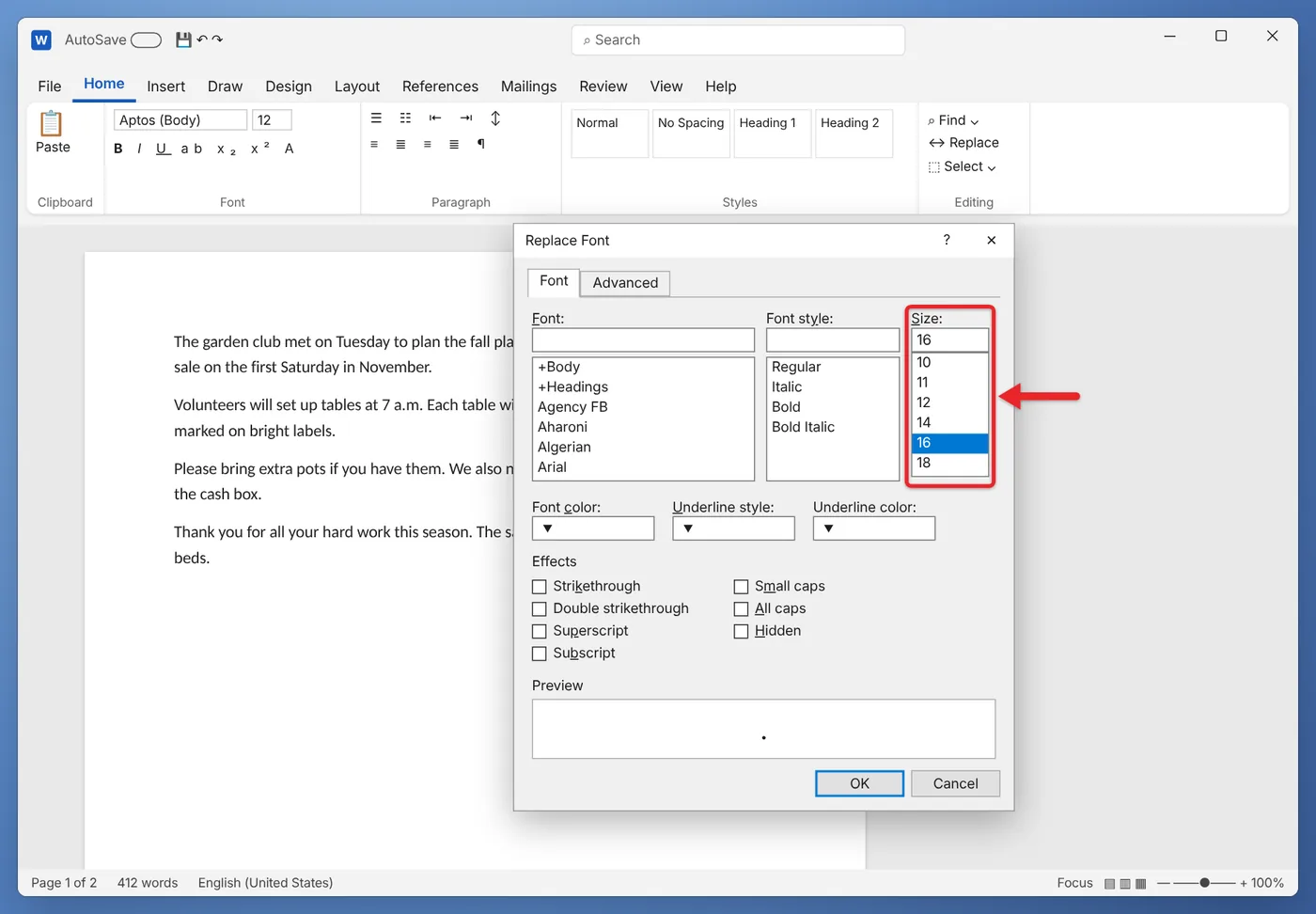
- In the Size list, pick a size larger than your text, such as 16 for a document typed in 12 point. You can also type a number in the box. Click OK. You’ll see Format: Font: 16 pt listed under the Replace with box.
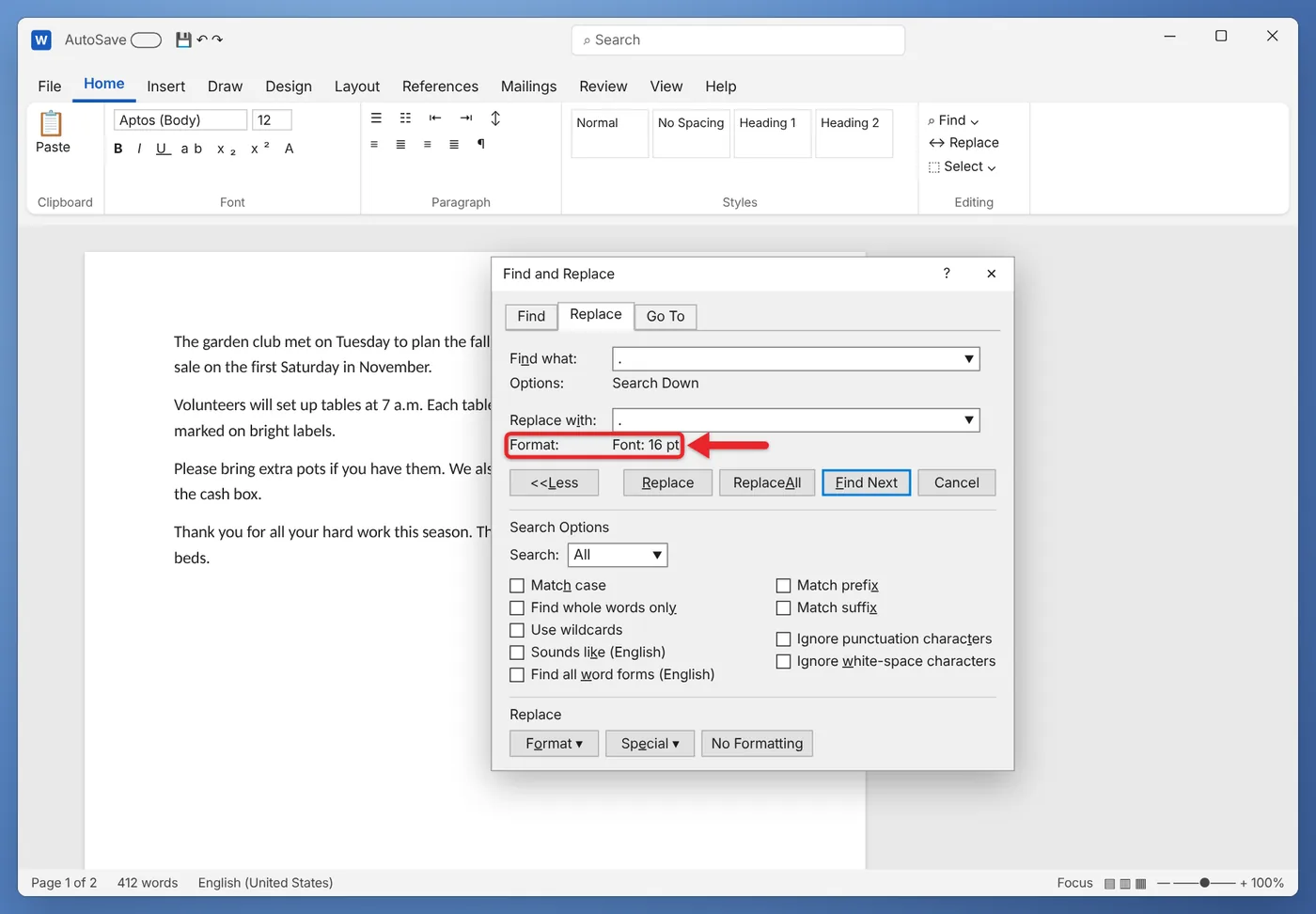
- Click Replace All. Word changes every period and shows how many replacements it made. Click OK, then Close.
Look through the document to check the result. If the periods are too big or too small, press Ctrl + Z to undo the whole replacement in one step, then repeat the steps with a different size.
A jump of 2 to 4 points is usually enough. A 12-point document with 14- or 16-point periods looks normal at a glance, while a 24-point period starts to look like a dot sitting on the line by itself.
Watch for Periods That Aren’t the End of a Sentence
Replace All changes every period character, including the ones in decimals (3.5), web addresses, email addresses, file names, and abbreviations such as “Dr.” or “a.m.” If your document has numbers or links, use this instead of Replace All:
- Follow steps 1 through 7 above.
- Click Find Next. Word highlights the first period.
- Click Replace if it ends a sentence, or Find Next to skip it. Keep going until Word reaches the end of the document.
You can also select only the paragraphs you want to change before opening Replace. Word replaces periods in the selection and then asks whether to search the rest of the document. Click No to stop there.
An ellipsis typed as three periods usually doesn’t change, because Word’s AutoCorrect turns it into a single ellipsis character (…) as you type. Search for that character separately if you want it bigger too.
Other Ways to Make Periods Easier to See
The Replace Font window has more than a size setting. Checking Bold makes a period darker and slightly wider. Picking a font with rounder, heavier dots, such as Verdana or Arial Black, makes periods stand out without changing their size much. You can combine these with a size change in the same pass.
The same steps work for other punctuation. Type a comma, question mark, or colon in both boxes instead of a period.
Stop Bigger Periods From Spreading Your Lines Apart
With Word’s normal line spacing, each line gets taller to fit the largest character on it. A 16-point period on a 12-point line pushes that line down, so a page with bigger periods can end up with uneven gaps between lines. To keep the spacing even, set a fixed line height:
- Press Ctrl + A to select the whole document.
- On the Home tab, click the small arrow at the bottom right of the Paragraph group. The Paragraph window opens on the Indents and Spacing tab.
- Under Line spacing, choose Exactly.
- In the At box, type a height in points. For 12-point text, 14 pt is close to single spacing and 24 pt is close to double spacing.
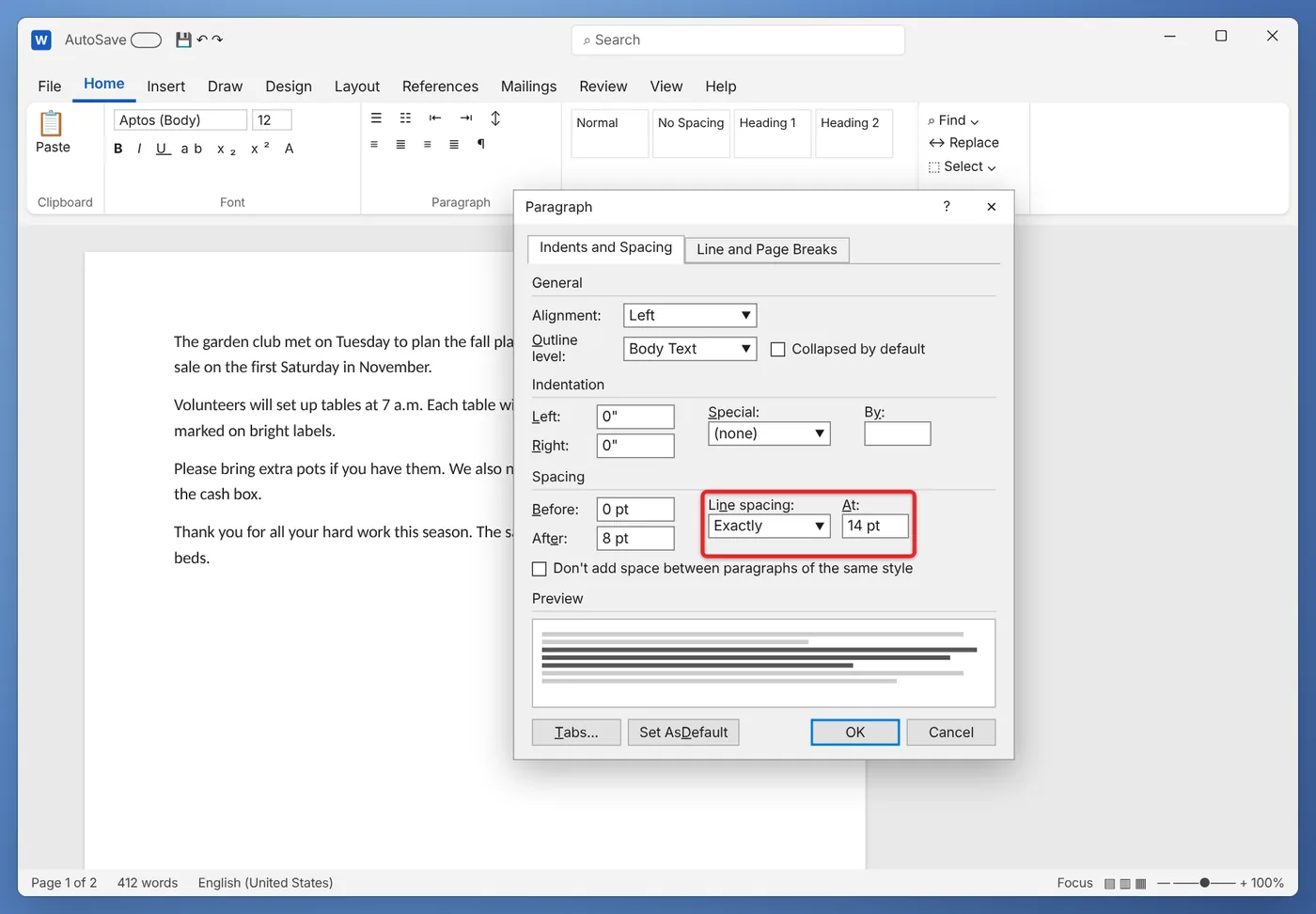
- Click OK. All lines now have the same height, no matter how big the periods are.
Microsoft’s Adjust indents and spacing page describes each line spacing option. Exactly is fixed, so anything taller than the line height gets cut off at the top. If tall letters, pictures placed in line with text, or very large periods look clipped, raise the At value. For more on line gaps, see our guide to fixing line spacing that’s too big in Word.
Make One Period Bigger
If you only need to change a few periods, resize them directly:
- Click just to the left of the period, then hold Shift and press the Right Arrow key once. Only the period is highlighted.
- Press Ctrl + ] to increase the size by 1 point. Press it again until the period looks right. Ctrl + Shift + > jumps up in bigger steps, following the sizes in the font size list.
- To shrink it, press Ctrl + [ or Ctrl + Shift + <.
These shortcuts are listed in Microsoft’s Word keyboard shortcuts. If you’d rather use the mouse, select the period and choose a size from the Font Size box on the Home tab, or click the Increase Font Size button (the large A with an up arrow) next to it. The font size box works the same way in Word for the web.
Make Periods Bigger in Word for Mac
Word for Mac has the same replace options, but they’re in the Advanced Find and Replace window.
- Open the document, click Edit in the menu bar, point to Find, and click Advanced Find and Replace.
- Click the Replace tab.
- Type a period in Find what and in Replace with. Leave the cursor in Replace with.
- Click the arrow button at the bottom left of the window to show more options.
- Click Format and choose Font. Pick a larger size and click OK. The new size appears under Replace with.
- Click Replace All, or use Find Next and Replace to skip decimals and links.
To undo the change, press Command + Z. To fix the line spacing on a Mac, select all text with Command + A, then choose Format > Paragraph and set Line spacing to Exactly.
If the Replacement Didn’t Work
- Word says it made 0 replacements. The size was probably added to Find what instead of Replace with, so Word searched for periods that were already that size. Click in Find what, click No Formatting, and try again with the cursor in Replace with.
- The periods didn’t get bigger, but the count was correct. The format line under Replace with is missing. Click in Replace with, then Format > Font, and set the size again.
- Spaces or letters changed size too. Something besides a single period was in one of the boxes, such as a period followed by a space. Press Ctrl + Z, make sure each box holds only a period, and run it again.
- Numbers and links look odd. Their periods got bigger too. Undo and use Find Next and Replace to approve each one.
- New periods are normal size. The replacement only affects text that’s already in the document. Run it again after you finish writing.
- Replace All is grayed out. The document may be in Protected View or read-only. Click Enable Editing in the yellow bar at the top of the document, if you see it.
Frequently Asked Questions
Can I make periods bigger by default in Word?
No. Word doesn’t have a separate size setting for punctuation. Periods use the same font and size as the text around them, so run Find and Replace once you’ve finished each document. To change the size of all your text in new documents, see how to set a default font in Word.
How do I change the periods back to normal size?
Press Ctrl + Z right after Replace All. If you’ve already made other edits, open Replace, put the larger size on Find what with Format > Font, put your normal text size on Replace with the same way, and click Replace All.
Will bigger periods make my paper longer?
Barely. A larger period is only a little wider, so it rarely pushes text onto a new line. Most of any change comes from taller lines, and instructors who check formatting can spot that. If you need to meet a length requirement, check the word count instead of the page count.
Does this work for commas and other punctuation?
Yes. Type the comma, question mark, or other mark in both boxes instead of a period. You can repeat the steps for each mark, using the same size each time so they match.

Matthew Burleigh is the founder, head writer, and editor of Solve Your Tech, which he launched in 2012. He has written technology tutorials since 2008 and worked in IT since 2003, including small-business support, IT management, and consulting. He holds Bachelor’s and Master’s degrees in Computer Science from Arizona State University.
Matthew writes practical guides for Windows, iPhone and iPad, Microsoft Office, Outlook, Google apps, and Android. Solve Your Tech’s guides are checked step by step against the device or app maker’s own documentation and tested on his own devices whenever he has the hardware or software, with clear steps, sources, and update dates.
Read more about Matthew and how Solve Your Tech writes and updates its guides, or report a correction.