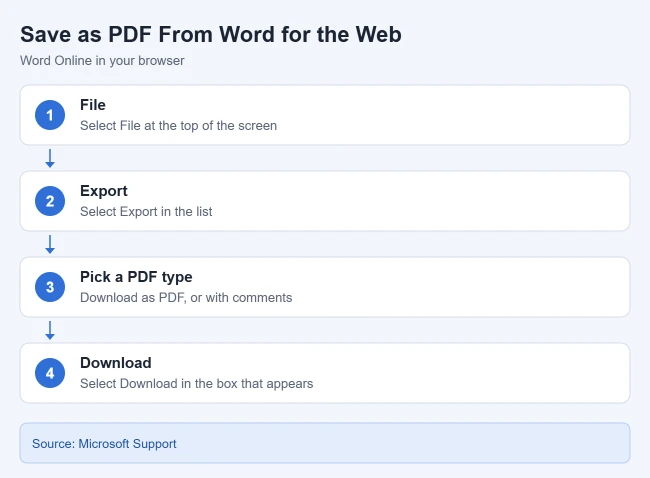
To save as a PDF from Word Online (Word for the web), select File > Export > Download as PDF, then select Download in the box that appears. Choose Download as PDF with comments instead if you want your comments in the file. The PDF goes to your browser’s usual download location.
These steps come from Microsoft Support’s Export Word document as PDF article for Word for the web. Details on the desktop app’s extra PDF settings come from the Microsoft Word Blog, and the note about formatting from a volunteer moderator on Microsoft Q&A.
How to Save a Word Online Document as a PDF
- Open the document in Word for the web.
- Select File at the top of the screen.
- Select Export.
- Choose Download as PDF, or Download as PDF with comments.
- Select Download in the confirmation box.
- Find the PDF in your download location.
Result: you get a PDF copy of the document. Microsoft describes the PDF as a shareable copy that preserves the document’s formatting.
Download as PDF vs. Download as PDF With Comments
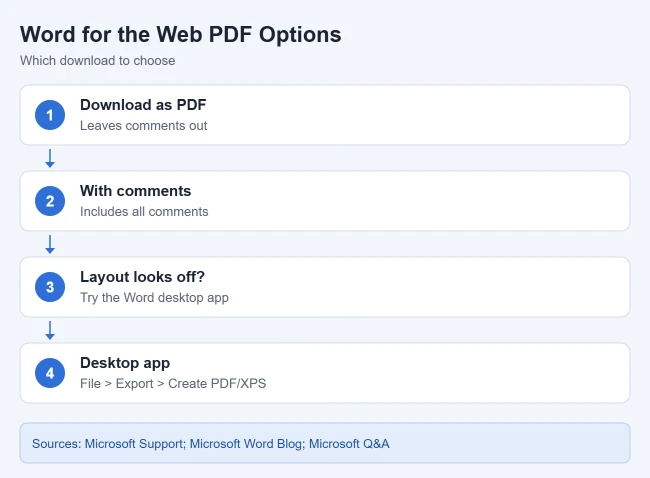
- Download as PDF: Microsoft says this exports the document without any comments included.
- Download as PDF with comments: this exports the PDF with all comments included, which is handy when you send a draft for review.
Does This Change My Word Document?
No. The download is a separate PDF copy, and the original document stays where it was, such as in OneDrive, so you can keep editing it.
Why Save a Word Document as a PDF?
The Microsoft Word Blog explains that a PDF keeps your layout, fonts, and text the same on every device. That makes it a good choice when you’re submitting a report, sending a proposal, or sharing with people who may not use Word. The blog lists resumes, invoices, and teaching templates as typical examples.
Keep the original Word document too, since that’s the version you’ll edit if anything needs to change later.
Need More PDF Settings? Use the Desktop App
Word for the web gives you the two download choices above. The Microsoft Word Blog describes more options in the Word desktop app on Windows:
- Open the document in the Word desktop app.
- Select File > Export > Create PDF/XPS.
- Under Optimize for, choose Standard for the best print quality, or Minimum size for a smaller file.
- Select Publish.
Result: the desktop app saves a PDF with the quality you chose. The blog adds that File > Save As with PDF selected has an Options button for a page range, bookmarks from headings, accessibility tags, and markup. You can also use the Save As route, choosing PDF next to Save as type.
Troubleshooting
The PDF’s formatting looks different
Users in a Microsoft Q&A thread reported layout changes in PDFs made from Word for the web. A volunteer moderator noted that the desktop app’s PDF options aren’t available in Word Online. If the online version doesn’t look right, try exporting from the desktop app instead.
Printing creates a PDF
The same moderator explained that when you print from Word Online, the document is automatically converted to PDF for printing. If you want to keep the file, use Export instead.
You can’t find the PDF
Check your browser’s downloads list. To change where files go, see your browser’s download settings, such as how to find downloaded files in Chrome.
FAQs
Is saving as a PDF in Word Online free?
Yes. Export is built into Word for the web, so you don’t need a separate converter.
Can I check the PDF for problems?
Open the PDF afterward and double-check formatting, especially graphics, illustrations, and tables.
If the document contains links, use our Word-to-PDF hyperlink guide to check the source targets and exported links, including the different Mac and Windows export choices.
More Word Online Guides
To go the other way and put a PDF inside a document, see how to embed a PDF in Word.

Matthew Burleigh is the founder, head writer, and editor of Solve Your Tech, which he launched in 2012. He has written technology tutorials since 2008 and worked in IT since 2003, including small-business support, IT management, and consulting. He holds Bachelor’s and Master’s degrees in Computer Science from Arizona State University.
Matthew writes practical guides for Windows, iPhone and iPad, Microsoft Office, Outlook, Google apps, and Android. Solve Your Tech’s guides are tested on current devices or checked against official product documentation, with clear steps, sources, and update dates.
Read more about Matthew and how Solve Your Tech writes and updates its guides, or report a correction.