To change the paper size in Word Online (Word for the web), open your document, select the Layout tab, select Size, and choose a paper size such as Letter, Legal or A4. The change applies to every page right away, so proofread afterward in case text or images moved. To check where each page now stops, show the page ends in Word Online.
These steps are for Word for the web in a desktop browser such as Edge, Chrome, Firefox or Safari, using a personal Microsoft account or a work or school Microsoft 365 account. A section near the end covers the extra page setup options in the Word desktop app. Checked October 16, 2026.
Before You Start
- Open the document for editing. If it opens in Viewing mode, the Layout tab is missing. Select Editing from the mode menu near the top right, or choose Edit Document if you see that button.
- Check your permission. If someone shared the file with you as view-only, you can’t change its paper size. Ask the owner for edit access, or save your own copy.
- Know your target size. Check the paper loaded in the printer, or the size a school, office or print shop asked for.
Why the Paper Size Matters
The paper size sets the shape of every page. Margins, line breaks, tables and images all sit inside it. New documents usually start on Letter in the US and A4 in many other countries. If the page size doesn’t match the paper it prints on, the printer may shrink the page, cut off the edges, or leave a wide blank strip.
How to Change the Paper Size in Word Online
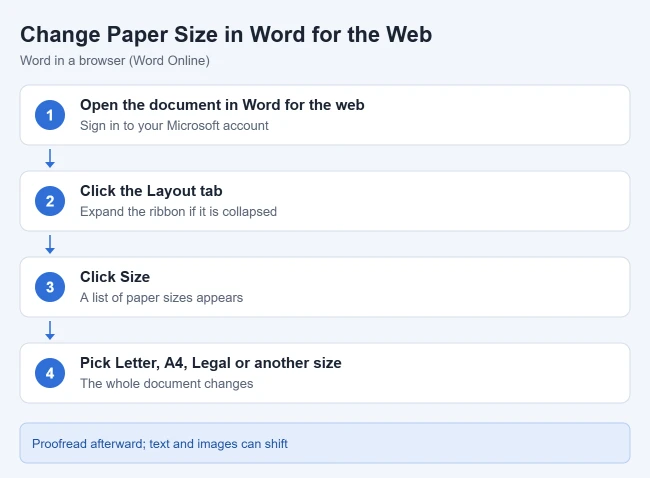
- Go to Word for the web and sign in with the Microsoft account that holds your document. Your recent documents appear.
- Open the document you want to change. It opens in the browser.
- Select the Layout tab at the top of the window. Page layout tools appear, including Margins, Orientation and Size, which Microsoft’s Word for the web layout guide also covers.
- Select Size. A list of paper sizes opens.
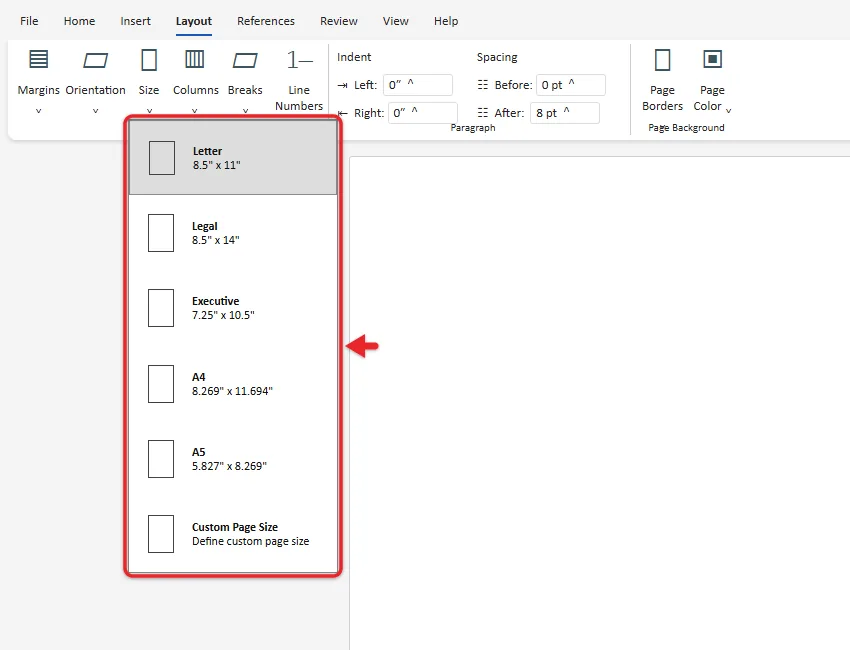
- Choose the size you want. Every page in the document switches to the new size, and Word saves the change automatically to OneDrive or SharePoint.
To confirm it worked, open Size again. The size you picked is highlighted. Scroll through the document to see the new page shape.
If you don’t see Size, the ribbon may be collapsed into a single line. Widen the browser window or show the full ribbon in Word Online. You can also type “size” in the Search box at the top of the window to find the command.
Paper Sizes in the Size Menu
| Size | Dimensions | Common use |
|---|---|---|
| Letter | 8.5 x 11 in | Standard US printer paper |
| Legal | 8.5 x 14 in | Contracts and legal forms in the US |
| Executive | 7.25 x 10.5 in | Some business stationery |
| A4 | 210 x 297 mm (about 8.27 x 11.69 in) | Standard paper outside North America |
| A5 | 148 x 210 mm | Booklets, notepads, half-sheet handouts |
A4 is a little narrower and taller than Letter. A document that looks fine on screen can lose its bottom line or right edge when it prints on the other size, so match the setting to the paper.
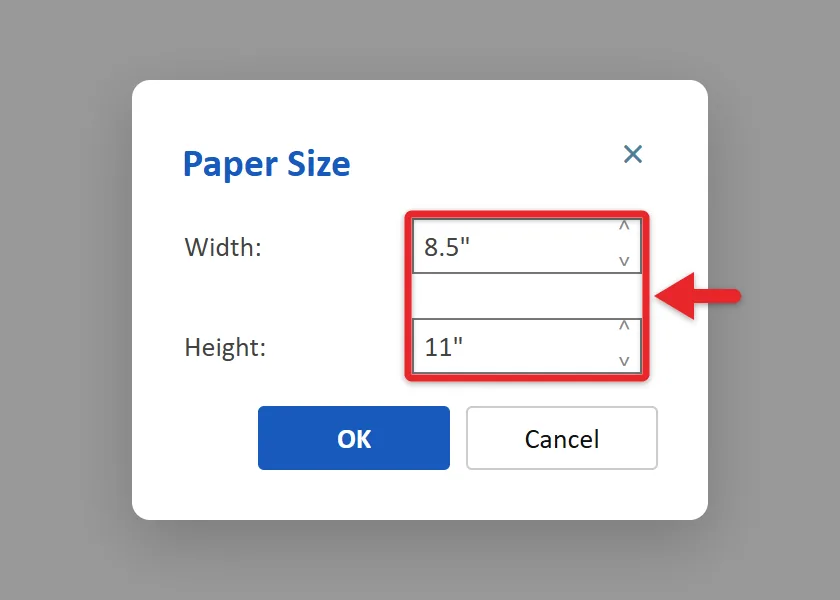
For a size that isn’t listed, such as a card or a printer’s specialty stock, choose Custom Page Size at the bottom of the Size menu and enter the width and height you need.
Change the Size Back
Open Layout > Size and choose the original size, or press Ctrl + Z (Command + Z on a Mac) right after the change to undo it. If the document has been edited since, use File > Info > Previous Versions to open and restore an earlier copy.
After You Change the Size
- Proofread the layout. Text reflows to the new page shape, so page breaks, tables and images may shift. The font size doesn’t change.
- Recheck margins. Use Layout > Margins if the new size makes your margins look off, or set 1-inch margins in Word.
- Consider orientation. For a wide table or chart, try Layout > Orientation > Landscape.
- Check headers and footers. A shorter page leaves less room, so make sure page numbers and footer text still fit.
- Match your printer. Make sure the printer can take that paper size and has it loaded. When you select File > Print > Print, your browser’s print window opens. Choose the same paper size there, and avoid “fit to page” scaling if you need exact dimensions.
When the pages look right, you can save the document as a PDF from Word Online to share a copy that keeps its page size and layout.
What Word for the Web Can’t Do
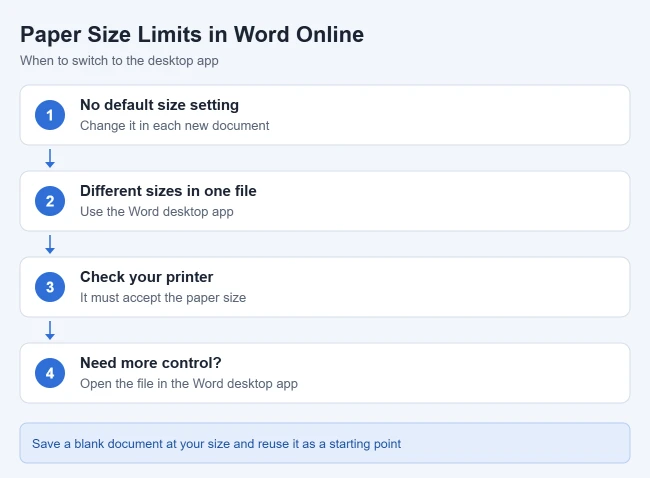
- Set a default size for new documents. Word for the web doesn’t have a default page size setting. Change it in each document, or keep a blank document at your size and make copies of it.
- Use different sizes in one file. One Legal page inside a Letter document needs its own section. Microsoft’s Word for the web vs. desktop comparison lists section breaks as a desktop feature, so mixed sizes require the Word desktop app.
- Change paper trays and printer-specific options. Those live in the desktop app’s Page Setup dialog box and in your printer settings.
To switch, select Editing and then Open in Desktop App, or download the file and open it in Word on your computer.
Change Paper Size in the Word Desktop App
These steps are for Word for Microsoft 365 and Word 2024, 2021, 2019 and 2016 on Windows. Older releases label the tab Page Layout.
- Open the document in the Word desktop app.
- Select Layout > Size and choose a paper size. The whole document changes.
- For other dimensions, choose More Paper Sizes. On the Paper tab of the Page Setup dialog box, pick a size from Paper size or enter a Width and Height. Microsoft explains that changing either number switches the setting to Custom size (Page Setup paper options).
- In Apply to, keep Whole document, or choose This point forward to change the size only from the cursor onward. Word adds a section break and starts the new size on a new page.
- To use this size for every new document, select Set As Default, then Yes.
- Select OK, then check File > Print to preview page breaks, tables and images.
The same section approach is how you make only one page landscape in Word. If a document prints much smaller than expected, its paper size and the printer’s paper probably don’t match; see why a Word document prints so small.
Troubleshooting
- The Layout tab is missing: the document is in Viewing mode or is view-only. Switch to Editing, or ask the owner for edit access.
- Size is grayed out or Word asks to convert the file: older .doc files and protected documents can open with limited editing. Follow Word’s prompt to convert the file, or open it in the desktop app and save it as a .docx file.
- The printout is cut off or shrunk: the browser print dialog is using a different paper size or a scale setting. Set it to the same size as the document and 100% scale.
- Images jumped to the next page: select the picture, open its Wrap Text options, and choose In Line with Text so it moves with the paragraph around it.
Frequently Asked Questions
Is Word Online the same as Word for the web?
Yes. Microsoft now calls it Word for the web. It’s the browser version of Word you reach through Microsoft 365, Office.com or OneDrive, and it’s free with a Microsoft account.
Will changing the paper size change my font size?
No. Fonts stay the same. Only the page dimensions change, so the text may wrap onto more or fewer pages.
Does the new size stay when I open the file in desktop Word?
Yes. The paper size is saved in the document, so it opens at the same size in the desktop app, on a Mac or on a phone.
Why did my page count change after switching between Letter and A4?
A4 is about a quarter inch narrower and two-thirds of an inch taller than Letter. Each line holds a little less text on A4 while each page holds a few more lines, so paragraphs and page breaks move. Adjust margins or line spacing slightly if you need to keep the original page count.

Matthew Burleigh is the founder, head writer, and editor of Solve Your Tech, which he launched in 2012. He has written technology tutorials since 2008 and worked in IT since 2003, including small-business support, IT management, and consulting. He holds Bachelor’s and Master’s degrees in Computer Science from Arizona State University.
Matthew writes practical guides for Windows, iPhone and iPad, Microsoft Office, Outlook, Google apps, and Android. Solve Your Tech’s guides are checked step by step against the device or app maker’s own documentation and tested on his own devices whenever he has the hardware or software, with clear steps, sources, and update dates.
Read more about Matthew and how Solve Your Tech writes and updates its guides, or report a correction.