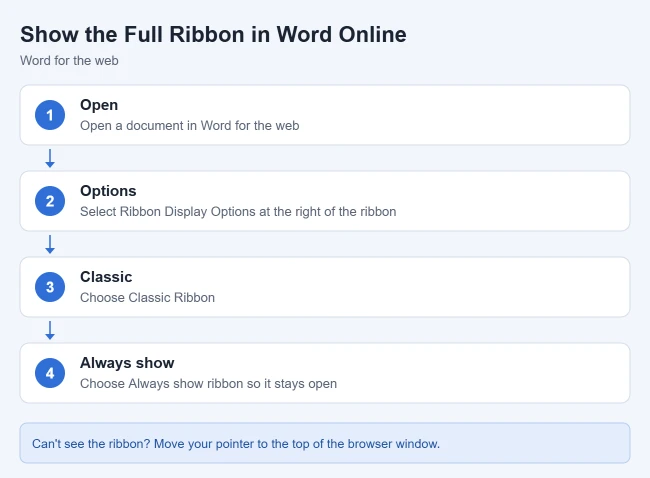
To show the full ribbon in Word Online, select the Ribbon Display Options arrow at the right end of the ribbon and choose Classic Ribbon. Then open the same menu again and choose Always show ribbon so it stays open. The Classic Ribbon is the taller layout with all of the buttons, like older versions of Word.
Word Online is now called Word for the web, and it is the version of Word that runs in a browser tab. The ribbon is the set of toolbars at the top of the window that holds commands such as fonts, styles, and page layout. Two separate settings control it: one picks the layout (full or compact) and the other picks the visibility (always open, tabs only, or hidden until needed). Getting the full ribbon back often means changing both.
What You Need Before You Start
- A document open for editing in Word for the web. The ribbon settings live inside an open document, not on the file list.
- A desktop or laptop browser, ideally. Microsoft recommends Microsoft Edge for Word for the web, though the menu is described the same way for the web version in general.
- A wide enough window. Microsoft notes that some commands collapse into a More options (…) menu depending on the width of your screen, so maximize the browser window first.
These steps apply to Word for the web only. The Word desktop apps for Windows and Mac use different option names, which are covered further down.
How to Show the Full Ribbon in Word Online
- Open a document in Word for the web.
- Look at the far right end of the ribbon and select the Ribbon Display Options icon, which is a small downward-pointing arrow. A short menu opens.
- Choose Classic Ribbon. The ribbon grows taller and the commands spread out into labeled groups.
- Select the Ribbon Display Options arrow again.
- Choose Always show ribbon. The ribbon now stays open while you type and scroll.
Microsoft describes the Classic Ribbon as the full ribbon you may be used to from previous versions of Office. Its single line ribbon article for Word for the web also says the downward-pointing arrow in the lower-right corner of the ribbon switches between the single line and classic layouts.
How to Confirm It Worked
You have the full ribbon when both of these are true:
- The ribbon is more than one row tall, and buttons that were tucked away now have their own spot. Microsoft gives the example of Find and Replace, which are separate buttons on the classic ribbon but share one button on the single line ribbon.
- The ribbon does not disappear when you click back into the document and start typing.
If the ribbon is tall but vanishes when you type, the layout is right and the visibility setting is not. Repeat steps 4 and 5. If it stays open but is still one thin row, repeat steps 2 and 3.
Ribbon Display Options Explained
Microsoft lists five choices in the menu on its Show or hide the ribbon in Office page (select the Web tab there). The first two set the layout and the last three set the visibility.
| Option | Type | What it does |
|---|---|---|
| Classic Ribbon | Layout | Shows the full ribbon from earlier versions of Office. |
| Single Line Ribbon | Layout | Shows a more compact ribbon that takes up less space. This is the default. |
| Always show ribbon | Visibility | Keeps the ribbon visible all the time. |
| Show tabs only | Visibility | Hides the commands and leaves the tab names, such as Home and Insert. |
| Adjust automatically | Visibility | Hides the ribbon and shows it when you move your pointer to the top of the page. |
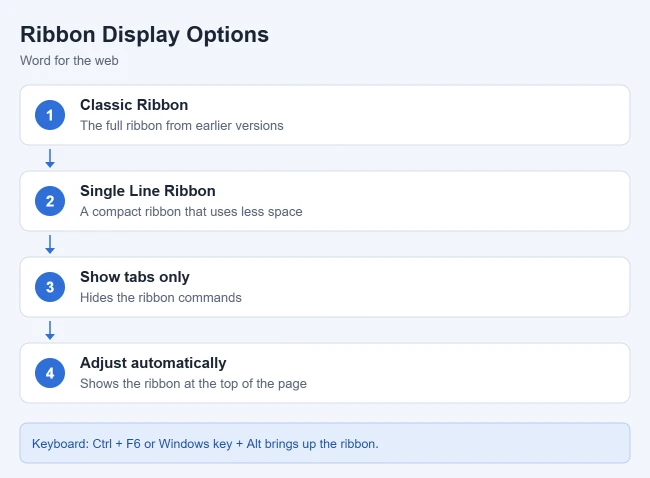
For the largest, most complete ribbon, pair Classic Ribbon with Always show ribbon. For the most room on a small laptop screen, pair Single Line Ribbon with Adjust automatically.
How to Switch Back to the Compact Ribbon
Nothing here is permanent, and changing the ribbon does not change your document. To undo it:
- Select the Ribbon Display Options arrow at the right end of the ribbon.
- Choose Single Line Ribbon.
- If you also want more room for the page, open the menu once more and choose Show tabs only or Adjust automatically.
Show or Hide the Ribbon With the Keyboard
Because Word for the web runs inside a browser, its shortcuts differ from the desktop app. Microsoft lists these in its keyboard shortcuts for Word (choose the web section):
- Ctrl + F3: collapses or expands the ribbon. Press it again to reverse it.
- Alt + Period or Alt + Windows logo key: moves to the ribbon on a Windows computer. Add a letter to jump to a tab, such as R for Review.
- Control + Period: does the same job on a Mac.
- Ctrl + F6: moves between regions of the page. Keep pressing it until you reach the Home tab.
- Tab: moves between tabs once you are on the ribbon.
Note that Ctrl + F1, the ribbon shortcut in desktop Word, is not the one Microsoft lists for the web version.
If You Can’t See the Ribbon at All
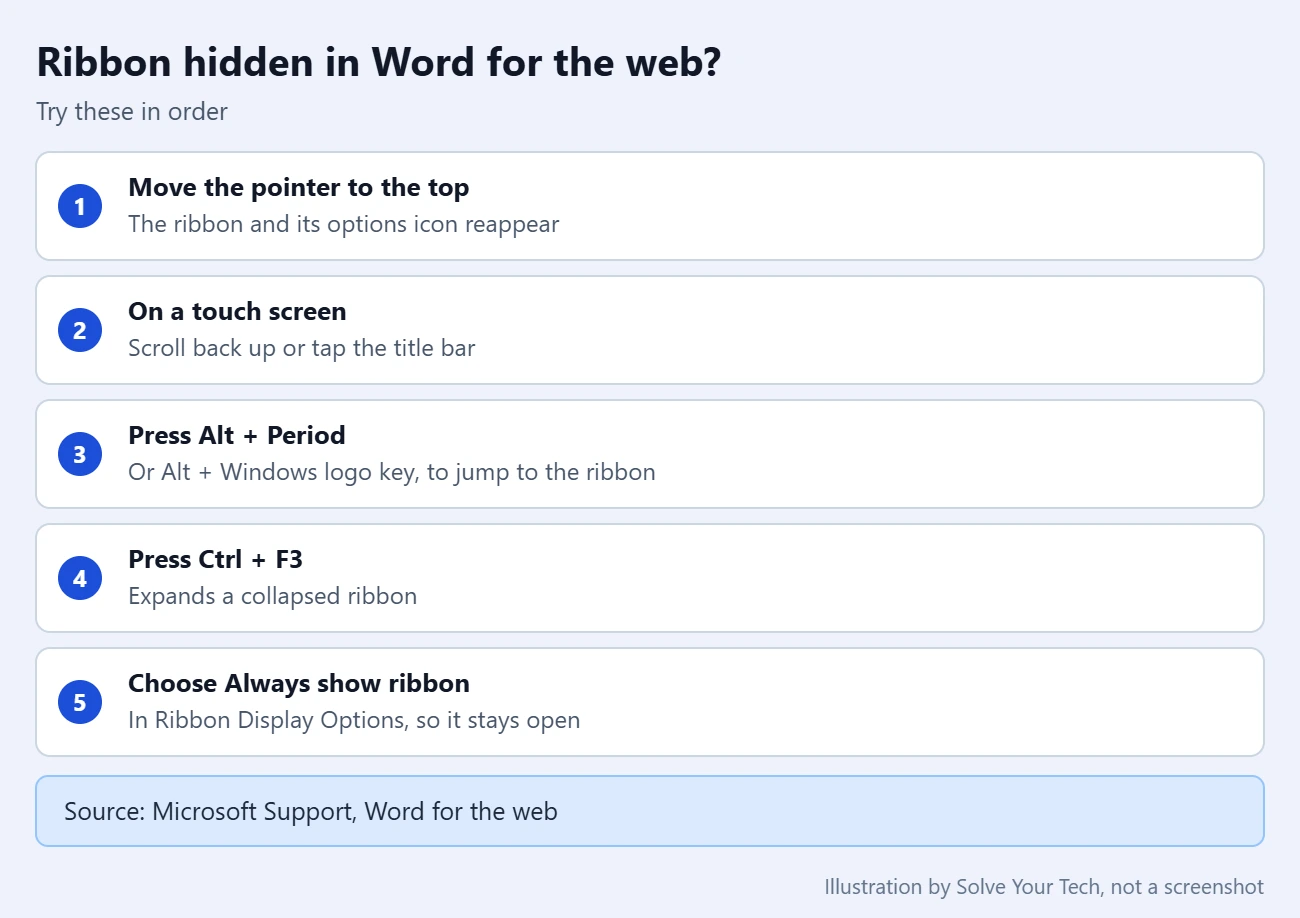
Microsoft says the ribbon and the Ribbon Display Options icon may both be hidden. That happens when the visibility setting is Adjust automatically. Work through these in order:
- Move your pointer to the top of the browser window. The ribbon and the icon should appear.
- On a touch screen, scroll back up or tap the title bar. Microsoft adds that scrolling up and down quickly also shows and hides the ribbon.
- On a keyboard, press Alt + Period or Alt + Windows logo key, or press Ctrl + F3 to expand a collapsed ribbon.
- While the ribbon is showing, open Ribbon Display Options and choose Always show ribbon so it does not hide again.
Troubleshooting
Buttons are still missing on the Classic Ribbon
Widen or maximize the browser window. Microsoft says that, depending on the width of your screen, some commands collapse into a More options menu that looks like an ellipsis (…). Select it to see the rest. Your browser’s zoom level may also affect how much fits, so try returning it to 100%.
The menu doesn’t list the same options
Check which Word you are using. If the choices are Full-screen mode, Show tabs only, and Always show Ribbon, you are in the Word desktop app for Windows, not the browser version. Microsoft also updates the web apps regularly, so wording can shift slightly. Look for the option that describes the full or classic layout.
There is no Ribbon Display Options arrow
The arrow sits on the ribbon, so it disappears when the ribbon does. Bring the ribbon back with your pointer or Ctrl + F3 first. If the document opened in a read-only or viewing state, you may also see fewer editing commands than usual. Our guide on editing permissions on a Word document explains how viewing and editing access work.
You can’t find one specific command
Not every desktop feature exists in the browser version, so a missing button is not always a ribbon problem. Type the command name in the Search bar at the top of the screen. Microsoft says Word shows both the command and help for it.
Finding Commands on the Single Line Ribbon
If you would rather keep the compact ribbon, Microsoft notes that not every button fits on one line. You have three ways to reach the rest:
- Type the command in the Search bar at the top of the screen.
- Select the down arrow next to a button to see similar commands. For example, Replace is under the Find arrow. See how to find and replace text in Word for the full steps.
- Select the More options (…) menu, where commands collapse on narrower screens.
How the Word Desktop App Differs
The Classic Ribbon and Single Line Ribbon choices described above belong to Word for the web. In Word for Windows, Microsoft lists three ribbon states instead:
- Always show Ribbon: keeps all tabs and commands visible.
- Show tabs only: shows the tab names and hides the commands.
- Full-screen mode: hides the ribbon until you select the ellipsis (…) at the top right or press Alt.
You can also right-click a ribbon tab there and clear Collapse the ribbon. For the desktop steps, see how to restore a missing toolbar or ribbon in Word.
Frequently Asked Questions
What is the difference between the Classic Ribbon and the Single Line Ribbon?
The Classic Ribbon is the full, taller ribbon from earlier versions of Office, with more commands visible at once. The Single Line Ribbon is a compact version that shows commands in one row and takes up less space. Microsoft says the single line ribbon is the default in Word for the web.
Why did my ribbon change on its own?
The single line ribbon is the default in Word for the web, per Microsoft. If the compact layout appears again, for example in a different browser or on another computer, switch back by choosing Classic Ribbon in Ribbon Display Options.
Does this change the ribbon in Excel and PowerPoint for the web too?
Microsoft’s documentation does not say that the choice carries over between apps. Its ribbon page covers the web apps together, so the same Ribbon Display Options menu is the place to look in each one. If Excel or PowerPoint for the web still shows the compact ribbon, set it there as well.
Does the Classic Ribbon add features that the compact ribbon lacks?
No. Both layouts reach the same commands. The classic layout puts more of them one click away, while the single line layout places some behind drop-down arrows, the More options menu, or the Search bar.
Is there a shortcut to hide the ribbon in Word for the web?
Yes. Microsoft lists Ctrl + F3 to hide the ribbon in Word for the web and says to repeat it to display the ribbon again.
Can I show the full ribbon on a phone?
Microsoft’s ribbon instructions for the web describe touch gestures, such as scrolling back up or tapping the title bar to bring the ribbon back, but the Word mobile apps use a different interface. On a small screen the commands that fit are limited by width, so a computer browser is the more reliable place to use the Classic Ribbon.
Next Step
With the full ribbon in place, the File tab is the next stop for most tasks. To turn your document into a shareable file, see how to save as a PDF from Word Online. To clean up old files afterward, see how to delete documents from Microsoft Word.

Matthew Burleigh is the founder, head writer, and editor of Solve Your Tech, which he launched in 2012. He has written technology tutorials since 2008 and worked in IT since 2003, including small-business support, IT management, and consulting. He holds Bachelor’s and Master’s degrees in Computer Science from Arizona State University.
Matthew writes practical guides for Windows, iPhone and iPad, Microsoft Office, Outlook, Google apps, and Android. Solve Your Tech’s guides are tested on current devices or checked against official product documentation, with clear steps, sources, and update dates.
Read more about Matthew and how Solve Your Tech writes and updates its guides, or report a correction.