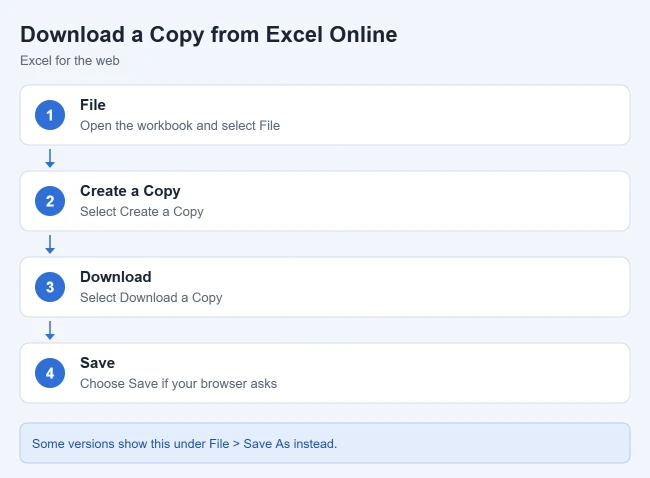
To download a copy of your file in Excel Online, open the workbook and select File > Create a Copy > Download a Copy. If your browser asks, choose Save. The file goes to your Downloads folder as a regular Excel workbook. You can also download it straight from the OneDrive website without opening it.
This guide covers downloading from inside Excel for the web, downloading from OneDrive, opening and saving the copy on your computer, and what to do if the menu looks different. The steps come from Microsoft’s Save a copy of a workbook to your computer and Download files and folders from OneDrive or SharePoint articles.
How to Download a Copy of an Excel Online File
- Open the workbook in Excel for the web.
- Select File.
- Select Create a Copy.
- Select Download a Copy.
- If your browser asks whether to open or save the file, choose Save.
Result: a copy of the workbook lands on your computer, usually in your Downloads folder. Microsoft notes that if you choose Open instead of Save, the workbook opens in Protected View, and that depending on your browser you might not be asked at all. The original file stays in OneDrive, and changes you make to the downloaded copy don’t sync back to it.
If you see File > Save As instead
Microsoft’s current article uses Create a Copy, but a Microsoft Q&A answer describes the same option as File > Save As > Download a Copy. If you don’t see one path, try the other. In both cases you’re looking for Download a Copy.
How to Download the File from OneDrive
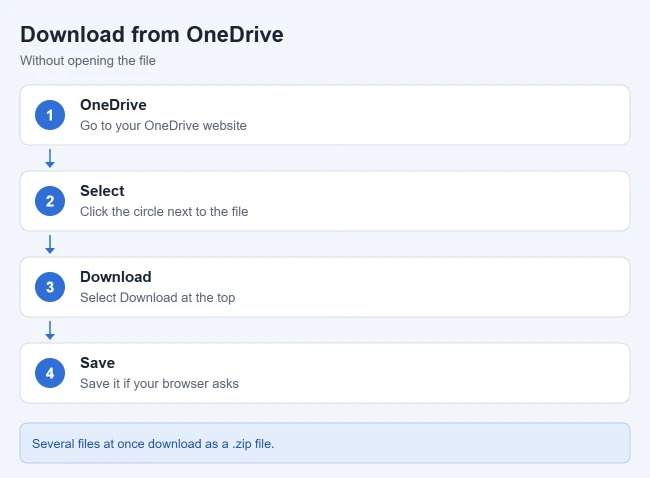
You don’t have to open the workbook first. Microsoft’s OneDrive steps work for any file:
- Go to your OneDrive website and find the workbook.
- Select the file by clicking the circle check box that appears next to it.
- Select Download in the top navigation. You can also right-click the file and select Download.
- If your browser prompts you, choose Save or Save As and pick a location.
Result: the workbook downloads to your computer. If you select several files or folders, Microsoft says your browser downloads them as a single .zip file. Note that you can’t download directly from the Shared view. Open the file and save a copy instead.
How to Open and Save the Downloaded File
- Open Excel on your computer and select File > Open, then pick the file.
- If a yellow Protected View bar appears, select Enable Editing.
- To keep it somewhere else, select File > Save a Copy > Browse, pick a folder, type a name, and select Save.
Microsoft also describes an Open folder option after the download. From there you can select the workbook and use Rename or Move to. If you don’t see those buttons, open the View tab at the top of the window and select the pushpin icon to show the ribbon.
Why Does It Open in Protected View?
Excel opens downloaded files in Protected View to keep you safe from harmful files. If you trust the file, select Enable Editing.
Frequently Asked Questions
Do I need the Excel desktop app to open the download?
To edit it on your computer, yes. Microsoft says you can open and change the downloaded workbook if you have the Excel desktop application. Without it, you can keep working on the original in Excel for the web.
Will the downloaded copy keep updating?
No. It’s a snapshot of the workbook at the moment you downloaded it. If you want files that stay in sync, see how to sync OneDrive on Windows 11.
More Excel Online Guides
- How to remove a worksheet tab in Excel Online
- How to hide columns in Excel Online
- How to sort by date in Excel Online
- How to convert a PDF to Excel with Acrobat

Matthew Burleigh is the founder, head writer, and editor of Solve Your Tech, which he launched in 2012. He has written technology tutorials since 2008 and worked in IT since 2003, including small-business support, IT management, and consulting. He holds Bachelor’s and Master’s degrees in Computer Science from Arizona State University.
Matthew writes practical guides for Windows, iPhone and iPad, Microsoft Office, Outlook, Google apps, and Android. Solve Your Tech’s guides are tested on current devices or checked against official product documentation, with clear steps, sources, and update dates.
Read more about Matthew and how Solve Your Tech writes and updates its guides, or report a correction.