To change the name of a file in Google Drive, go to drive.google.com, right-click the file, choose Rename, type the new name, and click OK. You can also select the file and press F2, or rename a Google Doc, Sheet, or Slides file by clicking its name at the top of the open file.
These steps cover Google Drive in a web browser on a Windows PC, Mac, or Chromebook, the Google Docs, Sheets, and Slides editors, and the Drive, Docs, Sheets, and Slides apps for iPhone and Android, as of October 2026. Renaming works the same way for folders. You need edit access to rename a file someone else shared with you.
Rename a File in Google Drive on a Computer
This method works for every file type stored in Drive, including Google Docs, Sheets, and Slides files, PDFs, Word and Excel files, photos, and videos.
- Open a web browser and go to drive.google.com. Sign in to your Google account if asked. Your files appear in My Drive.
- Find the file you want to rename. Open its folder, or type part of its current name into the Search in Drive box at the top of the page.
- Right-click the file. A menu opens with options such as Open with, Download, Rename, and Make a copy.
- Click Rename. A small Rename window opens with the current name already selected.
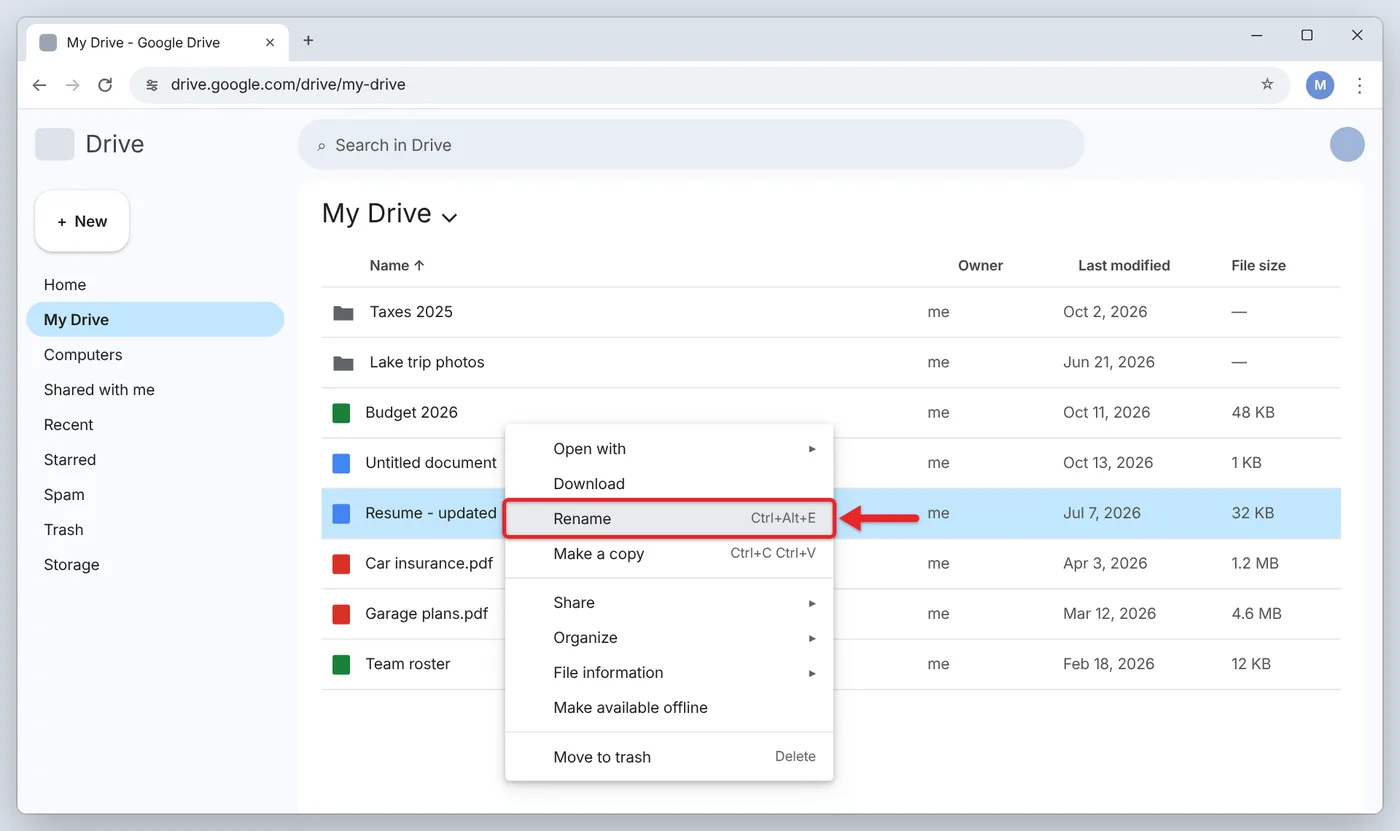
- Type the new name. Because the old name is highlighted, typing replaces it. Press the arrow keys first if you only want to change part of it.
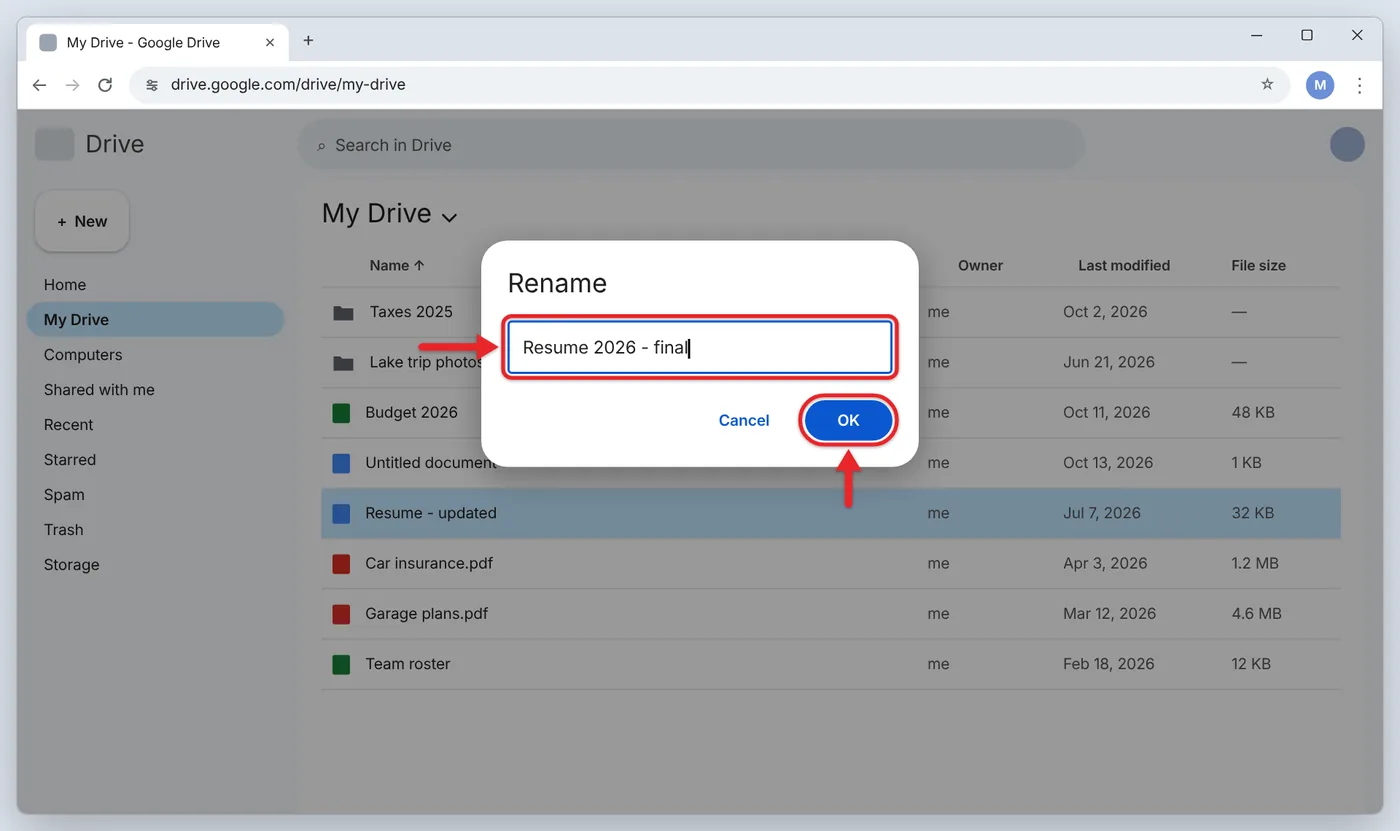
- Click OK or press Enter. The window closes and the file shows its new name in the list right away. There’s nothing else to save.
Other Ways to Open the Rename Window
- Keyboard shortcut: Click the file once to select it, then press F2. Google lists F2 as the rename shortcut on Windows, Mac, and ChromeOS in its Google Drive keyboard shortcuts page. On a Mac keyboard where the top row controls brightness and volume, press fn + F2.
- More actions menu: Click the file once to select it, then click the three-dot More actions button in the toolbar that appears above the file list, and choose Rename. In list view, the same three-dot button also sits at the right end of each file’s row.
The right-click menu is usually fastest. The three-dot button is handy on a laptop trackpad or a touchscreen Chromebook, where right-clicking can be awkward.
Keep the File Extension on Uploaded Files
Files you uploaded from a computer, such as report.pdf or budget.xlsx, keep their extension in the name. Leave the part after the dot as it is. Renaming budget.xlsx to budget.pdf doesn’t convert the spreadsheet to a PDF. It only changes the label, and the file may open in the wrong app after you download it.
Google Docs, Sheets, and Slides files don’t have an extension, so you can name them anything.
Rename a Google Doc, Sheet, or Slides File While It’s Open
If you already have the file open in Google Docs, Sheets, or Slides, you don’t need to go back to Drive. Google describes this method in its help page on how to create, name, or copy a file.
- Click the file name at the top left of the window, next to the colored Docs, Sheets, or Slides icon. A new file shows Untitled document, Untitled spreadsheet, or Untitled presentation. The name turns into an editable text box.

- Delete the old name and type the new one.
- Press Enter, or click anywhere in the document. The new name is saved and shows in Drive too.
You can also click File in the menu bar and choose Rename, which highlights the same name box.
This is also the quickest way to fix the “Untitled” name on a new file. Do it as soon as you create the file, and it will be much easier to find in Drive and in search later.
Rename a File on an iPhone or Android Phone
In the Google Drive App
- Open the Google Drive app. Tap Files at the bottom of the screen to see your folders.
- Find the file and tap the three-dot More icon next to its name. A menu slides up from the bottom.
- Tap Rename. You may need to scroll the menu to see it.
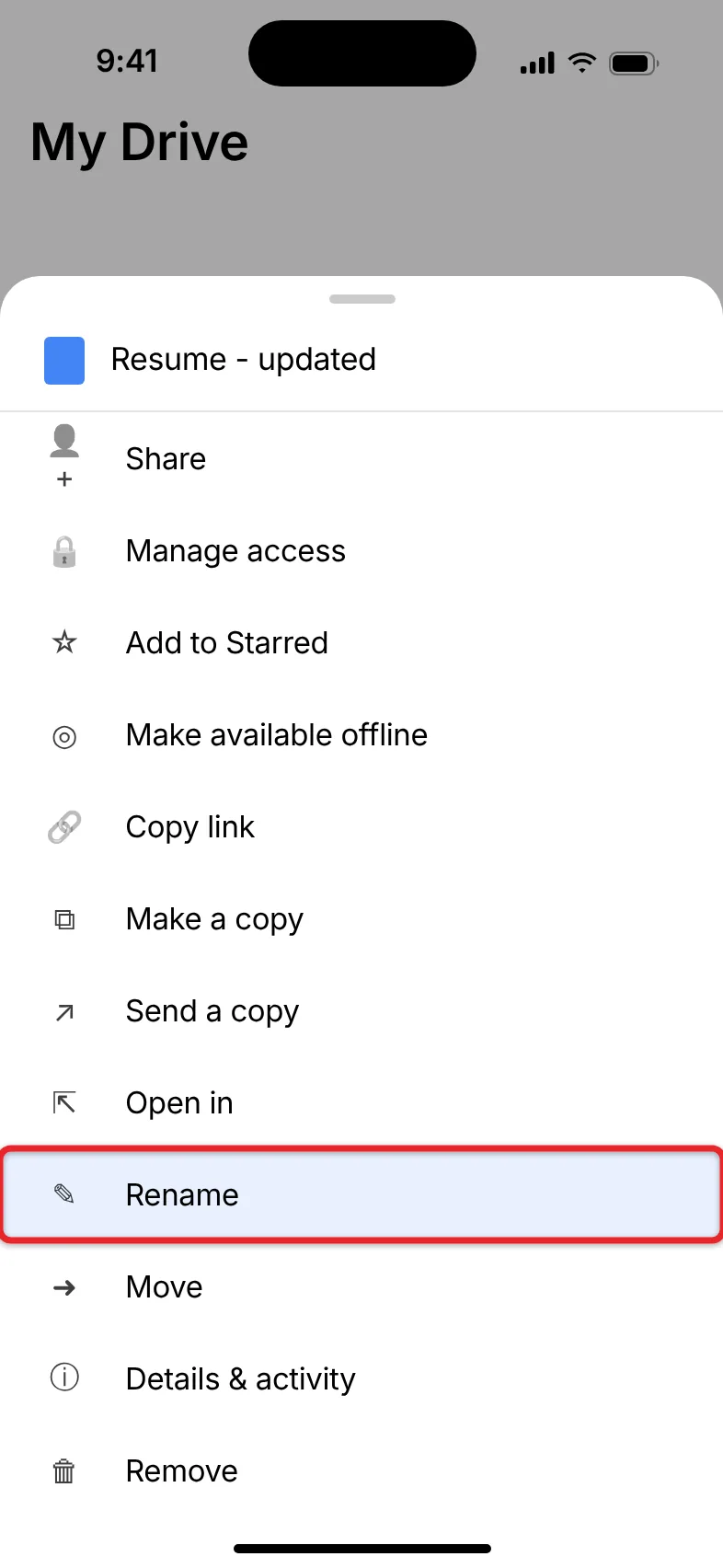
- Type the new name, then tap Rename (iPhone) or OK (Android). The file shows its new name in the list.
In the Google Docs, Sheets, or Slides App
Google’s steps for the editor apps are almost the same:
- Open the Google Docs, Sheets, or Slides app.
- On the file list, tap the More icon (three dots) next to the file.
- Tap Rename, type the new name, and tap Rename on an iPhone or OK on Android.
If you need the iPhone steps with more detail, see our guide on how to rename a file in the Google Docs iPhone app.
What Changes When You Rename a File
Renaming changes only the name. It’s a safe change to make, even on files you’ve shared.
- Shared links keep working. A Drive link points to the file’s ID, not its name, so anyone with the old link still gets to the file.
- Sharing doesn’t change. Everyone who had access keeps the same access, and they see the new name the next time they open Drive.
- The file stays in the same folder. To move it, right-click and choose Organize > Move.
- Contents don’t change. If you want a separate version with a different name, make a copy first. Our guide on how to make a copy of a file in Google Drive shows how.
- Drive for desktop stays in sync. If you use the Drive for desktop app, a rename in the browser shows up in File Explorer or Finder after it syncs, and a rename you make in File Explorer or Finder shows up in Drive.
To undo a rename, repeat the steps and type the old name back in.
Renaming a file is different from naming a saved version inside Google Docs. Version names only label points in a file’s version history. If that’s what you’re after, see how to name or rename a version in Google Docs.
If You Can’t Rename a File
- Rename is missing or grayed out. You probably have Viewer or Commenter access to a file someone shared with you. Only people who can edit a file can change its name. Ask the owner for edit access, or make your own copy and rename that.
- You selected more than one file. Drive renames one item at a time. If two or more files are selected, Rename doesn’t appear in the menu. Click an empty area to clear the selection, then right-click the single file you want. Drive has no built-in bulk rename. Renaming many files at once takes an add-on from the Google Workspace Marketplace or an Apps Script.
- F2 does nothing. Make sure a file is selected first (it’s highlighted in blue). On a Mac, try fn + F2. If your cursor is in the search box, click a blank spot in the file list first.
- The new name doesn’t show on another device. Refresh the browser page, or pull down on the file list in the mobile app. The change usually appears within a few seconds once the device is online.
- You can’t find the file after renaming it. Search for the new name in the Search in Drive box. If you’re not sure what you typed, sort the folder by Last modified, because the most recent changes appear near the top.
Frequently Asked Questions
Can I rename a folder in Google Drive?
Yes. Right-click the folder, choose Rename, type the new name, and click OK. Selecting the folder and pressing F2 works too, and so does the three-dot More menu in the mobile app. The files inside the folder aren’t affected.
Will people I shared the file with know I renamed it?
They’ll see the new name in their Drive and in the file’s title the next time they open it. Drive doesn’t send a separate notification just for a rename. The rename is recorded in the file’s activity, which you can see in the Details panel.
Can two files in the same folder have the same name?
Yes. Unlike Windows or macOS, Google Drive allows duplicate names in one folder, because it tracks files by ID instead of by name. That makes it easy to mix up two files, so give each one a name that tells them apart, such as adding a date.

Matthew Burleigh is the founder, head writer, and editor of Solve Your Tech, which he launched in 2012. He has written technology tutorials since 2008 and worked in IT since 2003, including small-business support, IT management, and consulting. He holds Bachelor’s and Master’s degrees in Computer Science from Arizona State University.
Matthew writes practical guides for Windows, iPhone and iPad, Microsoft Office, Outlook, Google apps, and Android. Solve Your Tech’s guides are checked step by step against the device or app maker’s own documentation and tested on his own devices whenever he has the hardware or software, with clear steps, sources, and update dates.
Read more about Matthew and how Solve Your Tech writes and updates its guides, or report a correction.