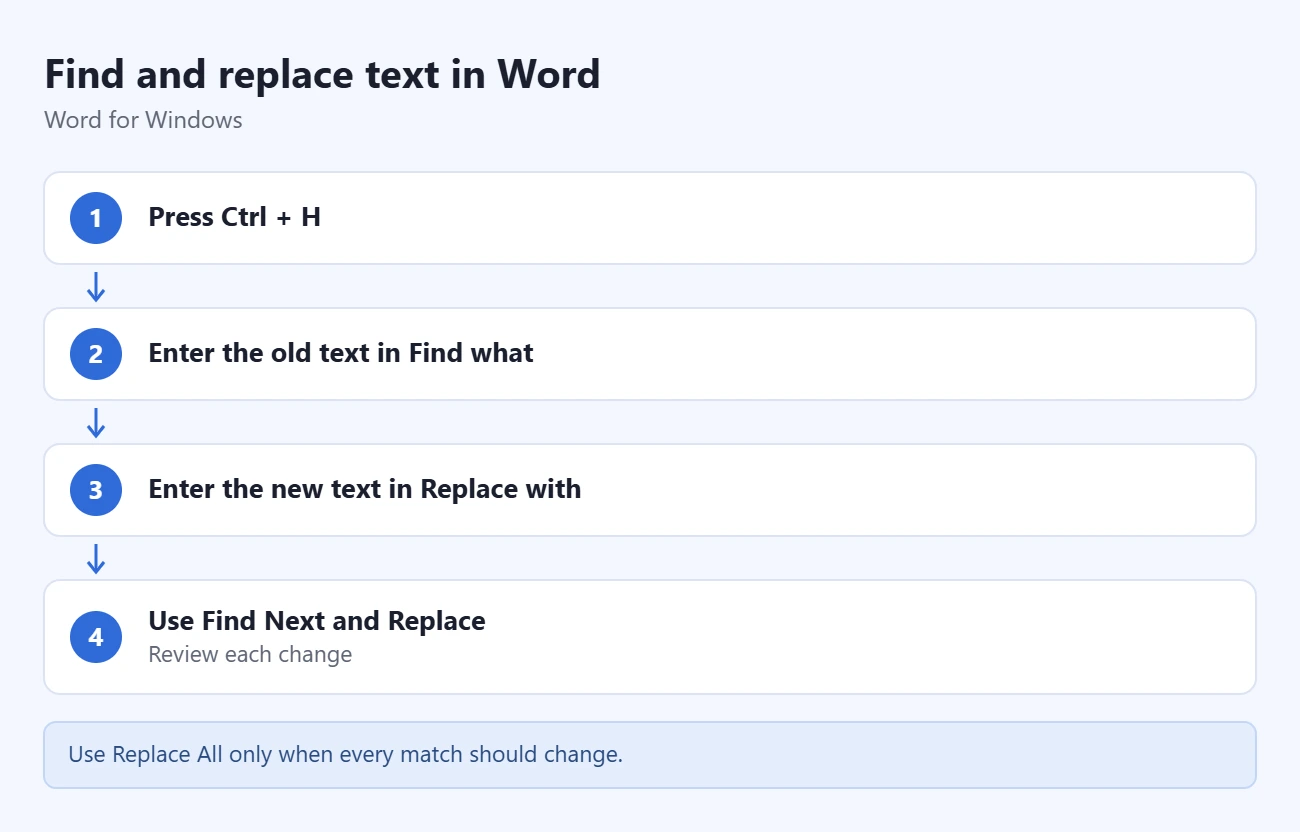
To find and replace text in Word for Windows, press Ctrl + H, enter the old text in Find what and the new text in Replace with, then use Find Next and Replace to review each change. Use Replace All only when every match should change.
The main steps below are for desktop Word on Windows. Microsoft documents the feature for Microsoft 365, Word 2024, 2021, 2019, and 2016. Mac and Word for the web have separate instructions below. This guide changes text in the open document; it does not perform a batch replacement across a folder of files.
Before You Replace Text
Save a copy before making a large change. Decide whether the replacement should apply everywhere or only in particular sentences. A product name, a person’s surname, and an ordinary word can look identical while requiring different edits.
Write down the exact old and new wording, including spaces and punctuation. For example, changing North Office to North Branch is more precise than replacing every occurrence of Office. Check whether headings, quotations, and historical references should keep the original wording.
Make sure you can edit the document. If someone shared it with viewing access, request editing permission or work on an authorized copy. Do not remove document protection merely to force a replacement.
Find and Replace in Word for Windows
Step 1: Open Replace
Click inside the document and press Ctrl + H. Alternatively, choose Home > Editing > Replace. The Replace controls should appear, with separate fields for the search and replacement text.
If you cannot find the ribbon, our guide to restoring Word’s toolbar or ribbon explains how to bring the controls back. For the browser version, see how to show the full ribbon in Word Online.
Step 2: Enter the Text You Want to Find
Type the existing word or phrase into Find what. Copying a short example from the document can help avoid an extra space or a different punctuation character. Check the beginning and end of the field before proceeding.
Open More for additional options. Use Match case when uppercase and lowercase versions should be treated differently. For an ordinary literal search, leave Use wildcards off; pattern matching is a different task.
Step 3: Enter the Replacement
Type the new wording into Replace with. Read the two fields as a pair: the first is what disappears, and the second is what takes its place. An empty replacement field is appropriate only when you intend to remove the matched text.
Step 4: Check One Match Before Changing More
Choose Find Next and read the highlighted occurrence in context. Select Replace if that occurrence needs the change. Continue reviewing matches individually when the document contains exceptions.
For the North Office example, a sentence about the current location might need North Branch, while a quotation from an old brochure might need to stay as written. The feature finds matching text; you still decide whether the replacement makes sense.
Step 5: Use Replace All When the Change Is Consistent
Choose Replace All when you have checked the search settings and want the same substitution for all matches. Read Word’s completion message, then examine several changed passages. A replacement count is useful information, but it is not proof that every resulting sentence is correct.
Search again for the old phrase and review any remaining matches. Also check the new phrase in headings and paragraphs before saving the finished document. Keep your original copy until you are satisfied with the result. If you only need to locate text without changing it, see how to search for a word in Microsoft Word.
Word for Mac and Word for the Web
Mac: press Control + H to open the basic Find and Replace pane. Enter the old and new wording and use Replace or Replace All. The search box’s magnifying-glass menu also provides Find and replace. Control is the key named Control, not Command.
Web: use editing view and Ctrl + H for replacement. For finding alone, use Home > Find or Ctrl + F. Web Word supports basic replacements, case matching, and whole-word searches; use desktop Word for advanced options. Microsoft’s web document-search guide explains its Navigation pane and filters.
If the Search or Replacement Does Not Work
No matches: first check that the old text is actually present in this file. Copy a short occurrence, retry the search, and inspect case, whole-word, wildcard, and formatting restrictions. A filter left from an earlier task can make a correct phrase appear absent.
Wrong matches: stop replacing and make the search more specific. If you meant a complete name or phrase, search for that complete phrase rather than a short fragment. Try Find Next before repeating a bulk change.
Unexpected edits: use Ctrl + Z on Windows or Command + Z on Mac to undo the previous action. Check the document after undoing. If you have continued editing, do not assume one undo restores everything; compare your saved copy or use our Word file version-recovery guide when applicable.
Other Replacement Tasks
Desktop Word has advanced tools for formatting, special characters, and wildcards. For Mac, Microsoft documents View > Navigation Pane, then the magnifying glass, Settings > Advanced Find & Replace. Use Format or Special as appropriate and preview matches individually. See Microsoft’s Find and Replace instructions for the platform-specific options and pattern syntax.
Replacing paragraph marks or breaks can alter the structure of a document. Treat that as a separate cleanup job and keep a backup. Do not combine it with a wording change simply because both use the same dialog.
Frequently Asked Questions
Does capitalization have to match?
Use Match case when capitalization is part of your search requirement. Type the replacement capitalization you want and inspect the result. For example, a heading and an ordinary sentence may need separate passes.
What about headers and footers?
Inspect those areas separately when they contain the wording you are changing. Do not rely on a supposed Headers and Footers checkbox in the basic Replace dialog or assume that reviewing body paragraphs verifies every part of the file.
Can I replace text in many documents at once?
The instructions here apply to one open document. Repeat the checked process for each file, preserving its original, rather than assuming Replace All means all documents.
Microsoft’s Word keyboard-shortcut reference lists the platform-specific Replace and Undo commands. Finish by checking the saved document in the view you plan to share or print. The useful result is consistent wording in the right places, with exceptions preserved.

Matthew Burleigh has been writing tech tutorials since 2008. His writing has appeared on dozens of different websites and been read hundreds of millions of times.
After receiving his Bachelor’s and Master’s degrees in Computer Science he spent several years working in IT management for small businesses. However, he now works full time writing content online and creating websites.
His main writing topics include iPhones, Microsoft Office, Google Apps, Android, and Photoshop, but he has also written about many other tech topics as well.