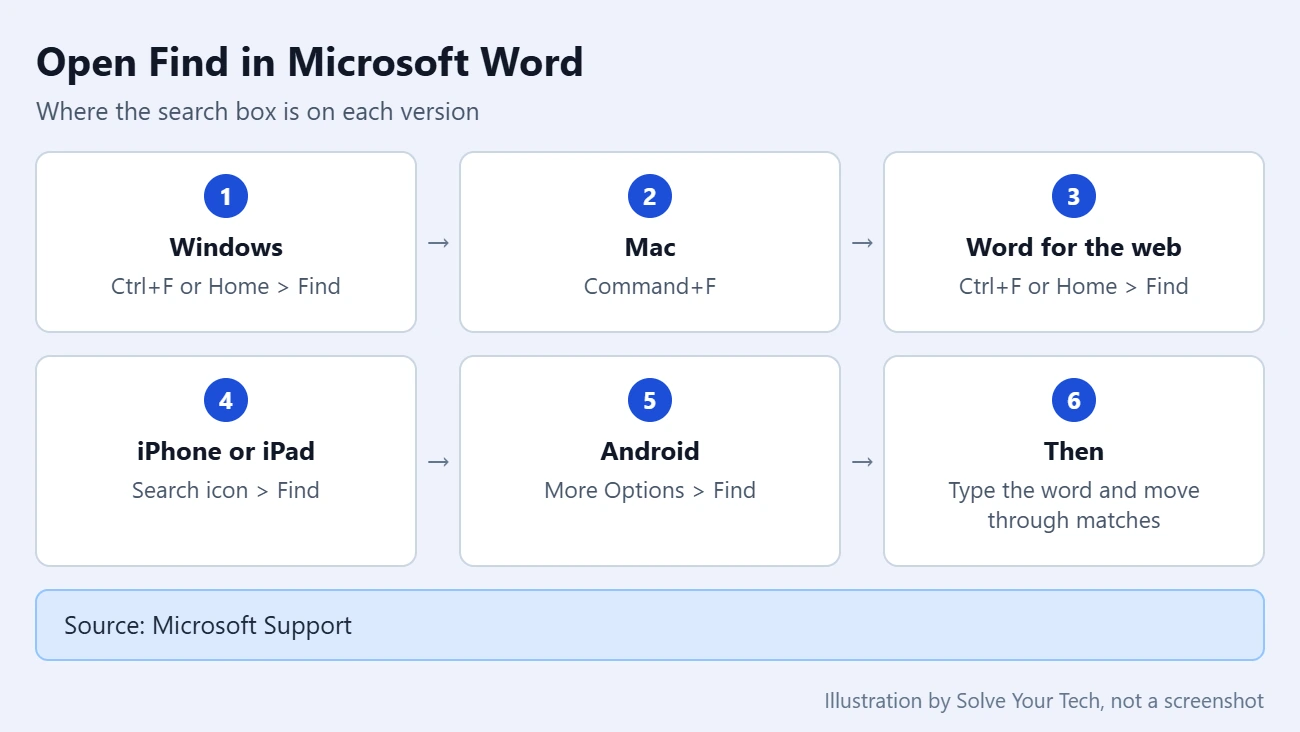
To search for a word in Microsoft Word, press Ctrl+F on Windows or Command+F on a Mac, type the word in the search box, and select a result to jump to it. On Windows you can also select Home > Find. Searching only locates text. It does not change anything in your document.
The steps below cover Word for Windows (Microsoft 365, Word 2024, 2021, 2019 and 2016), Word for Mac, Word for the web, and the Word apps for iPhone, iPad and Android. They follow Microsoft’s current help pages, which are linked in each section. You only need a document that is open for viewing or editing.
How to Search for a Word in Word for Windows
Word for Windows searches from the Navigation pane, a panel that opens beside your document and lists headings, pages and search results.
- Open your document.
- Press Ctrl+F. You can also select Home > Find, or open the View tab and check Navigation Pane. The pane opens with a search box at the top.
- Type the word or phrase in the search box. You do not need quotation marks around a phrase. Type the words in the order they appear.
- Select a result in the pane to see it in your document, or use the up and down arrows to browse through all the results.
- When you are done, clear the search box or close the pane.
You know it worked when the pane shows results and selecting one moves the document to that spot. Microsoft describes this in Use the Navigation pane in Word, and its Word keyboard shortcuts list confirms that Ctrl+F displays the Navigation pane for searching. For more on the pane itself, see our guide on how to open the Navigation pane in Word.
How to Search in Word for Mac
Microsoft notes that the Navigation pane behaves differently in Word for Mac, so the shortcuts are the reliable route there.
- Press Command+F. Microsoft’s shortcut list says this moves the cursor to the Search in Document box.
- Type the word or phrase.
- Press Command+G to go to the next match, or Shift+Command+G to go to the previous one.
To find and replace on a Mac, press Control+H, which Microsoft lists as the shortcut for the Find and Replace pane.
How to Search in Word for the Web
- In the Editing view, press Ctrl+F or select Home > Find. The Navigation pane opens.
- Type in the Search in document box. Word for the web starts searching as soon as you start typing.
- To narrow the results, select the filter icon and choose Match case or Whole words only.
- When you are done, select the X at the end of the search box.
These steps come from Microsoft’s Find text in a document page. If the magnifying glass is missing, Microsoft says to select the X at the end of the box and it comes back. In the Reading view, the shortcut list gives Ctrl+F or F3 for finding text. If the Home tab commands are hidden, see how to show the full ribbon in Word Online.
How to Search in the Word App on a Phone or Tablet
There is no keyboard shortcut to rely on here, so use the Find command in the app.
- iPhone or iPad: tap the search icon in the upper-right corner and select Find. Type the word or phrase.
- Android: tap More Options (the three dots) in the upper-right corner and select Find. Type the word or phrase.
On both, Microsoft says the search box shows a number for how many times the text occurs, and arrows let you move from one match to the next. Tap the options icon to the left of the search box for Match Case, whole-word matching, Sounds like, and replace commands. The details are in Microsoft’s Find text in an Office file on a mobile device page.
How to Narrow Your Search
A basic search ignores capitalization and also matches letters inside longer words. Two options fix most cluttered results:
- Match case: finds only text with the same capitalization, so a search for US does not stop at us.
- Find whole words only: skips partial matches, so a search for art does not stop at start or party.
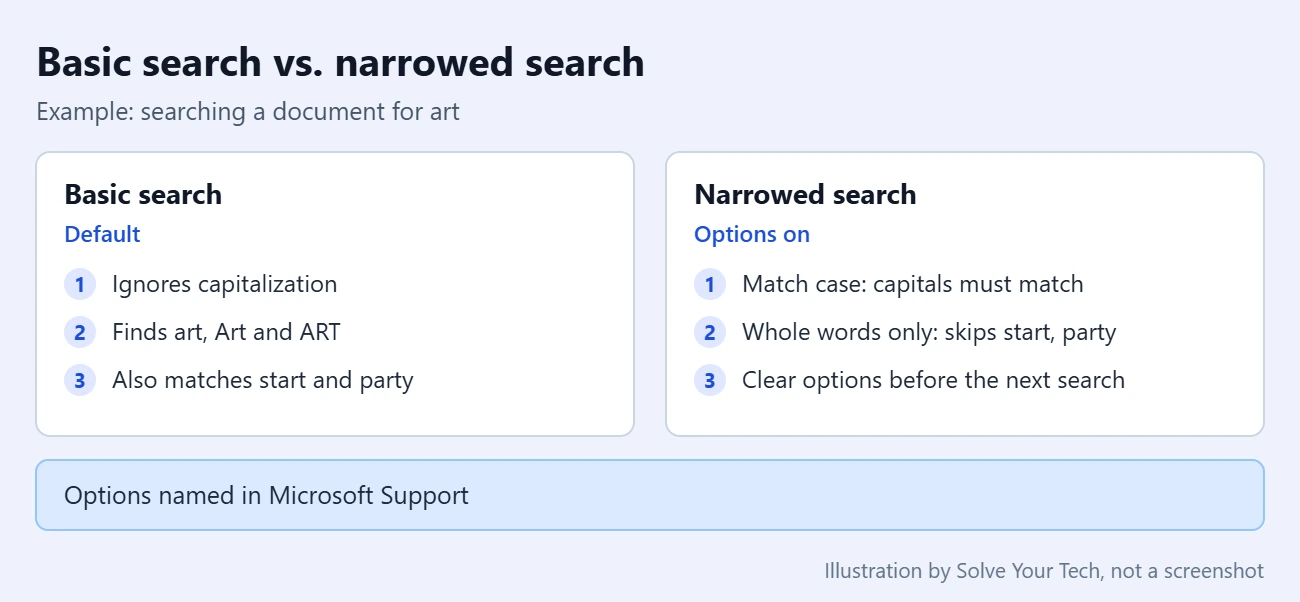
In Word for the web and the mobile apps, these options sit next to the search box as described above. In Word for Windows, they are in the Find and Replace dialog box under More, which the next section covers.
How to Use Advanced Find in Word for Windows
Advanced Find opens the Find and Replace dialog box, which has more search options than the Navigation pane. Press Esc when you are done with it, or see how to close a dialog box in Word if it will not go away.
- Press Ctrl+F to open the Navigation pane.
- Open the options menu on the search box and choose Advanced Find. Microsoft’s accessibility guide calls this menu More options. The Find and Replace dialog box opens with the cursor in Find what.
- Type the word, then select More to show the search options.
- Check the options you want and select Find Next to step through the matches.
Microsoft’s Replace Text page lists what each option does:
| Option | What it does |
|---|---|
| Search | Searches the whole document, or up or down from your cursor. |
| Match case | Finds only words with the same capitalization. |
| Find whole words only | Avoids partial matches. |
| Use wildcards | Gets partial matches. Microsoft’s example: the* finds theater and thespian. |
| Sounds like (English) | Finds words that sound alike, such as their and there. |
| Find all word forms (English) | Finds verb tenses. A search for find also returns finds, finding and found. |
| Match prefix, Match suffix | Work with other settings to find words with common beginnings or endings. |
| Ignore punctuation characters | Ignores differences in hyphenation. |
| Ignore white-space characters | Ignores spacing between characters. |
Two buttons at the bottom of the dialog box go further. Format searches for formatting such as a font, a color or highlighted words. Special searches for elements such as tabs, em dashes and section breaks. No Formatting turns off any formatting you selected.
Word remembers the settings you last used in this dialog box. Before a new search, uncheck the options you no longer need and select No Formatting. Otherwise a leftover setting can make a common word look like it is missing.
How to Find and Replace a Word
Warning: Replace All changes every match at once without stopping at each one. Check your search options first, and consider saving a copy of the document before a large replacement.
- Press Ctrl+H, or go to Home > Replace.
- Type the word to look for in Find what.
- Type the new text in Replace with.
- Select Find Next until you reach a match you want to change, then select Replace. Select Replace All only when every match should change.
Microsoft’s example shows why Find whole words only matters here: with it checked, changing One to Two does not turn Someone into Sometwo. If a replacement goes wrong, press Ctrl+Z right away to undo it. Our guide on how to find and replace text in Word walks through this in more detail.
What to Do If Word Cannot Find the Word
- Check the search text. Look for a typo, an extra space, or different punctuation. Copying a short piece of the text from the document into the search box rules these out.
- Clear leftover options. Turn off Match case, Find whole words only and Use wildcards, and select No Formatting in the Find and Replace dialog box.
- Check the search direction. In the dialog box, set Search to cover the whole document instead of only up or down from the cursor.
- Consider where the text is. Find matches document text. Words that are part of a picture, such as a screenshot or a scanned page, are generally not matched.
- Find or Replace is missing or unavailable. In Word for the web, switch to the Editing view. Microsoft’s replace steps apply to that view.
- The Navigation pane does not open. On Windows, open the View tab and check Navigation Pane.
Frequently Asked Questions
What is the shortcut to search for a word in Word?
Press Ctrl+F in Word for Windows and Word for the web, or Command+F in Word for Mac. Ctrl+H opens Replace on Windows and the web, and Control+H opens Find and Replace on a Mac.
Do I need quotation marks to search for a phrase?
No. Type the phrase as it appears in the document. Word looks for that sequence of characters, so quotation marks would only match if the document contains them too.
How do I find which document contains a word?
Word’s Find command searches only the open document. On Windows, search the folder in File Explorer instead. Microsoft says Windows indexes the contents of files with text so you can search for words inside them. Our guide on how to search file contents in Windows 10 and 11 has the steps. Then open the file and press Ctrl+F to reach the exact spot.
Does searching change my document?
No. Find only locates text and moves you to it. Your text changes only if you use Replace or Replace All, or edit a match yourself.
Can I search for bold or highlighted text instead of a word?
Yes, in Word for Windows. Open Advanced Find, select More, then use the Format button to choose the formatting to look for. Leave Find what empty to find any text with that formatting.
Next Steps
Once you can jump to any word, try the related tools in the same pane and dialog box. These guides cover other common Word tasks:

Matthew Burleigh is the founder, head writer, and editor of Solve Your Tech, which he launched in 2012. He has written technology tutorials since 2008 and worked in IT since 2003, including small-business support, IT management, and consulting. He holds Bachelor’s and Master’s degrees in Computer Science from Arizona State University.
Matthew writes practical guides for Windows, iPhone and iPad, Microsoft Office, Outlook, Google apps, and Android. Solve Your Tech’s guides are tested on current devices or checked against official product documentation, with clear steps, sources, and update dates.
Read more about Matthew and how Solve Your Tech writes and updates its guides, or report a correction.