To search for a word in Google Docs, open the document and press Ctrl + F (⌘ + F on a Mac), then type the word. Google Docs highlights every match. To swap a word for a different one, open Edit > Find and replace or press Ctrl + H (⌘ + Shift + H on a Mac).
The steps below follow Google’s Search and use find and replace help page and its Google Docs keyboard shortcuts list. They cover Google Docs in a web browser on a computer, plus the Google Docs app on Android, iPhone, and iPad.
Quick Answer: Keyboard Shortcuts
| Action | Windows / ChromeOS | Mac |
|---|---|---|
| Find | Ctrl + F | ⌘ + F |
| Find and replace | Ctrl + H | ⌘ + Shift + H |
| Find again (next match) | Ctrl + G | ⌘ + G |
| Find previous | Ctrl + Shift + G | ⌘ + Shift + G |
Result: You can jump between matches without touching the mouse.
How to Search for a Word in Google Docs on a Computer
- Open your document in Google Docs at docs.google.com.
- Press Ctrl + F on Windows or ChromeOS, or ⌘ + F on a Mac. A small search box opens near the top right of the document.
- Type the word or phrase you want to find. Every match in the document is highlighted, and the box shows how many matches it found.
- Use the up and down arrows in the search box, or press Ctrl + G and Ctrl + Shift + G, to move to the next or previous match.
- Press Esc or select the X to close the search box.
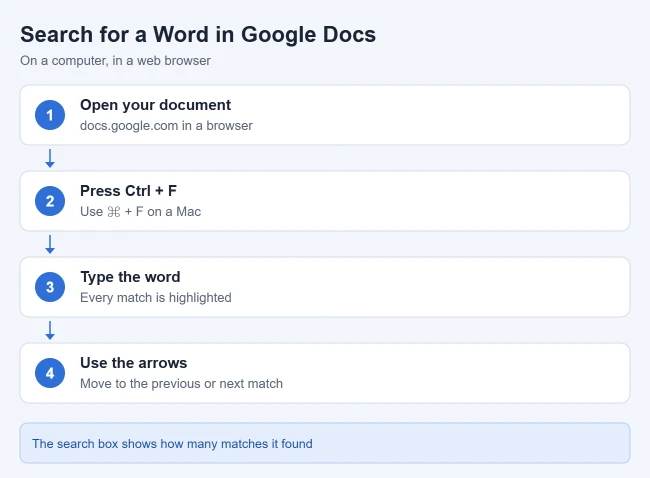
Result: Google Docs highlights each place the word appears so you can scan the document quickly.
If you only need a total, the word count tool in Google Docs counts all words, but the search box is the faster way to see how often one specific word appears.
How to Use Find and Replace in Google Docs
Google’s help page lists these steps for replacing words on a computer:
- Open the document in Google Docs.
- Select Edit > Find and replace, or press Ctrl + H (⌘ + Shift + H on a Mac).
- Next to Find, type the word you want to find. To see each place it’s used, select Next or Prev.
- Next to Replace with, type the new word.
- Select Replace to change the current match only, or Replace all to change every match.
- Close the window when you’re done.
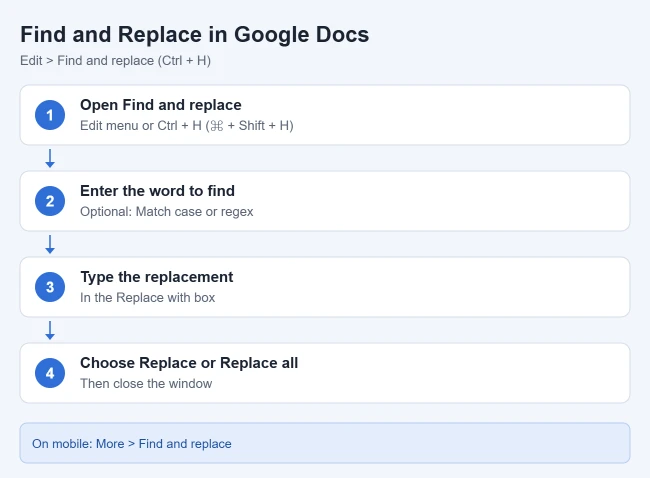
Result: The word is replaced with your new text. If you replace something by mistake, press Ctrl + Z (⌘ + Z) to undo it. If Docs keeps changing words as you type them, you can turn off AutoCorrect in Google Docs.
Find and replace options
- Match case: Only finds words with the same capitalization, so searching “Apple” skips “apple”.
- Match using regular expressions: Lets you search for patterns instead of exact words, such as any number or any word that starts with certain letters.
Before you select Replace all, step through a few matches with Next. Short words can appear inside longer ones, so replacing “cat” would also change “category” unless you use Match case or a regular expression to limit the search.
Regular expression example
Google’s help page includes examples of common regular expressions, and you can reuse parts of a match in your replacement with a dollar sign followed by the group number. For example, to flip names written as “Last, First” into “First Last”, search for (\w+), (\w+) with Match using regular expressions turned on, and replace with $2 $1. Test the pattern with Replace on one match before using Replace all.
How to Search for a Word in the Google Docs App on Android
- Open the document in the Google Docs app.
- Tap More (three dots) and then Find and replace.
- Type the word you want to find and tap Search.
- To see each place the word appears, tap the arrows in the top right.
- To replace one match, tap More > Replace, type the new word, and tap Replace. To replace every match, tap More > Replace all instead.
- Tap Done to return to the document.
Result: The app moves through each match and can replace them without a keyboard shortcut.
How to Search for a Word in Google Docs on iPhone or iPad
- Open the document in the Google Docs app.
- Tap More and then Find and replace.
- Type the word and tap Search.
- Use the arrows at the top of the screen to move through each match.
- To replace it, tap Replace with and type the new word. Tap Replace for the current match or All for every match.
- Tap Close to return to the document.
Result: Each match is highlighted in turn, and you can replace one or all of them.
Tips for Searching Long Documents
- Search for a short, unusual phrase rather than a common word to land on the right spot faster.
- If a search finds nothing, check spelling and turn off Match case. To find typos across the whole document, run spell check in Google Docs.
- Find and replace only works on the document you have open. It won’t change other files in Google Drive.
- If you’re replacing text in a shared document, let collaborators know, since Replace all changes their sections too. Version history lets you restore an earlier copy if needed.
Once you’ve found the right spot, you might want to add a hyperlink in Google Docs or add a footnote there. If you’re working in another language, you can also translate the whole document in Google Docs. To look things up on the web instead of inside the file, see what replaced the Google Docs Research feature.
Frequently Asked Questions
What is the shortcut to search in Google Docs?
Press Ctrl + F on Windows or ChromeOS, or ⌘ + F on a Mac. Ctrl + H (⌘ + Shift + H on a Mac) opens Find and replace.
Can I search for a word in Google Docs on my phone?
Yes. In the Google Docs app, tap More and then Find and replace. This works on Android, iPhone, and iPad.
Can I undo Replace all in Google Docs?
Yes. Press Ctrl + Z (⌘ + Z on a Mac) right after replacing, or use Version history to restore an earlier version of the document.
Does Google Docs search find partial words?
Yes. A standard search matches the text anywhere it appears, including inside longer words. Use Match case or a regular expression if you need tighter matches.
Working in the Google Docs app at night? You can also turn on dark mode in Google Docs.

Matthew Burleigh is the founder, head writer, and editor of Solve Your Tech, which he launched in 2012. He has written technology tutorials since 2008 and worked in IT since 2003, including small-business support, IT management, and consulting. He holds Bachelor’s and Master’s degrees in Computer Science from Arizona State University.
Matthew writes practical guides for Windows, iPhone and iPad, Microsoft Office, Outlook, Google apps, and Android. Solve Your Tech’s guides are tested on current devices or checked against official product documentation, with clear steps, sources, and update dates.
Read more about Matthew and how Solve Your Tech writes and updates its guides, or report a correction.