On an iPhone, the Settings app is the gray gear. The fastest way to find it is to swipe down on the Home Screen, type Settings, and tap the result, or look in App Library. On an Android phone, swipe up to open All Apps and tap the gear, or swipe down twice and tap the gear in Quick Settings.
This covers iPhones on iOS 18, iOS 26, and iOS 27 and Android phones on Android 14 and later, including Samsung Galaxy phones on One UI 6 and One UI 7 or later. Settings is part of the phone’s software, so a missing icon almost always means it was moved, not deleted.
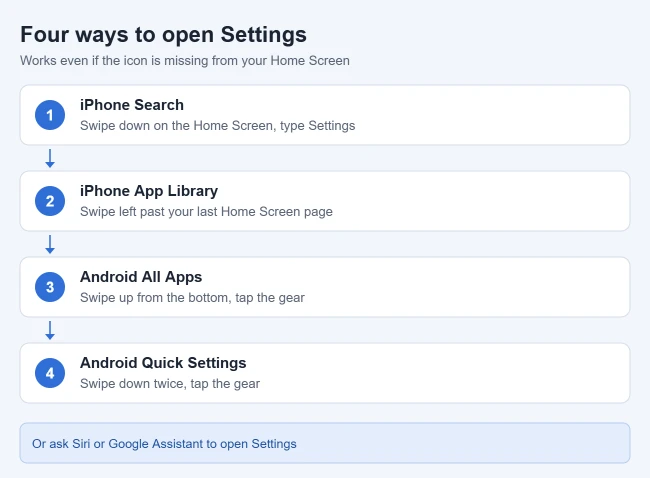
Which Phone Do You Have?
If you’re not sure, look at the bottom of the Home Screen. An iPhone has no back button or app drawer, and its apps sit in rows with a Dock of up to four icons at the bottom. Most Android phones show a Google search bar on the Home screen, and swiping up opens a list of every app. Samsung Galaxy, Google Pixel, Motorola, and OnePlus phones all run Android, so the Android sections apply to them.
| Phone | Fastest route | Backup route |
|---|---|---|
| iPhone | Swipe down on the Home Screen and search Settings | App Library |
| Android (Pixel and most brands) | Swipe up for All Apps and tap Settings | Swipe down twice and tap the gear |
| Samsung Galaxy | Swipe down from the top right and tap the gear | Apps screen |
iPhone: Find Settings With Search
- Go to the Home Screen and swipe down from the middle of the screen. The search field appears.
- Type Settings.

- Tap the gray gear app in the results. Settings opens.
Apple notes you can also search from the Lock Screen. Once Settings is open, use its own search field at the top to jump straight to a setting, such as volume or your passcode. See Apple’s Find settings on iPhone.
Search can do more than open apps, including quick actions, and you can choose which apps appear; here’s how to use Spotlight Search on iPhone.
iPhone: Find Settings in App Library
- Go to the Home Screen and swipe left past your last Home Screen page. App Library opens, with your apps sorted into categories.
- Tap the search field at the top and type Settings, or scroll the alphabetical list.

- Tap Settings to open it.
To put the icon back on your Home Screen, touch and hold Settings in App Library, then tap Add to Home Screen. If that option isn’t shown, the icon is already on a Home Screen page or inside a folder. More on this is in Apple’s App Library on iPhone guide.
iPhone: Keep Settings Where You Can Reach It
Once the icon is back on a Home Screen page, touch and hold an empty part of the screen until the icons jiggle, then drag Settings onto the Dock at the bottom. Dock apps stay put when you swipe between pages. Tap Done when you finish. If the Dock is full, drag another app out first.
If you see Remove App when you touch and hold Settings, the menu offers Remove from Home Screen, which only hides the icon. Settings has no Delete App option because it’s built in, so you can’t lose it this way.
iPhone: Other Places to Look
- Folders: Settings may be tucked inside a folder on a Home Screen page. It’s often in a folder named Utilities.
- Hidden Home Screen pages: touch and hold the wallpaper, tap the dots at the bottom of the screen, and check any unchecked pages to show them again. Pages can be hidden because every app is still in App Library.
- App Switcher: if you used Settings recently, swipe up from the bottom and pause (or double-click the Home button) to find it among your open apps.
- Siri: say “Siri, open Settings.” If the iPhone is locked, Siri asks you to unlock it first.
Control Center, which opens with a swipe down from the top right corner, is not Settings. It has quick controls such as Wi-Fi and brightness, but no button for the full Settings app. Don’t download a third-party “settings” app to replace the built-in one. On current iPhone software, controls for your installed apps are under Settings > Apps.
Android: Find Settings in All Apps
- From any Home screen, swipe up from the bottom of the screen to the top. If you see All Apps, tap it. The full app list opens.
- Find the gear icon labeled Settings, or type Settings in the search bar at the top of the list.

- Tap Settings. The Settings app opens.
These steps match Google’s Find, open & close apps on Android. If your phone uses a Google Account for work or school, apps can appear in a separate Work tab. Some older launchers show an Apps button instead of the swipe gesture.
To add Settings back to a Home screen, touch and hold the Settings icon in All Apps, then drag it onto the Home screen and lift your finger, as Google’s Home screen guide describes. You can also drag it into the row of favorite apps at the bottom so it shows on every page. For more on this, here’s how to get apps back on your Home screen on Android. To rearrange it once it’s there, here’s how to move apps on Android.
When you clean up a Home screen later, drag Settings to Remove, not Uninstall. Remove takes an icon off the Home screen only. Settings is a built-in system app, so it stays in All Apps even if you remove every Home screen icon.
Android: Use the Quick Settings Gear
- Swipe down from the top of the screen. Your first few Quick Settings tiles appear.
- Swipe down again to expand the full panel, as Google’s Quick Settings guide describes.
- Tap the gear icon. The full Settings app opens.

Tapping a tile such as Wi-Fi or Flashlight changes only that one setting. Touching and holding a tile opens its advanced settings, which is a quick shortcut to a specific page. To choose which tiles show, swipe down twice and tap Edit (the pencil), then add, remove, or drag tiles.

Samsung Galaxy Phones
Samsung’s Quick panel guidance splits by software version:
- One UI 7 and later: swipe down from the top right to open the Quick panel, then tap the gear. A swipe from the top left opens notifications instead. Swipe left or right at the top to switch between them.
- One UI 6.1.1 and earlier: swipe down from the top with two fingers to open the full Quick panel, then tap the gear.

To combine notifications and Quick settings on One UI 7, open the Quick panel, tap the pencil, tap Panel settings, and choose Together. If the gear still isn’t where you expect, open the Apps screen and tap Settings. On a Samsung Galaxy, Settings is also where you can turn on Easy mode for bigger text and a simpler Home screen.
Use Your Voice
- iPhone: say “Siri, open Settings.”
- Android with Google Assistant: say “Hey Google, open Settings.”
- Android with Gemini: ask “Open Settings” or name a page, such as “Open Bluetooth settings.” This uses the Device assistance connected app in the Gemini mobile app, covered in Google’s Gemini help.
Voice commands work only if the assistant is turned on. They’re handy when you’re helping someone over the phone.
If You Still Cannot Find Settings
- Make sure you’re searching the phone’s apps, not doing a web search in a browser or a search widget. A voice search in the Google search bar may show web results instead of opening the app.
- Try the other route for your platform: iPhone Search or App Library; Android All Apps or Quick Settings.
- On a work-managed Android phone, check both the Personal and Work tabs.
- If you’re helping someone remotely, first ask whether the phone is an iPhone or Android, and for Android ask the manufacturer.
- If the screen doesn’t respond to touches, treat that as a separate device problem. Try restarting the phone; here’s how to turn off an Android phone.
Settings handles phone-wide controls. Many apps also have their own settings inside the app, often behind a gear, a profile picture, or a three-dot menu, so an option you can’t find in Settings may be inside the app itself.
Keyboard click sounds are one example: they are set inside the keyboard, as shown in how to turn off sound when typing on Android.
How to Confirm You Opened the Right App
On an iPhone, the Settings screen shows a search field and your name (your Apple Account) near the top, followed by sections such as Wi-Fi and Bluetooth. On most Android phones, Settings opens with a search field and sections such as Network & internet or Connections. If you see a row of toggles over your wallpaper instead, you opened Control Center or Quick Settings; use the gear (Android) or Search (iPhone) to go to the full app.
Settings App Questions
Can I delete the Settings app by accident?
No. Settings is built into both iPhone and Android. You can remove its icon from a Home Screen, but the app stays in App Library (iPhone) or All Apps (Android).
Why did Settings disappear from my Home Screen?
Usually because the icon was moved, dragged into a folder, or its Home Screen page was hidden. Use Search to open it, then add it back from App Library or All Apps.
Is Control Center the same as Settings on iPhone?
No. Control Center offers quick toggles such as Wi-Fi and brightness, but it isn’t the full Settings app. Use Search or App Library to open Settings.
What can I change in Settings?
Apple’s Settings includes sections such as Wi-Fi, Bluetooth, Battery, General, Notifications, and Sounds & Haptics. Once you’re in Settings on an iPhone, you can also change your iPhone’s name.
How do I open Settings on a computer?
On a Windows PC, here’s how to open Settings on Windows 11.
Next step: once Settings is open, put it in your iPhone Dock or Android favorites row so it’s one tap away next time.

Matthew Burleigh is the founder, head writer, and editor of Solve Your Tech, which he launched in 2012. He has written technology tutorials since 2008 and worked in IT since 2003, including small-business support, IT management, and consulting. He holds Bachelor’s and Master’s degrees in Computer Science from Arizona State University.
Matthew writes practical guides for Windows, iPhone and iPad, Microsoft Office, Outlook, Google apps, and Android. Solve Your Tech’s guides are checked step by step against the device or app maker’s own documentation and tested on his own devices whenever he has the hardware or software, with clear steps, sources, and update dates.
Read more about Matthew and how Solve Your Tech writes and updates its guides, or report a correction.