To block attachments, pictures, and links from unknown senders in Outlook.com, select Settings, go to Mail > Junk email, and under Security options check Block attachments, pictures, and links from anyone not in my Safe senders and domains list. Then select Save. After that, only senders on your Safe senders and domains list get through with that content intact.
Microsoft names this check box in its article on adding recipients to the Safe Senders List in Outlook. The setting is strict, so plan to build your safe list at the same time. Both jobs are covered below.
What This Setting Does and Who It Applies To
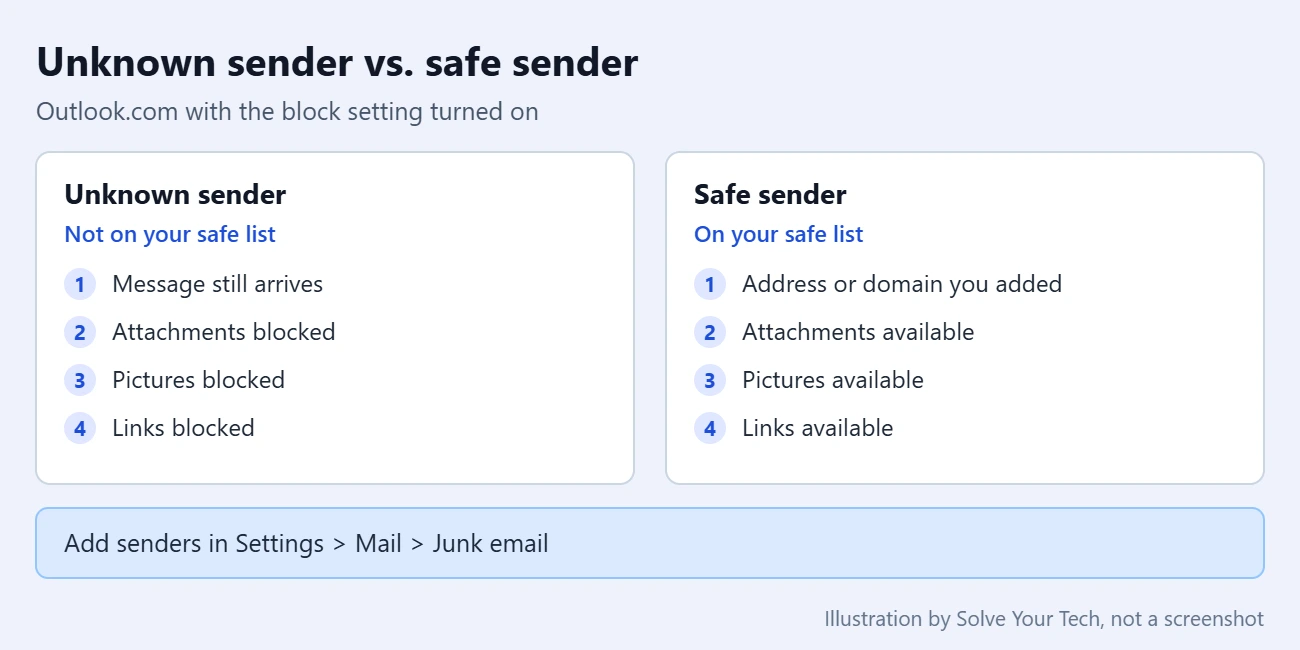
An “unknown sender” here means any address that is not on your Safe senders and domains list. A safe sender is an email address or a whole domain (the part after the @ sign, such as example.com) that you have told Outlook.com to trust.
With the box checked, a message from anyone outside that list still arrives, but its attachments, pictures, and links are blocked. That is useful against phishing, which is email that pretends to come from a company or person you know so that you will open a file or select a link.
- Where it works: Outlook.com in a web browser, signed in with a personal Microsoft account such as an outlook.com, hotmail.com, live.com, or msn.com address.
- What you need: a computer browser is the easiest place to reach the full Settings window.
- What it does not do: it does not delete mail, and it does not send mail to the Junk Email folder. Blocking a sender is a separate feature, covered later.
How to Block Attachments, Pictures, and Links From Unknown Senders
Before you start: once this is on, messages from people who are not on your safe list can look incomplete. A receipt, a photo from a relative, or a link from a new client may all be blocked until you add the sender. Add your most important senders right after you turn it on.
- Go to Outlook.com in a web browser and sign in to your account.
- Select Settings, the gear icon near the top right of the window. The Settings window opens.
- Select Mail in the left column, then select Junk email.
- Scroll down to the Security options section, which sits below the sender lists.
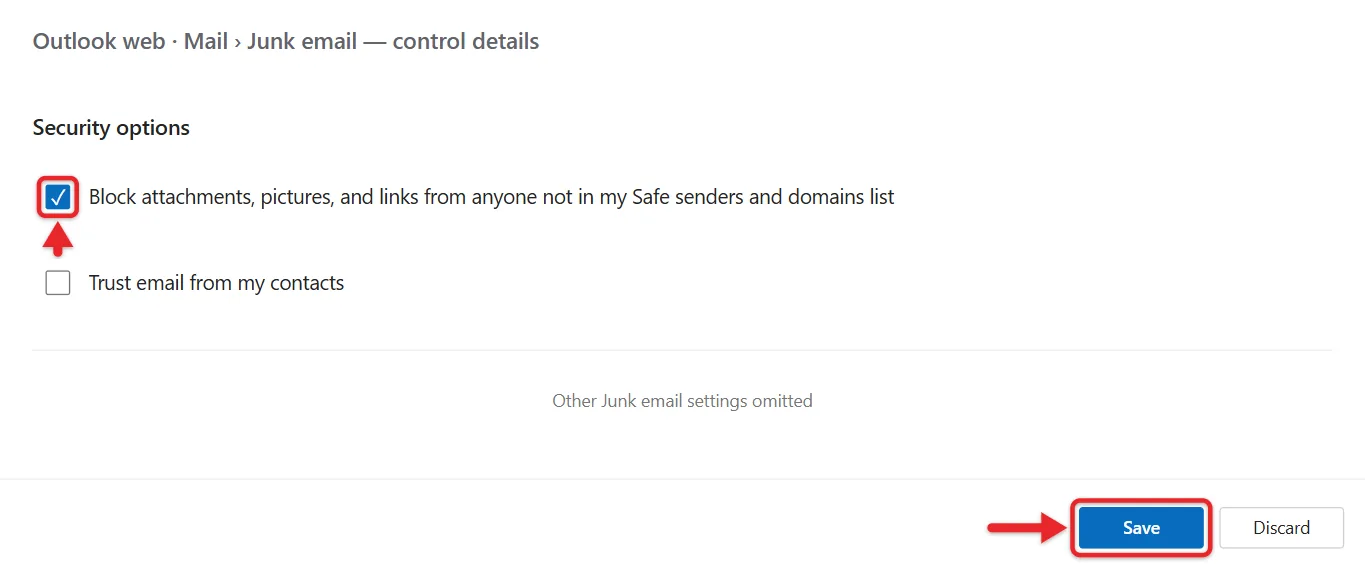
- Check the box next to Block attachments, pictures, and links from anyone not in my Safe senders and domains list.
- Select Save, then close the Settings window.
The change applies to mail from senders outside your safe list. Nothing on your safe list is removed, and no messages are deleted.
How to Add a Safe Sender or Domain in Outlook.com
Every address you add here is exempt from the block. Microsoft lists these steps for Outlook.com:
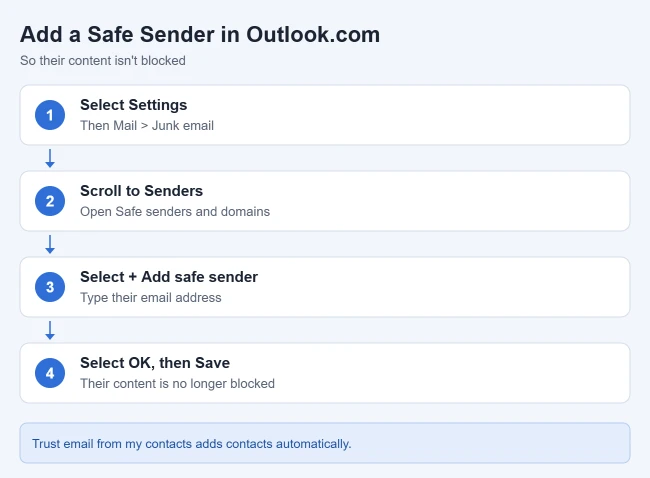
- Select Settings > Mail > Junk email.
- Under Junk email, scroll down to Senders and select the Safe senders and domains tab.
- Select + Add safe sender.
- Type the full email address, or type a domain to trust everyone at that organization.
- Select OK, and then select Save.
Be selective with domains. Adding a large public email domain would trust every stranger who uses that service, which defeats the purpose of the block.
If you get newsletters or group mail that is addressed to a list rather than to you, Microsoft’s page on Safe Senders in Outlook.com also describes a Safe mailing lists area with an Add safe mailing list button.
Trust Email From Your Contacts
Outlook on the web and the new Outlook for Windows have a Trust email from my contacts check box under Security options. When it is checked, addresses saved in your contacts are treated as safe senders. If you see it in your Outlook.com settings, leaving it on saves you from adding every friend and relative by hand. Clear it if you want the safe list to be the only thing that counts.
How to Confirm It Worked and How to Turn It Off
To confirm the setting saved, close Settings, open Settings > Mail > Junk email again, and check that the box under Security options is still checked. Then open a message from an address that is not on your safe list and not in your contacts. Its attachments, pictures, and links should be blocked.
To see the blocked content from a sender you trust, add that sender to Safe senders and domains and reopen the message.
If a file from a trusted sender still won’t open after that, work through these fixes for email attachments that won’t open.
To undo the change, return to Settings > Mail > Junk email, clear the same check box under Security options, and select Save. Your safe senders list stays as it was.
Block or Unblock a Sender in Outlook.com or Hotmail
To block a sender, go to Settings > Mail > Junk email. Under Blocked senders and domains, select Add, type the full email address (or a domain to block everyone at it), press Enter, and select Save. Future mail from that sender goes to Junk Email. To unblock, return to the same list, remove the address or domain, and select Save. This works the same for Hotmail and Live addresses, and Microsoft’s block or unblock instructions cover the details. Blocking one address does not stop a spammer who switches to another.
Blocking Content vs. Blocking a Sender
These two tools are easy to confuse. The Security options check box limits what unknown senders can show you. The blocked senders list deals with specific senders you never want to hear from.
| Tool | Who it affects | What happens |
|---|---|---|
| Block attachments, pictures, and links | Everyone not on your Safe senders and domains list | The message arrives, but that content is blocked |
| Blocked senders and domains | Only the addresses or domains you add | Their messages are moved to the Junk Email folder |
| Safe senders and domains | Only the addresses or domains you add | Their messages are not treated as junk, and the content block does not apply |
For the second tool, follow the steps in Block or unblock senders in Outlook. For the same idea in other mail programs, you can block an email address in Norton 360, Outlook or Gmail.
<p>For the full steps in every version of the app, see our guide on <a href=”https://www.solveyourtech.com/block-sender-outlook/”>how to block a sender in Outlook</a>.</p>A Related Setting: External Images
Outlook.com has a separate privacy option for online images in messages. Microsoft’s page on external image protection in Outlook.com explains that Outlook.com can load external images through an image proxy, a go-between service that fetches the picture for you, to help protect your personal data.
In your Privacy and data settings, choose Always use the Outlook service to load images or Don’t use the Outlook service to load images. Microsoft cautions that choosing not to use the Outlook service can put your personal data at risk, so the first option is the safer one. Gmail has its own version of this control: you can make Gmail ask before displaying external images. For AOL, check the settings that replaced the option to disable links from unknown senders in AOL Mail.
Read receipts are another way a sender can learn that you opened a message, and you can turn off read receipts in Outlook separately.
Troubleshooting
- You cannot find Security options. Make sure you are in Settings > Mail > Junk email, then scroll past the blocked and safe sender lists. On older layouts the route started with View all Outlook settings, and the section had a different name.
- The check box clears itself after you select Save. Reload the page, try another browser, and check the box again. If it still will not stick, use the Help option in Outlook.com to report it.
- Mail from a trusted person is still blocked. Compare the address on the message with the entry on your safe list. People often write from more than one address, and a single typo stops the match.
- Wanted mail is landing in Junk Email. That is the junk filter, not this setting. Adding the sender to Safe senders and domains fixes both problems at once.
- The settings look different at work or school. Those accounts are managed by an organization and can have different junk email options. Ask your IT administrator.
Frequently Asked Questions
Will this block attachments from people I already email?
It can. The setting applies to anyone who is not on your Safe senders and domains list, even people you write to often. Add the people you trust to the list, or keep Trust email from my contacts checked if your account offers it.
Can I still open a blocked attachment?
Add the sender under Settings > Mail > Junk email > Safe senders and domains, then reopen the message. Only do that for senders you recognize and were expecting to hear from.
Does this setting stop spam from arriving?
No. It limits what a message from an unknown sender can show, but the message is still delivered. To keep a specific sender out of your inbox, add the address under Blocked senders and domains so the mail goes to the Junk Email folder.
Does this affect the Outlook app on my phone?
This setting is for Outlook.com on the web, and there is no official word on how the phone apps display the affected messages. Change the setting in a browser, and check the app’s own settings if attachments behave differently there. To choose which buttons appear on your messages on the web, you can customize the toolbar in Outlook.com.
Is this the same as the junk email filter?
No. The junk filter decides which folder a message lands in. This check box decides whether attachments, pictures, and links from senders outside your safe list are available. They share the same Settings page, and the safe senders list feeds both.
Related Guides
Turn the setting on, add your key senders, and review the safe list every few months. These guides cover nearby Outlook tasks:
- Why can’t you see attachments in Outlook?
- How to stop grouping messages by conversation in Outlook.com
- How to remove a device that’s syncing with Outlook.com

Matthew Burleigh is the founder, head writer, and editor of Solve Your Tech, which he launched in 2012. He has written technology tutorials since 2008 and worked in IT since 2003, including small-business support, IT management, and consulting. He holds Bachelor’s and Master’s degrees in Computer Science from Arizona State University.
Matthew writes practical guides for Windows, iPhone and iPad, Microsoft Office, Outlook, Google apps, and Android. Solve Your Tech’s guides are checked step by step against the device or app maker’s own documentation and tested on his own devices whenever he has the hardware or software, with clear steps, sources, and update dates.
Read more about Matthew and how Solve Your Tech writes and updates its guides, or report a correction.