If you can’t see an attachment in Outlook, open the message in its own window by double-clicking it and look for the attachment bar just above the message text. If it’s still missing, the usual causes are that Outlook blocked the file type for safety, or the sender’s Outlook packed the attachment into a winmail.dat file your email program can’t read.
This guide explains each cause and the fix for it, in classic Outlook for Windows, the new Outlook for Windows and Outlook on the web. It’s based on Microsoft’s articles on blocked attachments, attachment problems in Outlook for Windows and how TNEF (winmail.dat) affects email.
Quick Checks to Find a Missing Attachment
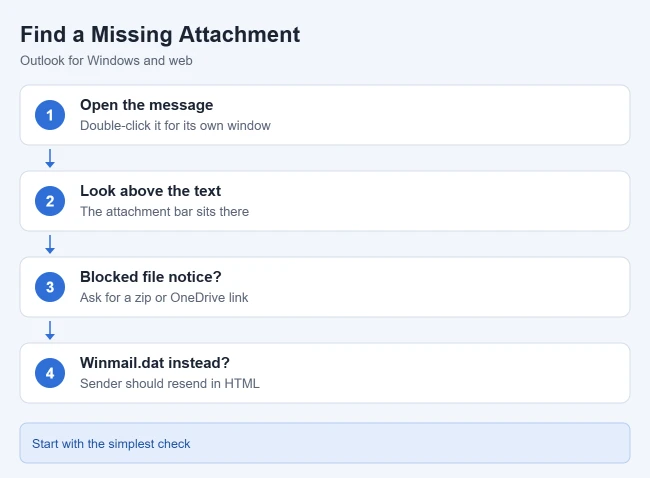
- Double-click the message so it opens in its own window. Attachments appear in a bar above the message body.
- Look for a notice near the top of the message saying Outlook blocked access to an unsafe attachment. If you see one, go to the blocked file section below.
- Check for a file named winmail.dat or ATT00001.dat. If that’s all you see, go to the winmail.dat section.
- Sign in to Outlook on the web (outlook.com, or your organization’s Outlook web address) and open the same message. If the attachment shows up there, the problem is with the Outlook app on your PC, so update the app and check again.
Result: In most cases you’ll either find the attachment or know which of the causes below applies.
Found the attachment but still cannot open it? Our email attachment troubleshooting guide separates download failures, incompatible readers and security blocks, with Gmail, Outlook and iPad steps.
Outlook Blocked the File Type
Outlook blocks more than 200 file types that can run code or change your system, including .exe, .bat, .cmd, .js, .vbs, .ps1, .reg and .iso. When a message includes one, Outlook keeps the file but won’t let you open it, and it shows a notice that it blocked access.
Microsoft suggests three ways to get the file safely. Ask the sender to do one of these:
- Share a link instead. Upload the file to OneDrive or a SharePoint site and send the link. Our guide on uploading large files to OneDrive covers the size limit and the upload methods.
- Zip the file. In Windows, right-click the file and select Send to > Compressed (zipped) folder, then attach the .zip file. Our guide on creating a zip file in Windows 10 walks through it.
- Rename the extension. The sender changes the extension to one Outlook allows, and you change it back after you save the file. Only do this when you trust the sender and know what the file is.
If you use a work or school Exchange account, your administrator can change which file types are blocked for your mailbox. Don’t try to unblock file types yourself unless you understand the risk.
Result: You receive the file in a form Outlook doesn’t block.
You See Winmail.dat Instead of the Attachment
Classic Outlook can send messages in Rich Text format. When it does, it packs the formatting and attachments into a format called TNEF. Email programs that don’t support TNEF show the plain text of the message plus an unreadable file named winmail.dat (sometimes a generic name like ATT00008.DAT), and the real attachment seems to be missing.
The fix is on the sender’s side. Ask them to resend the message in HTML or Plain Text format.
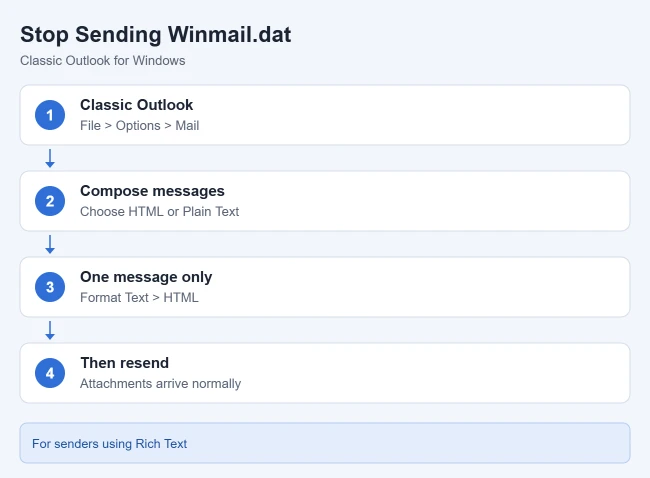
If you are the sender (classic Outlook for Windows)
- Select File > Options > Mail.
- Under Compose messages in this format, choose HTML or Plain Text instead of Rich Text.
- Select OK.
- To change just one message, open it and use the Format Text tab > Message Format to pick HTML or Plain Text.
Result: Recipients get the attachments as normal files. Keep in mind that meeting requests, voting buttons and task requests still need TNEF, so those features work best between Outlook users.
The Attachment Shows Up in the Message Body or as a Link
A couple of other formatting issues can make an attachment look like it’s missing:
- Attachments inside the body. In the new Outlook, attachments in a message that isn’t in HTML format can appear in the message body instead of below the subject line. When you write a message, select Options > Format. If the button says Switch to plain text, the message is already in HTML.
- Shared links as plain text. Cloud attachments shared as links only work in HTML messages. In a Plain Text message, the link turns into text that you can’t click.
Where Outlook Saves Attachments You Open
Sometimes the attachment was there, but you can’t find the file after saving it. In the new Outlook, select the drop-down arrow next to the attachment and choose Save As to pick a folder, or Save to OneDrive. If you save attachments to OneDrive and can’t see the Attachments folder on your PC, right-click the OneDrive cloud icon, select Settings, go to Choose folders and check Attachments.
If attachments from unknown senders are hidden on purpose, our guide to blocking attachments, pictures and links from unknown senders in Outlook.com explains that setting. To stop Outlook warning you about missing attachments when you send, see how to turn off the attachment reminder.
Frequently Asked Questions
Why does Outlook say it blocked access to an attachment?
The file type is on Outlook’s list of potentially unsafe files, such as .exe or .bat. Ask the sender to zip the file or share it through OneDrive.
What is winmail.dat?
It’s an attachment created when Outlook sends a message in Rich Text format. Programs that don’t support Microsoft’s TNEF format can’t open it. The sender should resend the message in HTML or Plain Text.
Can I open winmail.dat myself?
Microsoft’s fix is for the sender to change the message format. Asking them to resend is the simplest option. Note that winmail.dat files can include details like the sender’s sign-in name and data file path.
Why do I see the attachment in Outlook on the web but not on my PC?
That points to the Outlook app rather than the message. Update Outlook, or try the new Outlook for Windows.
If email has stopped syncing to your phone altogether, see how to remove a device that’s syncing with Outlook.com and reconnect it.

Matthew Burleigh is the founder, head writer, and editor of Solve Your Tech, which he launched in 2012. He has written technology tutorials since 2008 and worked in IT since 2003, including small-business support, IT management, and consulting. He holds Bachelor’s and Master’s degrees in Computer Science from Arizona State University.
Matthew writes practical guides for Windows, iPhone and iPad, Microsoft Office, Outlook, Google apps, and Android. Solve Your Tech’s guides are tested on current devices or checked against official product documentation, with clear steps, sources, and update dates.
Read more about Matthew and how Solve Your Tech writes and updates its guides, or report a correction.