To upload large files to OneDrive, copy them into your OneDrive folder in File Explorer (Windows) or Finder (Mac) and let the OneDrive desktop app upload them in the background. Microsoft’s current limit is 250 GB per file, and Microsoft recommends the desktop app instead of the website for any file larger than a few gigabytes. The website and the phone apps also work, and they are covered separately below.
SkyDrive is the old name for OneDrive. If you remember SkyDrive’s much smaller upload limits, they no longer apply.
What you need before you start
This guide covers OneDrive for personal Microsoft accounts on Windows 10, Windows 11, Mac, the OneDrive website, and the OneDrive apps for iPhone, iPad and Android. Work or school accounts use the same size limit, but your IT department may manage some settings.
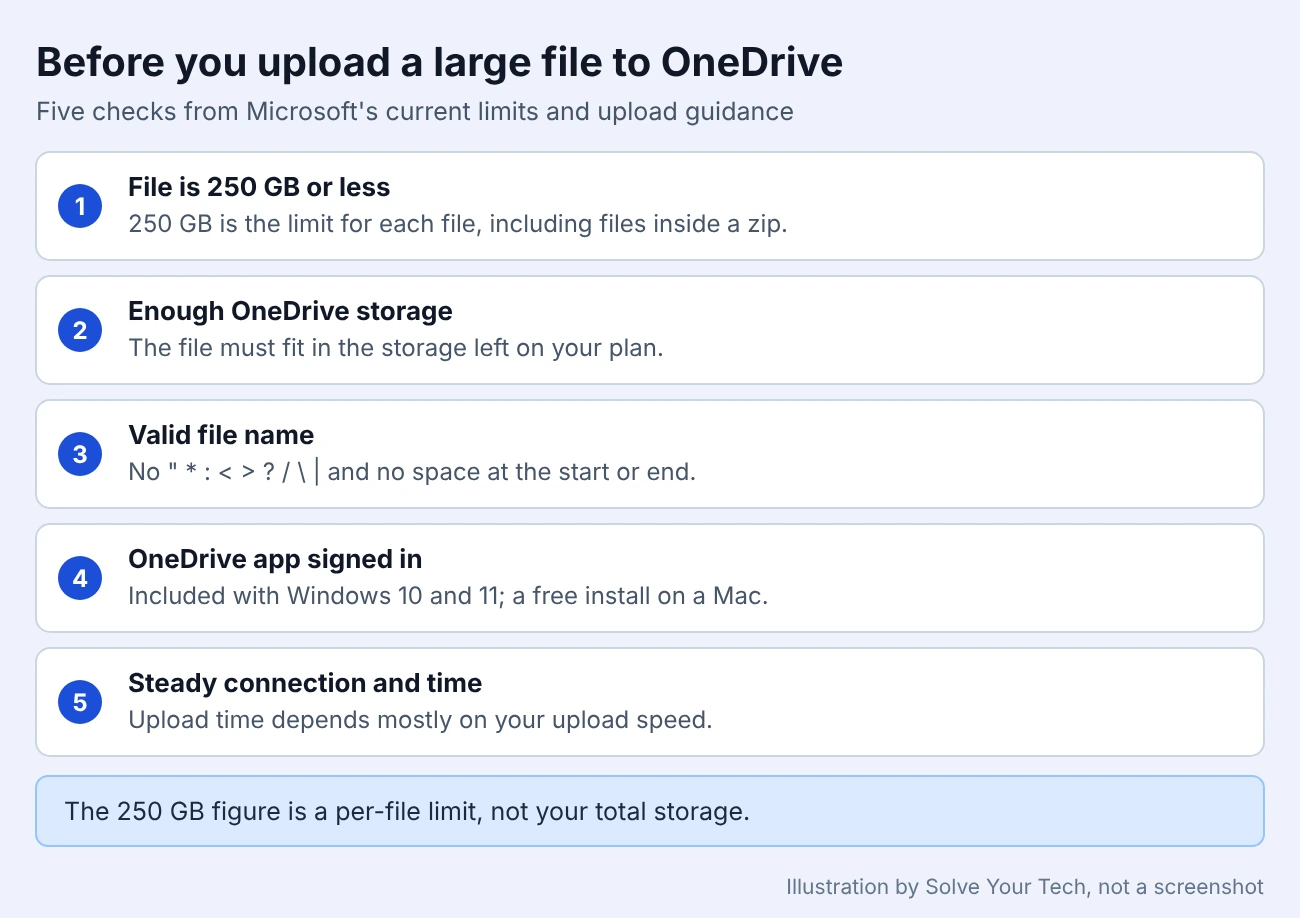
- A file of 250 GB or less. Microsoft’s restrictions and limitations page lists 250 GB as the maximum for syncing, for individual uploads, and for files inside a zip file.
- Enough OneDrive storage. The 250 GB figure is a per-file limit, not your total space. A file only uploads if it fits in the storage left on your plan.
- A valid file name. OneDrive does not allow these characters in file or folder names:
" * : < > ? / \ |. Names also cannot start or end with a space. Rename the file first if needed. - The OneDrive app, signed in. Windows 10 and Windows 11 usually include it. On a Mac you install the free OneDrive app. If it is not set up yet, see how to sync OneDrive on Windows 11.
- A steady internet connection and time. Upload time depends mostly on your connection’s upload speed, which is often much slower than its download speed.
The size limit has changed over the years, so older articles often quote 15 GB, 20 GB or 100 GB. One Microsoft page still mentions 20 GB for the Mac app. The current limits page, which Microsoft updates with dated change notes, lists 250 GB for every upload method, so that is the figure used here.
Upload large files with the OneDrive desktop app
The desktop app is also called the sync app. Sync means the OneDrive folder on your computer and your storage at onedrive.com are kept the same, so anything you put in the folder is uploaded for you. This is the method Microsoft recommends for large files.
Before you drag anything: dragging a file from another folder on your computer into OneDrive moves it. Microsoft notes that this removes the file from its original location and adds it to OneDrive. Use copy and paste if you want the original to stay where it is.
- Check that OneDrive is running. Look for the cloud icon in the notification area at the right end of the taskbar (Windows) or in the menu bar (Mac). A gray cloud with a line through it means you are not signed in.
- Open File Explorer or Finder and find the large file.
- Right-click the file and select Copy.
- Select OneDrive in the left pane. On Windows it may be named OneDrive – Personal. Open the folder where the file should go.
- Right-click an empty area and select Paste. The file appears in the folder right away, and the upload starts in the background.
- Leave the computer on, awake and connected until the upload finishes. Microsoft warns that all uploading stops if the computer goes to sleep.

Pasting a copy means the file takes up space twice on your computer for now: once in the original folder and once in the OneDrive folder. Make sure the drive has room for both. Microsoft’s own walkthrough is in Upload photos and files to OneDrive.
How to check that the upload finished
A large file can take hours, so it helps to know what the icons mean. Microsoft describes them in What do the OneDrive icons mean?
- Circular arrows on the OneDrive cloud icon mean a sync is in progress, which includes uploading files.
- A paused symbol means nothing is syncing right now.
- A red circle with a white cross means a file or folder cannot be synced. Select the cloud icon to read the reason.
Select the cloud icon at any time to open the activity center, a small panel that lists recent files and the current status. When the arrows are gone and no error is shown, confirm the result from the other side: sign in at onedrive.com, open the same folder, and check that the file is listed with the size you expect.
Once the file is safely online, you can get the local disk space back. Right-click the file in your OneDrive folder and select Free up space. The file becomes online-only, shown with a blue cloud icon. It stays in OneDrive but no longer takes up room on your computer, and you need an internet connection to open it.
Upload large files on the OneDrive website
Use the website when you are on a computer without the OneDrive app, or for a single file that is not very big. Microsoft says the website accepts files up to 250 GB, but it still recommends the desktop app for large files or large numbers of files.

- Sign in with your Microsoft account at onedrive.com.
- Browse to the folder where you want the file.
- Select Upload. In some versions of the site the button is named Add new, with Files upload and Folder upload beneath it.
- Choose the file and select Open. You can also drag files from File Explorer or Finder straight onto the page.
- Keep the browser tab open and the computer awake until the upload finishes.
Uploading a whole folder from the website works in Microsoft Edge and Google Chrome. In other browsers, Microsoft suggests creating a folder on the site first and then uploading the files into it.
A browser upload depends on that one tab. If the tab closes or the connection drops, you may have to start the file again, which is the main reason to prefer the desktop app for anything big.
Upload a large file from a phone or tablet
The OneDrive mobile app can upload files that are stored on your device. Large videos are the usual case.
- Open the OneDrive app and go to the folder where the file should be saved.
- Tap the + (Add) icon at the top of the screen.
- Tap Upload a file or photo, then choose the file.
- Keep the app open and the device on Wi-Fi until the upload finishes.
On an iPhone or iPad, Microsoft notes that OneDrive cannot upload photos that are optimized for iCloud, because the full-size original is not on the device. Microsoft’s steps for each platform are in its guides for iOS and Android. Large uploads use a lot of data, so check your mobile plan before uploading without Wi-Fi.
OneDrive size and item limits
| Limit | Value | What it means |
|---|---|---|
| Single file (upload, download or sync) | 250 GB | Applies to each file, not to your total storage |
| Files inside a zip file | 250 GB | Zipping does not raise the limit |
| OneNote notebooks | 2 GB | Notebooks saved in OneDrive have their own, smaller limit |
| Copying on the website | 2,500 files at one time | Larger batches are better handled by the desktop app |
| Total items in your storage | 300,000 recommended | Microsoft says sync performance can suffer above this |
Microsoft also states that it might limit the number of files you can upload to OneDrive each month, without publishing a number. If a file is bigger than 250 GB, OneDrive will not accept it in one piece. The only option is to split it into smaller parts with an archive or video tool first, and the parts must be joined again after downloading.
Make a large upload go faster
OneDrive cannot upload faster than your connection allows. Microsoft’s Maximize upload and download speed page lists these tips:
- Use a wired connection instead of Wi-Fi.
- Close other apps on the computer while a large upload runs.
- Avoid streaming, video calls and other heavy internet use during the upload. Uploading overnight can help.
- Change your power settings so the computer does not go to sleep.
Also check that OneDrive itself is not being held back. The sync app has an upload rate setting:
- Select the OneDrive cloud icon, then select the Help & Settings gear icon and choose Settings.
- Open the Sync and back up tab and expand Advanced settings.
- Look at the upload rate. If it is limited to a low fixed number, raise it or remove the limit. Adjust automatically tells OneDrive to use only spare bandwidth so other apps are not slowed down.
Microsoft documents this in Change the OneDrive sync app upload or download rate. On a work or school account these settings may be controlled by your IT department.
If you are uploading a folder with thousands of small files, such as an old project archive, consider compressing it into one zip file first. It then counts as a single item in OneDrive. The trade-off is that you cannot open the individual files online without downloading the zip.
Pause, resume or undo an upload
You do not have to finish a large upload in one sitting with the desktop app.
- Right-click the OneDrive cloud icon on the taskbar. On a Mac, Control-click the icon in the menu bar.
- Choose how long to pause: 2, 8 or 24 hours. The icon shows a paused symbol.
- To continue sooner, select the paused icon and choose Resume syncing. Otherwise syncing resumes by itself when the time is up.
Microsoft’s pause and resume guide adds that OneDrive pauses automatically when a PC enters battery saver mode or connects to a metered network, which is a connection Windows treats as having a data limit.
To undo an upload, delete the file from your OneDrive folder or from the website. Be careful: because OneDrive syncs, deleting it in one place removes it from OneDrive on every device. If you only wanted a copy in the cloud, make sure the original still exists elsewhere before you delete. Our guide on how to delete files from OneDrive walks through it.
Fix a large upload that is stuck or fails
- The status says “Processing changes” for a long time. Microsoft lists a very large file syncing as one normal cause, along with an open online file or a long queue. Give it time first. Pausing and then resuming sync can also help.
- The cloud icon shows a paused symbol. Select it and choose Resume syncing. On a laptop, plug in the charger so battery saver does not pause it again.
- The cloud icon is gray with a line through it. OneDrive is not signed in. Open the OneDrive app and finish signing in.
- A red circle with a white cross appears. Select the cloud icon to see the message. Common causes are a file name with a character OneDrive does not allow, a file over 250 GB, or not enough storage.
- Your storage is full. Remove files you no longer need, or move to a larger plan. Emptying space on your PC does not help here. It is your OneDrive storage that counts.
- The website upload keeps failing. Switch to the desktop app, as Microsoft recommends for large files.
- You do not see the upload rate settings. On a work or school account, Microsoft says these are managed by your IT department.
- Sync errors continue. Resetting the app can clear them. See how to clear the OneDrive cache.
Frequently asked questions
What is the largest file I can upload to OneDrive?
The largest single file OneDrive accepts is 250 GB, according to Microsoft’s current limits page. That figure applies to the desktop app, the website and syncing. It is a per-file limit, so you also need that much free space in your OneDrive storage.
Is the desktop app or the website better for large files?
The desktop app is better for large files. Microsoft recommends the OneDrive sync app over the website’s upload button for any file larger than a few gigabytes and for large numbers of files. The app uploads in the background and can be paused and resumed.
Can I turn off my computer during a large OneDrive upload?
No. Uploading stops when the computer is off or asleep. With the desktop app, the file stays in your OneDrive folder, and OneDrive carries on syncing after you turn the computer back on and sign in. Microsoft does not say exactly how much of a partly uploaded file is kept, so allow extra time.
Does zipping a file get around the OneDrive size limit?
No. Microsoft lists the same 250 GB limit for files inside a zip file. Zipping is still useful for turning a folder of many small files into one item, and it may shrink some file types, but it does not raise the limit.
Why did my file disappear from its original folder after I uploaded it?
You most likely dragged it. Dragging a file from another folder on your computer into the OneDrive folder moves it instead of copying it. The file is not lost. It is now in your OneDrive folder, and you can copy it back to the original location.
How do I share a large file after it uploads?
Share a link instead of attaching the file to an email. On the OneDrive website, select the file and choose Share, then decide who can open the link. See how to change sharing permissions in OneDrive, or how to email OneDrive files from an iPad.
Next step
Start with one large file using the copy and paste method, then confirm it at onedrive.com before you delete the original or free up space. If the first upload goes smoothly, the same steps work for the rest of your files.

Matthew Burleigh has been writing tech tutorials since 2008. His writing has appeared on dozens of different websites and been read hundreds of millions of times.
After receiving his Bachelor’s and Master’s degrees in Computer Science he spent several years working in IT management for small businesses. However, he now works full time writing content online and creating websites.
His main writing topics include iPhones, Microsoft Office, Google Apps, Android, and Photoshop, but he has also written about many other tech topics as well.