To turn off the forgotten attachment reminder in classic Outlook, go to File › Options › Mail, scroll to Send messages, and uncheck Warn me when I send a message that may be missing an attachment. In Outlook on the web, the same switch is under Settings › Mail › Attachments. Outlook will stop asking if you meant to attach a file when your message mentions one.
This guide covers classic Outlook for Windows, Outlook on the web and Outlook.com, how the reminder decides when to warn you, and how to turn it back on. The option’s behavior comes from Microsoft’s Mail settings article.
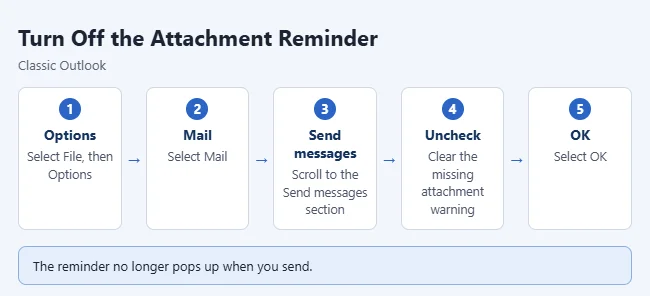
How to turn off the attachment reminder in classic Outlook
- Select File › Options.
- Select Mail.
- Scroll to the Send messages section.
- Uncheck Warn me when I send a message that may be missing an attachment.
- Select OK.
Result: Outlook sends messages that mention an attachment without stopping to warn you. A shortcut to the same settings page: right-click the Mail icon in the navigation bar and choose Options to open the Mail tab directly.
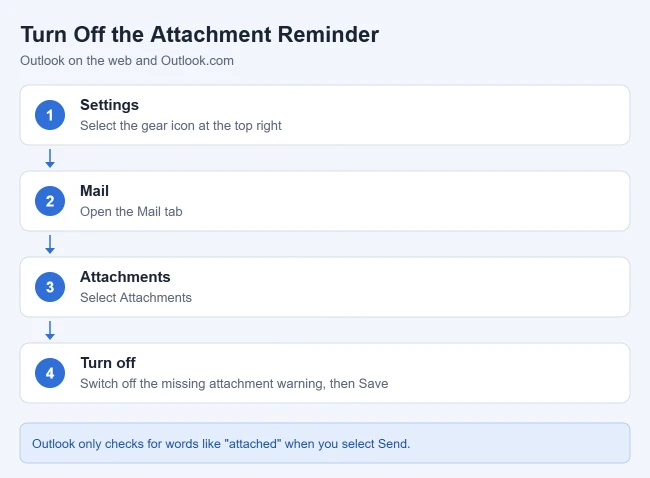
How to turn it off in Outlook on the web and Outlook.com
- Select the Settings gear at the top right of Outlook.
- Select Mail › Attachments.
- Turn off Warn me when I send a message that may be missing an attachment.
- Select Save.
Result: the warning no longer appears when you send from Outlook in a browser. There is also a Settings button on the View tab that opens the same dialog. If your organization still uses the older Outlook Web App on Exchange Server 2016 or 2019, Microsoft’s Mail settings article lists the option under Message options instead.
How the attachment reminder works
The reminder isn’t reading your mind. Outlook looks for words such as “attachment,” “attaching,” or “attached” in your message. If it finds one and nothing is attached, it shows the warning when you select Send. Microsoft adds that you can still send the message with or without an attachment, so the warning never blocks you.
That’s also why it sometimes fires when you don’t expect it. One example is a conversation about “attachment theory” or a technical issue with attachments. You can’t edit the list of trigger words, so turning the reminder off is the only way to stop false alarms.
Why you might keep it on
It’s easy to forget the file, especially when you’ve edited the message several times. The warning costs you one click when it’s wrong and saves an awkward follow-up email when it’s right. If you only get false alarms occasionally, you can leave it on and select Send anyway when it pops up.
How to turn the reminder back on
Repeat the same steps and check the box (classic Outlook) or switch the option back on (Outlook on the web). The option is on by default. In a Microsoft Q&A thread, a user whose reminder had stopped appearing fixed it by unchecking and then re-checking the box in File › Options › Mail.
Frequently Asked Questions
Does the setting sync between classic Outlook and Outlook on the web?
They’re set in separate places: File › Options in classic Outlook, and Settings in Outlook on the web. If you use both, change the option in each one. The same is true of sound alerts, so see how to turn off the new email sound in Outlook if that interrupts you too.
Can I choose which words trigger the reminder?
No. Outlook doesn’t let you edit the keywords. Your only choices are on or off.
For more Outlook help, see our Outlook guides.
Related Guides
- Why you can’t see attachments in Outlook
- How to schedule an email in Outlook
- How to add a signature in Outlook

Matthew Burleigh is the founder, head writer, and editor of Solve Your Tech, which he launched in 2012. He has written technology tutorials since 2008 and worked in IT since 2003, including small-business support, IT management, and consulting. He holds Bachelor’s and Master’s degrees in Computer Science from Arizona State University.
Matthew writes practical guides for Windows, iPhone and iPad, Microsoft Office, Outlook, Google apps, and Android. Solve Your Tech’s guides are tested on current devices or checked against official product documentation, with clear steps, sources, and update dates.
Read more about Matthew and how Solve Your Tech writes and updates its guides, or report a correction.