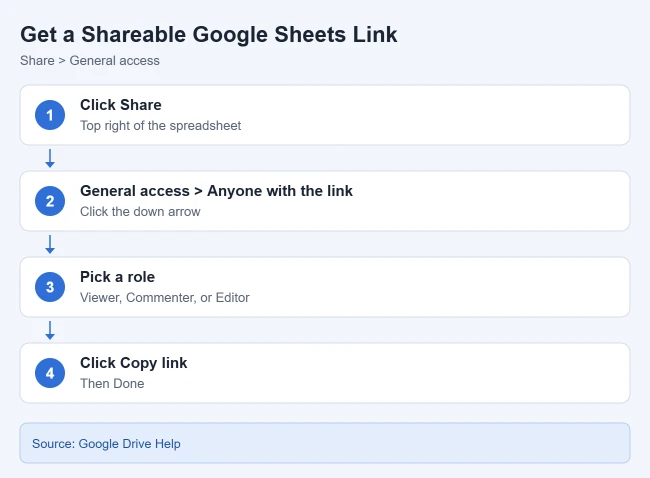
To get a shareable link for a Google Sheets file, open it, click Share, and under General access choose Anyone with the link. Pick Viewer, Commenter, or Editor, then click Copy link. To unshare it, change General access back to Restricted and remove people with Remove access.
These steps cover Google Sheets in a web browser with a personal Google account or a work or school (Google Workspace) account, plus the Google Sheets and Google Drive apps for Android, iPhone, and iPad. They come from Google Drive Help’s Share files from Google Drive and Stop, limit, or change sharing pages.
Link, People, or Publish: Which Should You Use?
Google Sheets has three ways to let other people see a spreadsheet. They all start from the same file, but they reach different audiences.
| Option | Who can open it | Good for | Watch out for |
|---|---|---|---|
| Anyone with the link | Anyone who gets the address | Large groups, people outside your organization, or addresses you don’t know | The link can be forwarded, so anyone who receives it gets the same access |
| Specific people | Only the email addresses or Google Groups you add | Private or sensitive data, and different roles for different people | Each person needs a Google Account to sign in |
| Publish to web | Anyone on the internet who has the published address | A read-only page or an embed on a website | It’s separate from sharing, and viewers can’t see formulas |
For most private work, share with specific people and leave General access set to Restricted. Use a link when convenience matters more than knowing exactly who opens the file.
- Open the spreadsheet at sheets.google.com, or right-click it in Google Drive.
- Click Share in the top right corner (or Share > Share in the Drive menu). The sharing window opens and lists the people who already have access.
- Under General access, click the down arrow and choose Anyone with the link.
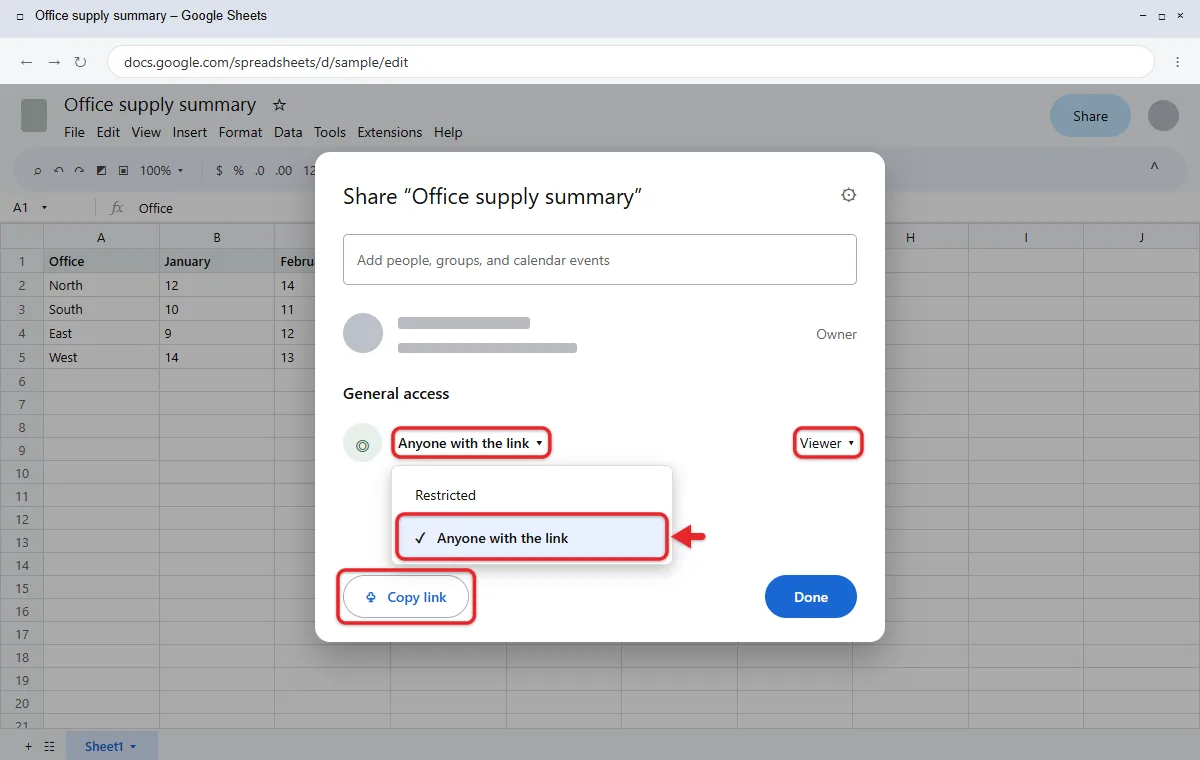
- Click the role menu on the right of the General access line and choose Viewer, Commenter, or Editor. Viewer is the safest choice for a link you’ll send widely.
- Click Copy link. A short message confirms the link is on your clipboard.
- Click Done, then paste the link into an email, chat, or document.
Anyone you send the link to can open the spreadsheet with the role you chose. Your name and email are visible as the file owner, and people who aren’t signed in to a Google Account appear as anonymous animals in the file. To check what others see, paste the link into a private or incognito browser window. The spreadsheet should open in view-only mode if you chose Viewer.
To point someone to a single comment instead of the whole file, the steps to create a link to a comment in Google Slides work the same way in Sheets.
The same steps work for pictures, so you can also create a Google Drive link for photos.
The options in the General access list depend on your account. With a work or school account, you may also see your organization’s name, which limits the link to people signed in to that organization, and your administrator may hide Anyone with the link altogether.
- Open the spreadsheet and click Share.
- In the Add people and groups box, enter one or more email addresses or a Google Group.
- Choose Viewer, Commenter, or Editor from the menu next to the names.
- Add an optional message, or uncheck Notify people if you don’t want Google to send an email.
- Click Send (or Share if you turned off notifications).
Only those people can open the file, as long as General access stays Restricted. Each person shows up in the sharing window with their role.
A few limits from Google’s help pages:
- You can share a single file with up to 600 individual email addresses. Sharing with a Google Group counts as one entry, which helps for large teams.
- A spreadsheet can be edited from up to 100 open tabs or devices at once. Past that point, only the owner and some editors can make changes.
- With an eligible work or school account, you can add an expiration date. Click the down arrow next to a person’s name, choose Add expiration, and pick a date within one year.
- Work or school accounts may not be able to share outside the organization.
If too many invitation and comment emails reach you after you share, you can turn off Google Drive email notifications without changing anyone’s access.
What Each Role Can Do
Google’s permission table for files in My Drive, in plain terms:
| Role | View | Comment | Edit | Share | Download, print, copy |
|---|---|---|---|---|---|
| Viewer | Yes | No | No | No | Yes, unless the owner turns it off |
| Commenter | Yes | Yes | No | No | Yes, unless the owner turns it off |
| Editor | Yes | Yes | Yes | Yes, by default | Yes |
| Owner | Yes | Yes | Yes | Yes | Yes, and controls what the other roles can do |
- Viewer: can open the file and, by default, download or make a copy. Can’t comment, edit, or share.
- Commenter: can view and comment. Can download by default. Can’t edit or share.
- Editor: can view, comment, edit, and share. By default, editors can also change permissions, but they can’t change the owner.
- Owner: can do everything, including control what editors and viewers are allowed to do.
When a discussion is finished, here is how to remove comments and notes in Google Sheets.
Editors can change cell values, add or delete sheets, and change formatting, so give Editor access only to people who need it. If one person changes too much, you can roll the file back with version history.
Sharing always applies to the whole spreadsheet. You can’t share just one tab from the Share window. To keep editors away from certain cells or tabs, use Data > Protect sheets and ranges instead (the same menu you use to remove sheet protection in Google Sheets). Hiding a tab isn’t a security step, because editors can unhide it.
The phone apps use the same roles and General access options, with slightly different buttons.
On Android
- Open the spreadsheet in the Google Sheets app.
- Tap More (three dots) next to the file’s name, then tap Share. In the Google Drive app, select the file and tap Share.
- Enter email addresses, choose Viewer, Commenter, or Editor, and tap Send.
To share by link instead:
- Open the Google Drive app and select the file.
- Tap Manage access.
- Under General access, tap Change.
- Choose Anyone with the link and pick a role.
- Tap Copy link, then tap Back.
On iPhone or iPad
- Open the Google Drive app.
- Next to the spreadsheet, tap More (three dots), then tap Share.
- Enter email addresses, choose a role, and tap Send.
For a link, tap More > Manage access for the file, tap Change under General access, choose Anyone with the link, select a role, and tap Copy link. In the Google Sheets app, the same options are under the three-dot menu at Share & export.
There are three ways someone can still reach your spreadsheet: a link, a name in the sharing list, or a shared folder that contains the file. Check all three.
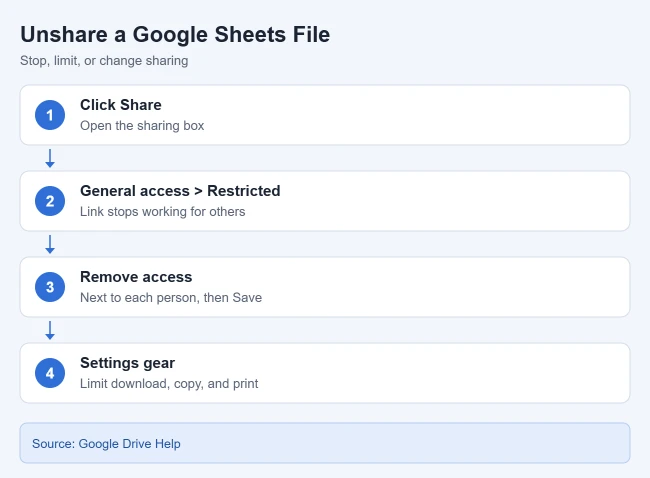
- Open the spreadsheet and click Share.
- Under General access, choose Restricted so the link only works for people you added.
- Next to each person’s name, click the down arrow and choose Remove access.
- Click Save.
Restricted means only people with access can open the file, and it overrides link access inherited from the parent folder. Anyone who had only the link now sees a request-access page. Docs and Slides work the same way, so you can stop sharing a Google Docs file with these steps too.
If You Published the Sheet to the Web
Publishing is separate from sharing, so Restricted doesn’t turn it off. To stop it:
- Click File > Share > Publish to web.
- Click Published content & settings.
- Click Stop publishing.
To Change a Role Instead of Removing Someone
Open Share, click the role next to the person’s name, and pick a lower role, such as Viewer in place of Editor. Click Save.
To Hand the File to Someone Else
With a personal account, you can make someone else the owner. Share the file with them first, then click Share, click the down arrow next to their name, and choose Transfer ownership. They get an email and must accept. You stay the owner until they do, and then you become an editor. Google doesn’t allow transfers from a personal account to a work or school account.
Stop People From Downloading, Copying, or Resharing
Only the owner can change these settings.
- Click Share, then the Settings gear at the top right of the sharing window.
- To stop editors from adding people or changing the link, uncheck Editors can change permissions and share.
- Under People who can download, copy, and print, check only the roles you want to allow.
- Click Done.
This limits downloads and copying inside Drive and Sheets, but it can’t stop people from sharing the content in other ways, such as taking a screenshot. Copies people made before you changed the setting stay theirs. Unchecking the first box also stops editors from using Publish to web.
How to See Who Has Access
Click Share. The sharing window lists every person and group with access and their role, and the General access line shows whether a link is on. You can also right-click the file in Google Drive and click File information > Details, or click Manage access if you can make changes.
With a work or school account, the Activity dashboard shows which signed-in people in your organization have viewed a shared file. Google’s help page on viewing activity in Docs, Sheets, and Slides notes that this view history comes from work or school accounts, and people can hide their own views. It doesn’t name anonymous visitors who opened the file through a link.
Troubleshooting
- People get “You need access”: General access is still Restricted and they weren’t added by email. Switch to Anyone with the link or add them. Also check that they’re signed in to the account you shared with.
- The link opens but they can’t edit: the link’s role is Viewer or Commenter. Change the role on the General access line, or add the person by email as an Editor.
- You can’t change sharing, or the Share options are grayed out: only the owner, and editors the owner allows, can change permissions. Confirm you’re signed in to the right Google Account by checking the profile picture in the top right.
- Someone still has access after you removed them: folder permissions are inherited. Check who has access to the parent folder, and check whether the person is in a Google Group you shared with.
- You can’t share outside your company, or Anyone with the link is missing: your administrator may block external sharing on work or school accounts.
- Some editors suddenly can’t edit: the file is open in more than 100 tabs or devices, so only the owner and some editors can edit until others close it.
Frequently Asked Questions
Does deleting the file unshare it?
People you shared with can still open it and make a copy until you permanently delete the file from your trash. Unsharing first is safer. If others still need the file, transfer ownership instead of deleting it.
Do people need a Google Account to open a shared link?
Not to view it. With Anyone with the link, people who aren’t signed in can open the spreadsheet and appear as anonymous animals. To be added by name or to get a role tied to them, they need a Google Account.
Can I share only one tab of a spreadsheet?
Not from the Share window, because sharing covers the whole file. Copy the tab into a new spreadsheet and share that file, or protect the other tabs so collaborators can’t change them.
Can I make a shared link expire?
Google offers expiration dates only for people you add by name, and only on eligible work or school accounts. A link stays active until you set General access back to Restricted.
Does making a copy keep the sharing settings?
No. A copy made in Drive starts out private to you; here’s how to make a copy of a file in Google Drive. Sharing the copy doesn’t change who can open the original.
Next, if your spreadsheet links to other files, make sure those are shared too. You can link to a Drive file from a cell when you add a hyperlink in Google Sheets.
Related Guides
- How to remove sheet protection in Google Sheets
- How to stop sharing a Google Docs file
- How to embed Google Sheets in WordPress

Matthew Burleigh is the founder, head writer, and editor of Solve Your Tech, which he launched in 2012. He has written technology tutorials since 2008 and worked in IT since 2003, including small-business support, IT management, and consulting. He holds Bachelor’s and Master’s degrees in Computer Science from Arizona State University.
Matthew writes practical guides for Windows, iPhone and iPad, Microsoft Office, Outlook, Google apps, and Android. Solve Your Tech’s guides are checked step by step against the device or app maker’s own documentation and tested on his own devices whenever he has the hardware or software, with clear steps, sources, and update dates.
Read more about Matthew and how Solve Your Tech writes and updates its guides, or report a correction.