To configure redirects in Firefox, click the menu button, choose Settings, select Permissions and data, and scroll to the Permissions section. The Block pop-ups and third-party redirects checkbox turns Firefox’s redirect blocker on or off, and Manage exceptions lets one trusted site through. That checkbox is on by default, so most people only need to add an exception or confirm it is still checked.
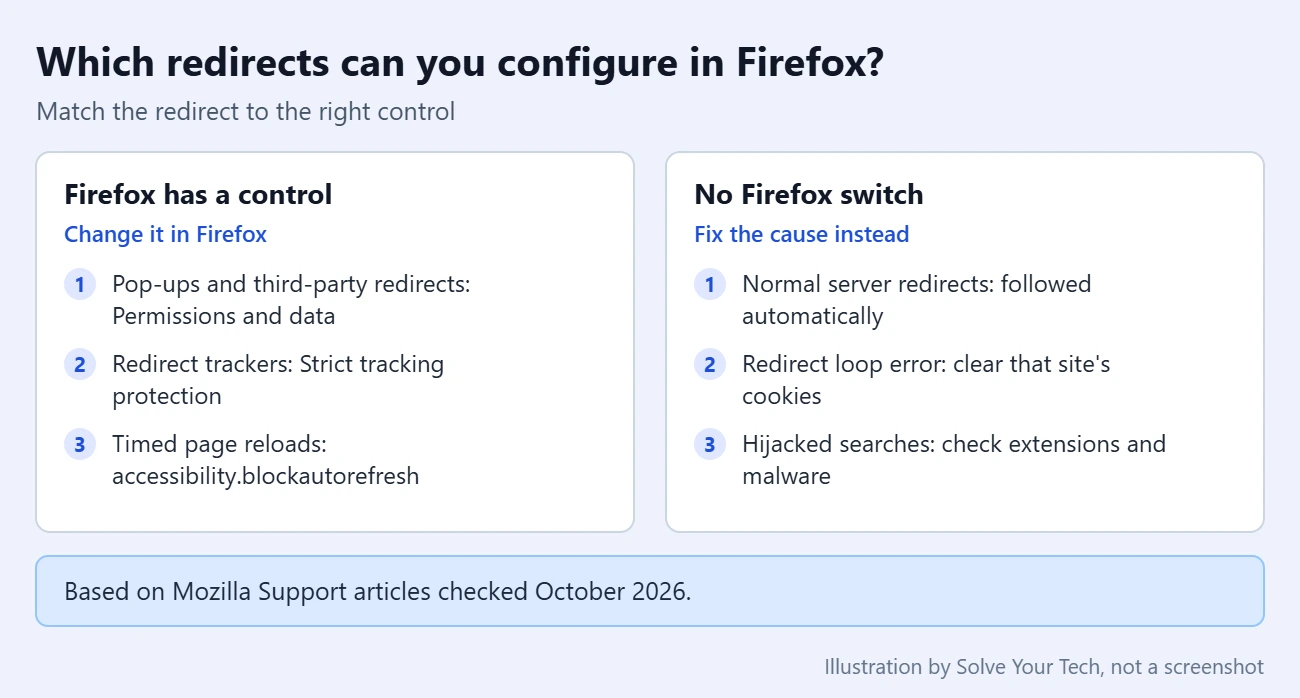
Firefox has no single “redirects” switch. A redirect is anything that sends your browser from one web address to another, and Firefox handles several kinds in different places. This guide covers each one, including the advanced accessibility.blockautorefresh preference that replaced the old “Warn me when websites try to redirect or reload the page” checkbox.
What You Can and Cannot Configure
These steps are for Firefox on a Windows, Mac, or Linux computer and follow Mozilla’s help pages. You do not need a Mozilla account. Menu names have changed over the past year, so update Firefox first if your Settings page looks different. To do that, check for updates in Firefox. If you would rather decide when new versions arrive, you can also choose when Firefox installs updates.
It helps to know which kind of redirect you are dealing with before you change anything.
| Type of redirect | What it looks like | Where to control it |
|---|---|---|
| Pop-up or third-party redirect | A site opens a new window, or an embedded part of a page tries to take over the whole tab | Settings > Permissions and data > Block pop-ups and third-party redirects |
| Redirect tracker (bounce tracker) | A link quietly passes through a tracking address before the real page loads | Enhanced Tracking Protection set to Strict |
| Timed reload or redirect | A page reloads itself or moves to another page after a few seconds | accessibility.blockautorefresh in about:config (advanced) |
| Normal server redirect | An old address forwards to a new one | No Firefox setting. Firefox follows these automatically |
| Redirect loop | “The page isn’t redirecting properly” error | Clear that site’s cookies |
| Hijacked searches or home page | Searches land on a site you did not choose | Check extensions and scan for malware |
How to Block or Allow Redirects in Firefox Settings
This is the main control. Mozilla describes third-party redirect blocking as an extension of the pop-up blocker. It stops websites from forcing their pages to open outside the tab or frame they belong in, which is a trick used for fake login pages and full-screen scam prompts.
- Open Firefox and click the menu button (three horizontal lines) in the top-right corner.
- Click Settings. A Settings tab opens.
- Click Permissions and data on the left side.
- Scroll down to the Permissions section.
- Find Block pop-ups and third-party redirects. Leave the box checked to keep blocking on. Uncheck it to turn the blocker off for every site.
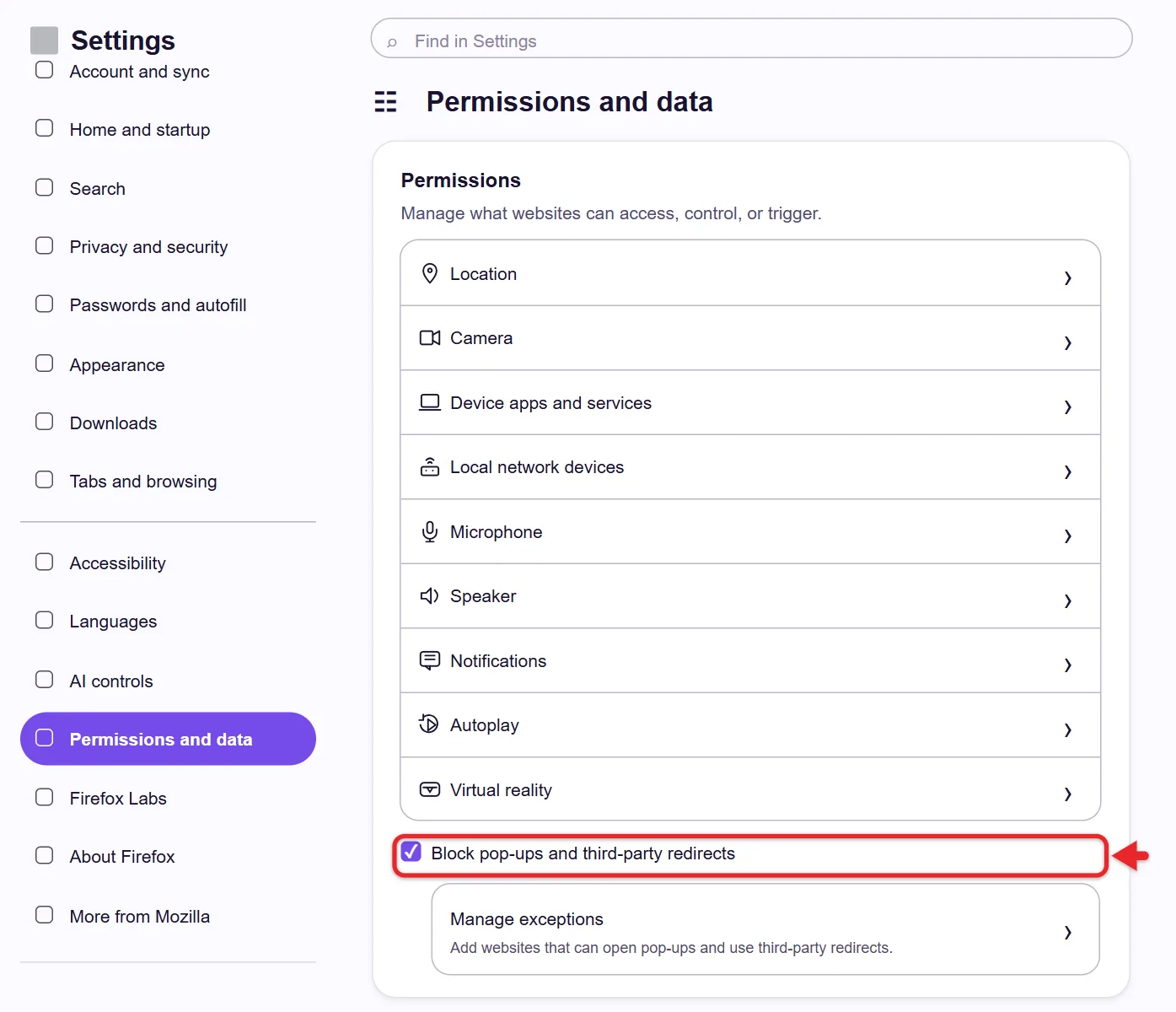
The change applies right away. There is no Save button for the checkbox itself.
Warning: unchecking the box turns off pop-up blocking and third-party redirect blocking together for all websites, including ad and scam pages. If only one site is having trouble, add an exception instead.
Mozilla’s pop-up blocker settings article is the source for these labels. In older versions of Firefox the same checkbox is called Block pop-up windows, sits under Privacy & Security, and has an Exceptions button next to it.
The same Permissions section has Location, Camera and Microphone buttons, which you can use to stop websites from asking for your location.
How to Allow Redirects for One Trusted Site
Some sites, including some banking sites, rely on pop-ups for sign-in or payment windows. An exception lets that one site through while Firefox keeps blocking everything else.
- Open Settings and click Permissions and data.
- In the Permissions section, click Manage exceptions under Block pop-ups and third-party redirects. A dialog box opens.
- Type or paste the website’s address into the box.
- Click Allow. The site appears in the list below.
- Click Save Changes.
The two protections are linked. Allowing pop-ups for a site also exempts it from third-party redirect blocking, and you cannot set them separately. Only add sites you trust.
There is a faster route when Firefox has just blocked something. Firefox shows an information bar under the toolbar and an icon in the address bar. Click Options on the bar, or click the icon, and choose Allow pop-ups for followed by the site’s name. The same menu lists the blocked address, so you can open it once without creating an exception.
How to remove an exception
Open Manage exceptions again, select the site in the list, click Remove Website, and then click Save Changes. Remove All Websites clears the whole list. Firefox goes back to blocking that site’s pop-ups and third-party redirects.
How to Block Redirect Trackers
A redirect tracker, also called a bounce tracker, sends you through an in-between address when you click a link so it can record where you came from and where you are going. Firefox includes Bounce Tracking Protection for this, but it works only when Enhanced Tracking Protection is set to Strict. The default level is Standard.
- Click the shield icon to the left of the address bar on any web page.
- Click Privacy Settings. The Privacy and security page of Settings opens in a new tab.
- Under Enhanced Tracking Protection, click Advanced settings.
- Select Strict.
- Use the button Firefox shows to apply the change to your open tabs.
Warning: Strict can break parts of some websites, such as embedded videos or social media posts that contain trackers. If a site stops working, click the shield icon on that site and turn protection off for it, or switch back to Standard using the same steps. See Mozilla’s guide to Enhanced Tracking Protection in Firefox for desktop for the full list of what each level blocks.
Bounce Tracking Protection runs in the background. It has no switch of its own, and it does not show a warning each time it acts.
How to Stop Pages From Redirecting or Reloading Themselves
Older versions of Firefox had a checkbox named Warn me when websites try to redirect or reload the page in the Advanced options. A moderator on the Mozilla Support forum explains that the checkbox was removed in Firefox 56, and the setting now lives only in the Configuration Editor as accessibility.blockautorefresh.
Warning: the Configuration Editor, opened by typing about:config, is a list of advanced preferences. Changing settings there can seriously affect Firefox’s stability, security, and performance. Change only the preference named here.
- Click in the address bar, type about:config, and press Enter.
- If a warning page appears, click Accept the Risk and Continue.
- Type accessibility.blockautorefresh in the Search preference name box. One result appears.
- Double-click the preference, or click the Toggle button at the right end of its row, so the value changes from false to true.
- Close the tab. The preference is saved as soon as it changes.
With the value set to true, Firefox should stop a page that tries to reload or forward itself on a timer and show a notice at the top of the page with a button to allow it. This is an accessibility feature meant to stop pages from changing underneath you. It does not block ordinary server redirects, pop-ups, or links you click.
Expect some inconvenience. Sites that forward you after signing in, after a payment, or from a “you will be redirected in 5 seconds” page will wait for you to allow each one.
How to undo the change
Return to about:config, search for accessibility.blockautorefresh, and click Toggle so the value reads false. A preference you have changed appears in bold with a Reset button, which also returns it to the default. Mozilla’s Configuration Editor article explains the Toggle, Reset, and search controls.
How to Check That Your Settings Worked
- Redirect blocker: go back to Settings > Permissions and data and confirm Block pop-ups and third-party redirects is checked. When Firefox blocks something on a page, the information bar and address bar icon appear.
- Exception: reload the trusted site and repeat the action that failed. The window or page should now open without the information bar.
- Tracking protection: click the shield icon on any site. Blocked trackers are listed there, and the Settings page shows Strict as selected.
- Automatic refresh: open about:config and search for the preference. The row shows true in bold when the change is active.
Troubleshooting Redirect Problems in Firefox
“The page isn’t redirecting properly”
This error means a site is sending Firefox in a circle. No redirect setting fixes it. The problem can be caused by cookies, which are small files a site stores to remember your sign-in and preferences. Open the site, click the shield icon to the left of the address bar, and click Clear cookies and site data. You will be signed out of that site only. You can also delete cookies for one site from Settings, and Mozilla’s Clear cookies and site data in Firefox article covers both methods.
Pop-ups or redirects still get through
Check that the site is not on the exceptions list. Mozilla also points out three limits. Pop-ups that open because you clicked something or pressed a key are allowed on purpose, so sites keep working. Some ads are drawn inside the page to look like windows, and the blocker cannot stop those. And some sites use methods the blocker does not cover.
Searches or the home page go to a site you did not pick
Redirected searches and constant ad pop-ups are signs of malware or an unwanted extension. Click the menu button, click Extensions and themes, select Extensions, and turn off anything you do not recognize with its toggle. To remove one for good, delete or disable a Firefox add-on from the same page. Then run a scan with your security software. Mozilla’s article on Firefox issues caused by malware lists the other symptoms to look for.
The setting is missing or has a different name
If you see Privacy & Security and Block pop-up windows instead of Permissions and data and Block pop-ups and third-party redirects, you are on an older layout. Update Firefox, or use the search box at the top of Settings and type pop-up. On a work or school computer, an administrator can lock settings, and a locked control cannot be changed from your side.
Nothing else helps
Refresh Firefox restores the browser to its default state. Click the menu button, select Help, choose More troubleshooting information, and click Refresh Firefox.
Warning: Mozilla’s Refresh Firefox article says a refresh removes extensions and themes, website permissions, and modified preferences. That includes your pop-up exceptions and any about:config change. Bookmarks, history, passwords, and cookies are kept.
Start with the checkbox under Settings > Permissions and data, since it is the only redirect control most people need. Add an exception for any trusted site that breaks, and move on to Strict tracking protection or the about:config preference only if a specific kind of redirect is still getting through.
Firefox Redirect Questions
Can Firefox block all redirects?
No. Firefox follows normal server redirects automatically, such as an old address forwarding to a new one, and it has no setting to stop them. You can block pop-ups and third-party redirects in Settings, block redirect trackers with Strict tracking protection, and hold timed reloads with the accessibility.blockautorefresh preference.
Where did “Warn me when websites try to redirect or reload the page” go?
It is no longer in the Settings window. A Mozilla Support forum moderator states that in Firefox 56 and later the option exists only as the accessibility.blockautorefresh preference in about:config. Setting it to true turns the warning on, and false turns it off.
Is the redirect blocker on by default?
Yes. Pop-up blocking is turned on by default in Firefox, and third-party redirect blocking is part of the same checkbox. You only need to visit the setting to add an exception or to confirm nobody turned it off.
Can I allow redirects for one site but keep blocking pop-ups there?
No. The two are linked and must be toggled together. Adding a site under Manage exceptions allows both pop-ups and third-party redirects for that site.
Why does a “Redirect Notice” page appear when I open a Google link?
That page comes from Google, not from Firefox. A contributor on the Mozilla Support forum explains that it appears when one of Google’s encoded search-result links is opened on its own in a new tab, and that Firefox preferences such as accessibility.blockautorefresh are not expected to change it.
Do these steps work in Firefox on a phone?
No. This guide covers Firefox on a computer. The phone apps have their own, smaller set of settings. On iPhone, the Firefox app has its own switch to allow pop-ups.
Does changing Firefox affect Chrome or Edge?
No. Each browser keeps its own settings. Edge and Chrome each have a Pop-ups and redirects setting, and the article on the pop-up blocker on Windows 11 walks through both.

Matthew Burleigh is the founder, head writer, and editor of Solve Your Tech, which he launched in 2012. He has written technology tutorials since 2008 and worked in IT since 2003, including small-business support, IT management, and consulting. He holds Bachelor’s and Master’s degrees in Computer Science from Arizona State University.
Matthew writes practical guides for Windows, iPhone and iPad, Microsoft Office, Outlook, Google apps, and Android. Solve Your Tech’s guides are checked step by step against the device or app maker’s own documentation and tested on his own devices whenever he has the hardware or software, with clear steps, sources, and update dates.
Read more about Matthew and how Solve Your Tech writes and updates its guides, or report a correction.