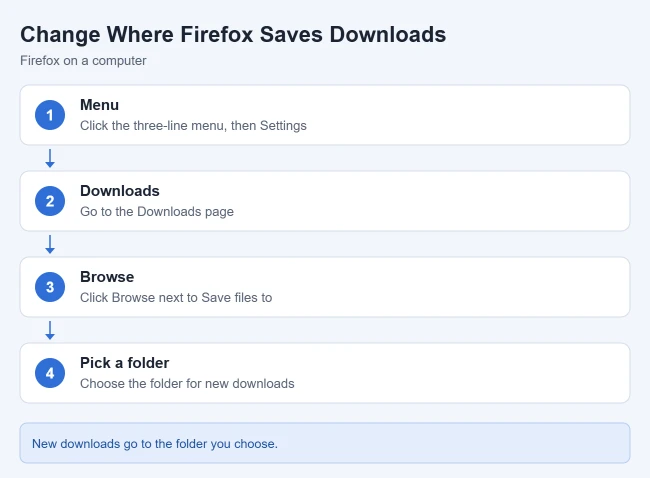
To choose where Firefox saves downloads, click the menu button (three lines), choose Settings, find the Downloads settings, click Browse next to Save files to, and pick a folder. Every new download goes to that folder from then on.
These steps cover desktop Firefox on Windows, Mac and Linux, using the labels in Mozilla’s Where to find and manage downloaded files in Firefox help article. Firefox for Android and iPhone works differently.
How to Change Where Firefox Saves Downloads
- Click the menu button (three horizontal lines) in the top-right corner of Firefox. The main menu opens.
- Choose Settings. The Settings page opens in a new tab.
- Go to the Downloads page in the list on the left.
- Click the Browse button next to Save files to. A folder window from your computer opens.
- Choose the folder you want to use, then click Select Folder (Windows) or Choose (Mac).
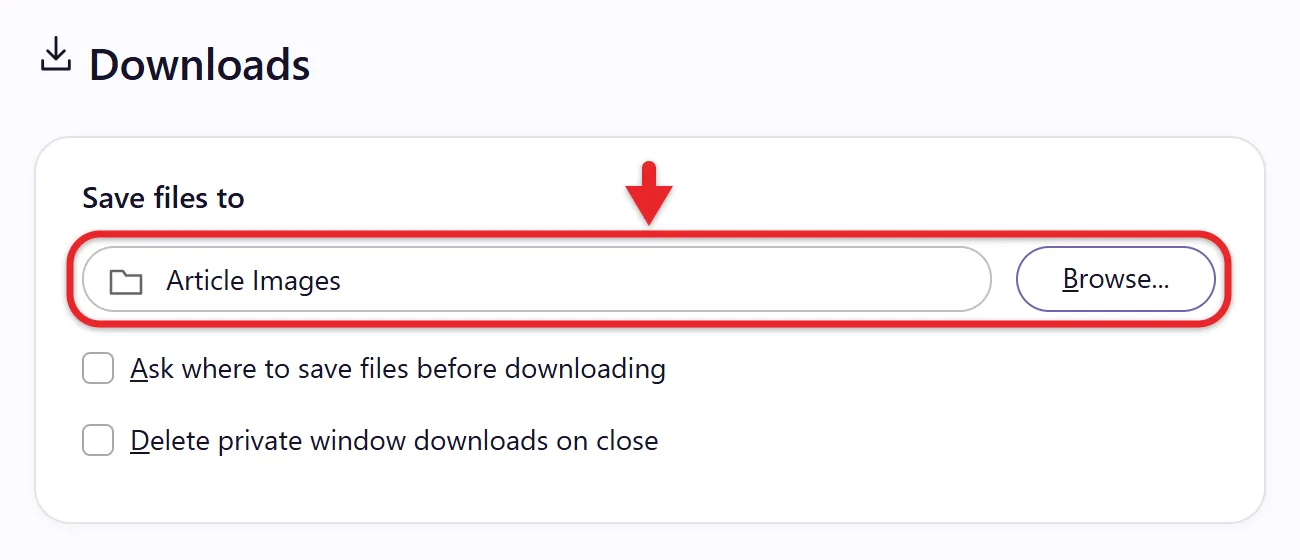
The folder name now appears next to Save files to. There is no Save button; close the Settings tab when you’re done.
Files you already downloaded stay where they are. Only new downloads use the new folder.
If you don’t see a Downloads page
In older Firefox versions there is no separate Downloads page. Open Settings, stay on the General panel, and scroll to the Downloads section under Files and Applications. On some versions the button says Choose instead of Browse. If your labels match neither layout, check for updates in Firefox first.
If you pick an external or USB drive, keep it connected, or downloads can fail until you choose another folder.
To move the default Downloads folder for all of Windows, not only Firefox, read how to change the default download location in Windows 11.
How to Pick a Folder for Each Download
To choose a location every time, turn on Always ask you where to save files in the same Downloads section. Firefox then shows a Save window for each download. Mozilla notes it doesn’t ask when it opens a file directly with an app. Clear the check box to go back to automatic saving.
How to Find a File You Just Downloaded
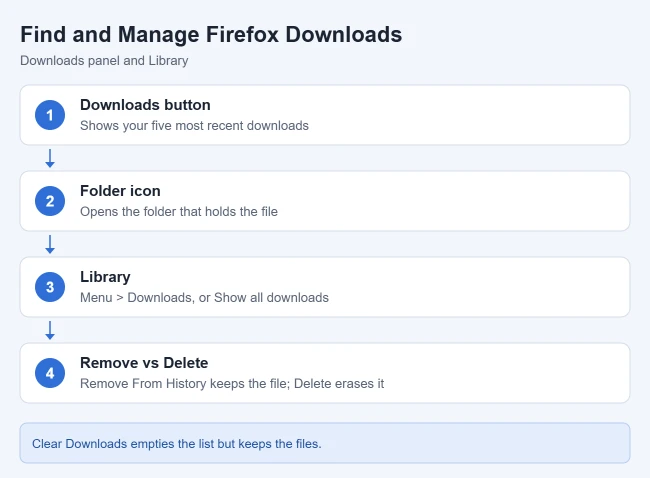
- Click the Downloads button (the arrow) in the toolbar. The arrow turns blue when you have downloads you haven’t looked at yet.
- Find the file in the Downloads panel, which shows your five most recent downloads with their size and status.
- Click the folder icon next to the file to open the folder that holds it. On a Mac, this is a magnifying glass labeled Show In Finder. Click the file itself to open it.
The Downloads button isn’t in the toolbar by default when you haven’t downloaded anything in the current session. Use the menu instead (next section). If the panel popping open bothers you, right-click the Downloads button and turn off Show Panel When Download Begins.
How to See All Your Firefox Downloads
The Library keeps a list of all your downloads unless you’ve cleared them from your history.
- Click the menu button and choose Downloads.
- Or click Show all downloads at the bottom of the Downloads panel.
The Library window lists each file with its size, source and download time.
Can’t find a file outside Firefox? Read how to find downloads on Windows 11. If you used Chrome for the download, it keeps its own list; here’s how to see recent downloads in Google Chrome.
How to Pause, Remove or Delete Downloads in Firefox
The Downloads panel and Library have these options:
- Pause or resume: right-click a download in progress and choose Pause, then Resume later.
- Cancel or retry: click the X beside a download to cancel it, then the refresh symbol to restart.
- Go to Download Page: right-click a file to revisit the page it came from.
- Copy Download Link: right-click a file to copy its web address.
- Remove From History: removes the entry from the list but doesn’t delete the file.
- Delete: right-click a file and choose Delete to remove the file from your disk. The entry then shows File deleted.
- Clear Downloads: in the Library, clears the whole download history without deleting the files.
You can also clear download history with the menu button > History > Clear Recent History. That clears the pages you visited in the chosen time range as well.
How to Change What Firefox Does With a File Type
- Click the menu button and choose Settings.
- On the Downloads page, scroll to Files and applications.
- Find the file type and click the arrow in the Action column.
- Choose what Firefox should do, such as open the file with an app or Always ask.
A shortcut: right-click a file in the Downloads panel and choose Always Open Similar Files. That adds the file type to Files and applications, where you can change it later.
Troubleshooting Firefox Download Location Problems
- Downloads still go to the old folder: check the folder next to Save files to, and whether Always ask you where to save files is on. When it is, the folder you pick in the Save window wins.
- A download is blocked: Firefox can stop files it thinks are harmful, with a warning such as This file may harm your computer. Click the arrow next to the file in the Downloads panel for details, and choose Allow Download only if you trust the source.
- Downloads fail or won’t save: Mozilla’s can’t download or save files page suggests clearing the download list, choosing a different folder, and checking whether antivirus software is blocking downloads. As an advanced fix, it describes resetting the browser.download entries in about:config, then setting your folder again.
Firefox Download Folder Questions
Where does Firefox save downloads by default?
Usually your computer’s Downloads folder. The exact folder is listed next to Save files to on the Settings > Downloads page.
Where do files go that I open instead of save?
Since Firefox 98, on Windows and Linux, files you open with an app are saved to your download folder rather than a temporary folder. Look for them there.
Does Remove From History delete the file?
No. It removes the entry only. Use Delete to remove the file from your disk.
Are files from a private window saved?
Yes. Files you download in Private Browsing are saved, but they won’t be listed in the Library afterward. For more, read about private browsing in Firefox.
More Firefox guides: how to turn off automatic updates in Firefox, how to change Firefox tab settings, how to show the menu bar in Firefox, how to print without headers and footers in Firefox and how to fix delayed typing in Firefox.
Before you reinstall Firefox or move to a new computer, learn how to back up and restore your bookmarks in Firefox.

Matthew Burleigh is the founder, head writer, and editor of Solve Your Tech, which he launched in 2012. He has written technology tutorials since 2008 and worked in IT since 2003, including small-business support, IT management, and consulting. He holds Bachelor’s and Master’s degrees in Computer Science from Arizona State University.
Matthew writes practical guides for Windows, iPhone and iPad, Microsoft Office, Outlook, Google apps, and Android. Solve Your Tech’s guides are checked step by step against the device or app maker’s own documentation and tested on his own devices whenever he has the hardware or software, with clear steps, sources, and update dates.
Read more about Matthew and how Solve Your Tech writes and updates its guides, or report a correction.