The Google Docs Research tool no longer exists under that name. Google replaced it with a sidebar called Explore in 2016, and Google’s help article for Explore now redirects to its page about Gemini in Docs. To do the same jobs in current Google Docs on a computer, use Tools > Citations to cite sources, Insert > Link to search for a website and link to it, Insert > Image > Stock & web to find pictures, and Ask Gemini for web answers if your account has an eligible plan.
The shortest reliable route for most school and work papers is the Citations tool, because it is part of Google Docs on a computer and does not depend on a paid plan. The sections below cover each replacement separately so you can jump to the one you need.
What Happened to the Research Tool
The original Research tool was a panel on the right side of a document. You typed a search, and it showed web results with buttons to preview a page, insert a link, or cite the page as a footnote. Its successor, Explore, opened from Tools > Explore or from an icon in the bottom-right corner and added tabs for web results, images, and Google Drive files.
Many guides still describe Explore as if it were available. If your Tools menu has no Explore option and there is no Explore icon in the corner of the document, nothing is wrong with your account or your browser. The feature is simply not offered there, and no setting brings it back.
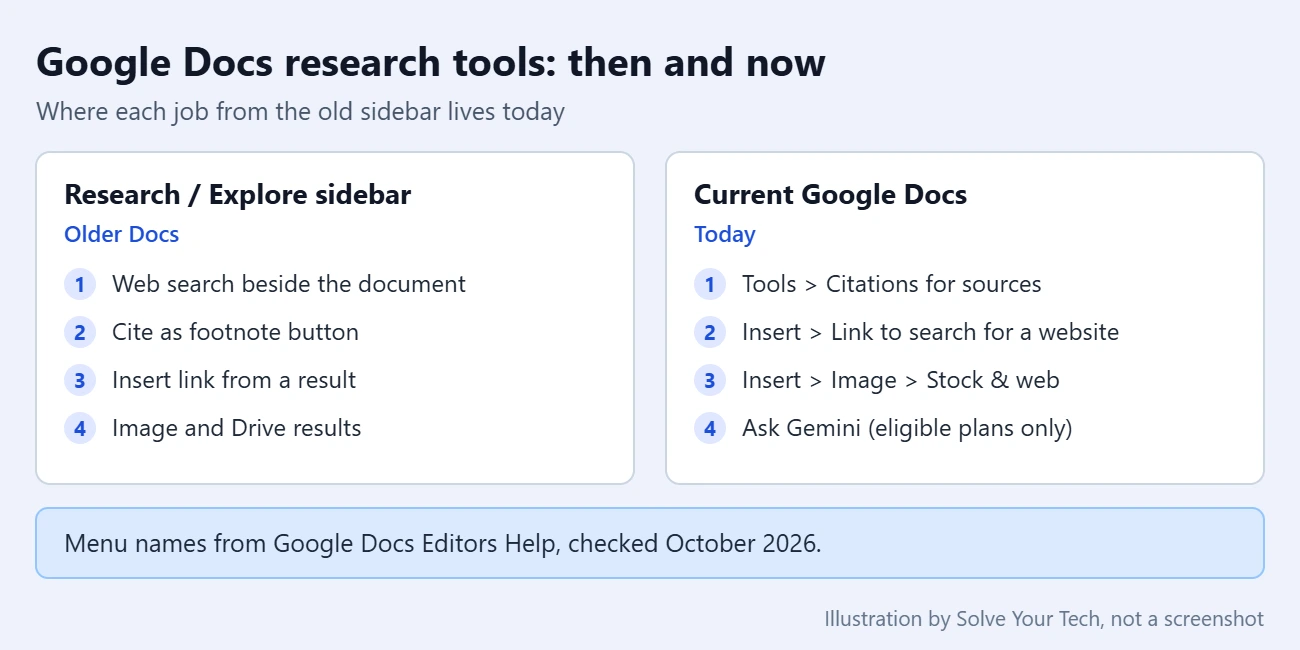
| Old Research or Explore job | Where to do it now | Works on |
|---|---|---|
| Cite a source | Tools > Citations | Computer only |
| Add a footnote | Insert > Page elements > Footnote | Computer and mobile app |
| Insert a link to a web page | Insert > Link | Computer and mobile app |
| Find an image | Insert > Image > Stock & web | Computer |
| Ask a question about a topic | Ask Gemini | Eligible plans only |
What You Need
- A Google Account and a document you can edit. If you only have view or comment access, the Insert and Tools commands described here are not available to you.
- A computer with a web browser for the Citations tool. Google states that the citations tool must be opened in Google Docs on a computer.
- For Gemini only: an eligible Google Workspace or Google AI plan, or an account enrolled in Google Workspace Experiments. Without one of those, the Ask Gemini button does not appear.
How to Cite Sources With the Citations Tool
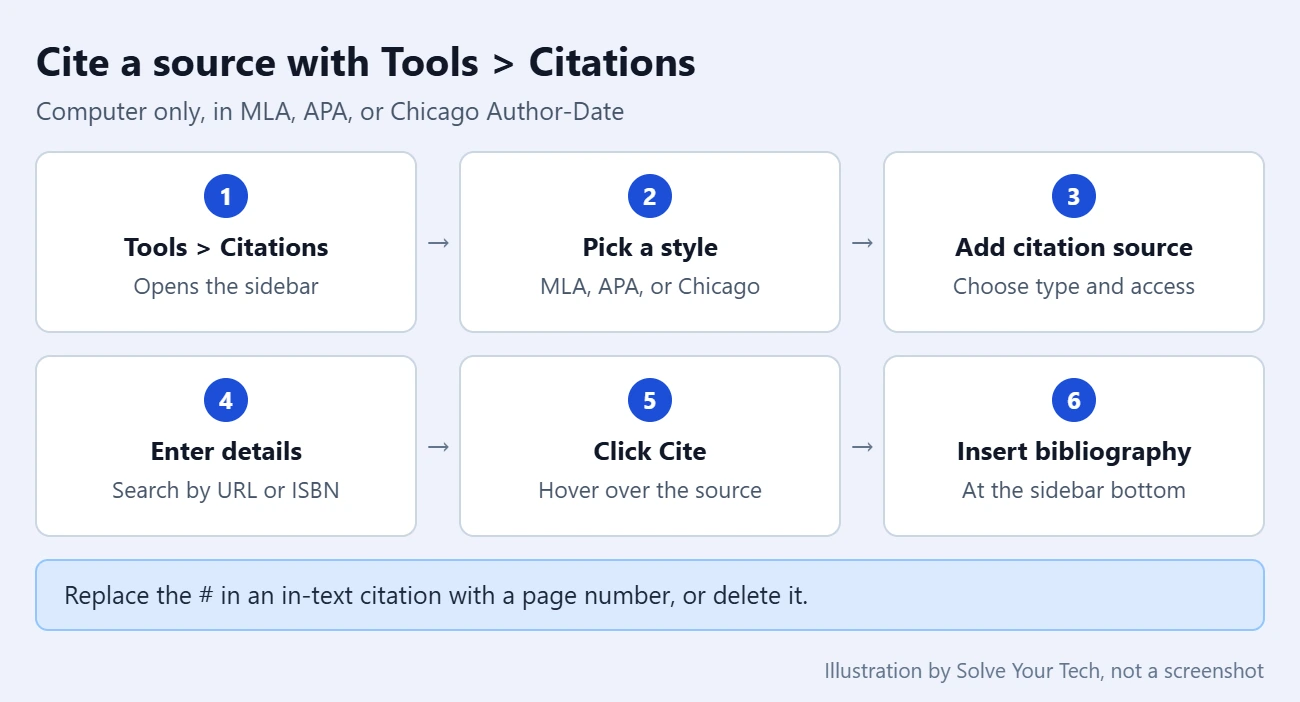
A citation is a short reference in your text that points to a source, and a bibliography is the full list of those sources at the end. The Citations tool stores your sources in a sidebar and formats both for you in MLA (8th edition), APA (7th edition), or Chicago Author-Date (17th edition). Google documents the process in its Add citations and a bibliography help page.
- Open your document in Google Docs on a computer and click Tools > Citations. A Citations sidebar opens on the right.
- In the sidebar, choose your formatting style: MLA, APA, or Chicago Author-Date. Use the style your teacher or publisher requires.
- Click + Add citation source.
- Select the source type, such as a book or website, and then select how you accessed it.
- Fill in the source details. For a website or online newspaper you can search by URL, and for a book you can search by ISBN, so that Docs fills in what it can find. Recommended fields are marked with a blue asterisk. Click + Contributor to add more than one author.
- Click Add citation source. The source now appears in the sidebar list.
- In your document, click where the citation should go.
- In the sidebar, hover over the source and click the Cite button that appears. The in-text citation is inserted in your chosen style.
- If a # appears in the citation, replace it with the page number or delete it.
- When you finish writing, click where the source list belongs, then click Insert bibliography at the bottom of the sidebar.
Always check the details that Docs fills in from a URL or ISBN. Automatic lookups can miss an author or a date, and the citation is only as accurate as the fields in the sidebar.
How to Change or Remove a Source
Hover over the source in the Citations sidebar and click the Menu button that appears beside it. Choose Edit, change the fields, and click Save source at the bottom of the sidebar, or choose Delete to remove the source from the list. To take a citation or bibliography out of the document itself, select that text and delete it as you would any other text.
If You Need Footnotes Instead
The old Research tool cited pages as numbered footnotes. The Citations tool does not; it places citations in the text. If your style calls for notes at the bottom of the page, click Insert > Page elements > Footnote, or press Ctrl + Alt + F (Command + Option + F on a Mac), and type the source yourself. Our guide on how to add footnotes in Google Docs covers that in detail.
How to Search for a Website and Link to It
The Insert Link button in the old tool has a direct replacement. The link box in Google Docs accepts a search as well as an address, so you can find a page without opening another tab.
- Highlight the text you want to turn into a link, or click where the link should go.
- Click Insert > Link, or press Ctrl + K (Command + K on a Mac).
- Under Text, check the words that will be linked.
- Under Link, type a URL or type words to search for a website, then pick the page you want.
- Click Apply.
To undo it, click the linked text and choose Remove. Google describes these controls in Work with links & bookmarks, and we have a longer walkthrough on adding a hyperlink in Google Docs.
How to Find and Insert Images
- Click where the picture should appear.
- Click Insert > Image.
- Choose Stock & web. Google describes this option as the place to insert stock images, GIF files, stickers, and Google images.
- Search for a subject, select a picture, and click Insert.
The same menu also offers Upload from computer, Drive & Photos, Camera, and By URL, as listed in Google’s Insert or delete images & videos page. Finding a picture in a search does not give you the right to publish it. Check the license on the image’s source page before you use it in anything you share outside a classroom or your own notes.
How to Research With Gemini in Docs
Gemini is Google’s AI assistant, and in Docs it opens in a side panel much like the old research panel did. It is not free for everyone: Google says it requires an eligible Google Workspace or Google AI plan, or enrollment in Google Workspace Experiments.
- On a computer, open a document and click Ask Gemini at the top right.
- In the side panel, pick a suggested prompt or type your own question.
- To make Gemini look online, include a phrase such as Use Google Search or using web search in your prompt. Google’s Gemini in Docs help page says this wording is needed to get answers from the web.
- Read the response. If you want to keep it, click Insert to place the text in your document, or Copy to paste it yourself.
Two cautions apply before you rely on this. First, Google warns that Gemini can give inaccurate suggestions, so confirm every fact against the original source and cite that source, not the assistant. Second, the conversation is temporary. Google states that you lose your Gemini history when you refresh the browser, close and reopen the document, or go offline, so insert anything you want to keep.
Deep Research for Longer Reports
For a bigger project, eligible accounts can also run Deep Research from the same panel. Click Ask Gemini, click Tools > Deep Research at the bottom, and describe the topic. You then choose sources, which can include Web, Drive, Gmail, and Chat, review the research plan, and click Start research. According to Google’s Deep Research help page, the finished report opens as a new Google Doc with findings and citations and is saved to your Drive. It can take a while, and it continues in the background if you close the panel.
How to Look Up a Word
Explore could also define a word. In current Docs, select the word and press Ctrl + Shift + Y (Command + Shift + Y on a Mac). Google lists this shortcut as Open dictionary in its Google Docs keyboard shortcuts.
Troubleshooting
- There is no Research or Explore option under Tools. That is expected in current Google Docs. Use the replacements above. Google’s shortcut list still shows an Open Explore tool shortcut (Ctrl + Alt + Shift + I), but if pressing it does nothing, the tool is not in your account.
- Tools > Citations is missing. You are probably in the mobile app. Google says to open the document in Google Docs on a computer to use the citations tool.
- The menus are grayed out. You have view-only or comment-only access. Ask the owner for edit access, or click File > Make a copy and work in your own copy.
- There is no Ask Gemini button. Your account does not have an eligible plan, or, on a work or school account, your administrator has not made it available. This cannot be turned on from inside the document.
- The bibliography heading is in English. Google notes that the elements the citations tool generates appear only in English for now. You can translate them by hand after inserting them.
- Gemini answered without checking the web. Add Use Google Search to the prompt and send it again, or use the Retry with Google Search option under the response.
Frequently Asked Questions
Can I get the old Research tool back?
No. Google Docs has no setting, add-on switch, or menu option that restores the Research tool or the Explore sidebar that followed it. The same tasks are now split between the Citations tool, the link box, the image search, and Gemini.
Is there a research tool in the Google Docs mobile app?
The citations tool is not available in the Android or iPhone and iPad apps; Google directs you to a computer for it. Gemini does have an Ask Gemini button in the mobile app, but only on accounts with an eligible plan. Footnotes and links can be added in the app.
Does the Citations tool find sources for me?
No. It formats sources you already have. It can look up details when you give it a website URL or a book’s ISBN, but it does not search the web by topic the way the Research panel did. Find your sources in a browser tab or with Gemini, then add them to the sidebar.
How do I search inside my own document instead of the web?
Press Ctrl + F (Command + F on a Mac) and type the word, or click Edit > Find and replace for more options. See how to search for a word in Google Docs for the full steps.
Which citation styles does Google Docs support?
The Citations tool supports MLA (8th edition), APA (7th edition), and Chicago Author-Date (17th edition). For any other style, type the citations and source list by hand.
Next Step
Open the document you are working on, click Tools > Citations, and add the first source you have already used. Once your sources are in the sidebar, citing each one takes a single click, and the bibliography can be inserted at the end.

Matthew Burleigh is the founder, head writer, and editor of Solve Your Tech, which he launched in 2012. He has written technology tutorials since 2008 and worked in IT since 2003, including small-business support, IT management, and consulting. He holds Bachelor’s and Master’s degrees in Computer Science from Arizona State University.
Matthew writes practical guides for Windows, iPhone and iPad, Microsoft Office, Outlook, Google apps, and Android. Solve Your Tech’s guides are tested on current devices or checked against official product documentation, with clear steps, sources, and update dates.
Read more about Matthew and how Solve Your Tech writes and updates its guides, or report a correction.