To show the battery percentage on an iPhone, open Settings, tap Battery, and turn on Battery Percentage. On an iPhone with Face ID, the number then appears inside the battery icon at the top-right of the screen; on an iPhone with a Home button or an iPad, it appears next to the icon.
These steps cover iPhones running iOS 16 through iOS 26 and iPads running current iPadOS. They match Apple’s Show the battery percentage on your iPhone or iPad support article.
Before You Start
- Know which kind of iPhone you have. A Face ID iPhone (iPhone X and later, except the iPhone SE models) has no Home button and a notch or Dynamic Island at the top. A Home button iPhone (iPhone SE 2nd and 3rd generation, iPhone 8 and earlier) has a round button below the screen. The setting is the same, but the number sits in a different spot.
- Check your iOS version on a Face ID iPhone. The status bar option needs iOS 16 or later. On iPhone XR, iPhone 11, iPhone 12 mini, and iPhone 13 mini, it arrived in iOS 16.1. To see your version, go to Settings > General > About and look at iOS Version.
How to Turn On Battery Percentage
- Open the Settings app (the gray gear icon) on your Home Screen.
- Scroll down and tap Battery. The Battery screen opens with your charge level and usage chart.
- Turn on the Battery Percentage switch. It turns green.
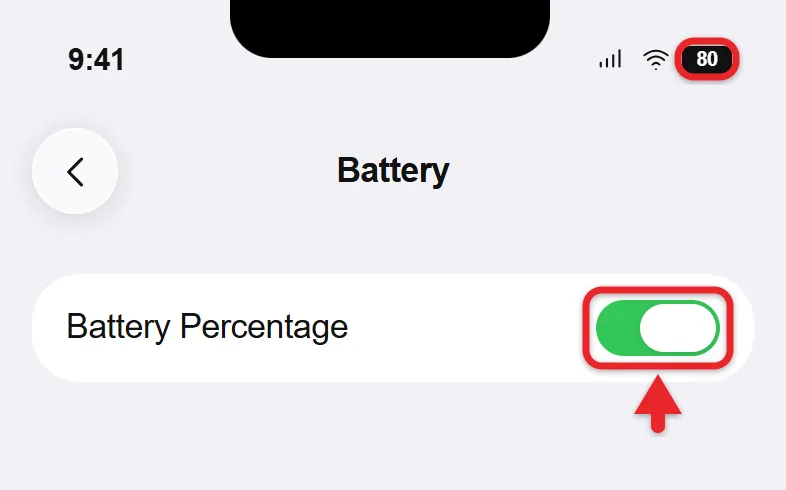
Look at the top-right corner of the screen. The battery level now shows as a number, such as 80, on every screen including the Lock Screen. On Face ID models, the number sits inside the battery symbol, which still shades to show roughly how full it is.
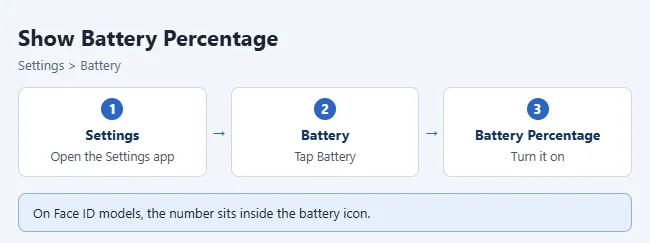
To hide the number again, go back to Settings > Battery and turn Battery Percentage off. The icon returns to a plain battery shape right away.
Where the Percentage Appears on Each Device
| Device | Where the number shows | Notes |
|---|---|---|
| iPhone with Face ID (iPhone X and later) | Inside the battery icon | Needs iOS 16 or later (iOS 16.1 on XR, 11, 12 mini, 13 mini) |
| iPhone with a Home button (SE 2nd/3rd gen, iPhone 8 and earlier) | Next to the battery icon | Turn on Battery Percentage if it’s missing |
| iPad (all models) | Next to the battery icon | Same switch in Settings > Battery |
Show Battery Percentage on an iPad
- Open Settings on the iPad.
- Tap Battery.
- Turn on Battery Percentage.
The number appears next to the battery icon at the top-right of the screen. Apple’s iPad battery guide covers the same switch, and the Batteries widget works on iPad too.
Android phones use a different menu. Here’s how to show battery percentage on a Google Pixel.
Other Ways to Check Your Battery Level
These options are useful if you prefer the plain icon in the status bar, or if your Face ID iPhone runs a version older than iOS 16.
Control Center
On an iPhone with Face ID, swipe down from the top-right corner of the screen, near the battery icon. Control Center opens and shows the exact percentage at the top-right, even if the status bar switch is off. This works from the Lock Screen too. On an iPhone with a Home button, swipe up from the bottom edge.
Batteries widget on the Home Screen
The Batteries widget shows your iPhone’s charge plus connected accessories such as AirPods and Apple Watch. These steps follow Apple’s guide to adding widgets.
- Touch and hold an empty spot on the Home Screen until the apps jiggle.
- Tap Edit in the upper-left corner, then tap Add Widget.
- Search for Batteries and tap it.
- Swipe to choose a size, then tap Add Widget.
- Tap Done.
The widget appears on the Home Screen with each device’s percentage. You can add the same widget to Today View, the screen you reach by swiping right from the first Home Screen page.
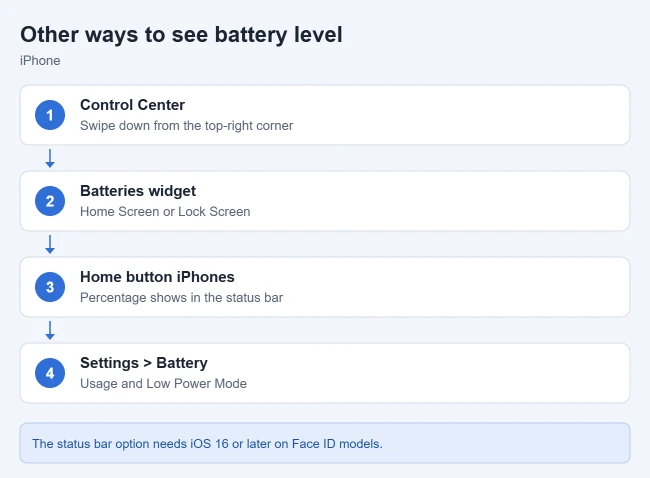
Batteries widget on the Lock Screen
- Touch and hold the Lock Screen until Customize appears, then tap it.
- Choose the Lock Screen, then tap Add Widgets.
- Tap Batteries and pick a widget to add it.
- Tap Done.
Plug it in or ask Siri
When you connect a charger, the Lock Screen briefly shows the current percentage. You can also ask Siri, “What’s my battery level?” and it answers with the number.
Battery Percentage Not Showing? Fixes
- There’s no Battery Percentage switch. Your Face ID iPhone is on iOS 15 or earlier. Update it in Settings > General > Software Update. Until then, use Control Center or the Batteries widget.
- The switch is on, but no number appears. Restart the iPhone, then check Settings > Battery again. On a Home button iPhone, make sure you’re looking to the left of the icon.
- The battery icon is yellow. Low Power Mode is on. The percentage still works. Here are the steps to turn Low Power Mode on or off.
- Charging stops at 80%. On iPhone 15 and later, check Settings > Battery > Charging, where you can set a charge limit between 80% and 100%. Optimized Battery Charging can also pause charging at 80% overnight. Both are normal.
- The charging icon is gray. Apple uses a gray charging icon to show that charging is paused for now.
Battery Percentage vs. Battery Health
The number in the status bar is your current charge. It is not the same as Maximum Capacity in battery health, which estimates how much charge the battery can hold compared with when it was new. A phone can read 100% charge with a worn battery. To see the second number, check iPhone battery health.
Frequently Asked Questions
Does showing the percentage use more battery?
Apple doesn’t list it as a factor in battery life. It only changes how the existing battery icon is drawn.
Can I see the percentage on the Lock Screen?
Yes. Once Battery Percentage is on, the number shows in the status bar on the Lock Screen too. You can also add a Batteries widget to the Lock Screen.
Why did my iPhone stop showing the percentage after an update?
Updates usually keep the setting, but check Settings > Battery and turn Battery Percentage back on if it’s off.
Can I see my AirPods or Apple Watch battery too?
Yes. The Batteries widget lists connected accessories with their own percentages. For case and earbud details, read about checking AirPods battery life.
Can I change the size or color of the number?
No. iOS doesn’t offer a setting for the percentage’s font or color. The larger Batteries widget is the best option if you want a bigger readout.

Matthew Burleigh is the founder, head writer, and editor of Solve Your Tech, which he launched in 2012. He has written technology tutorials since 2008 and worked in IT since 2003, including small-business support, IT management, and consulting. He holds Bachelor’s and Master’s degrees in Computer Science from Arizona State University.
Matthew writes practical guides for Windows, iPhone and iPad, Microsoft Office, Outlook, Google apps, and Android. Solve Your Tech’s guides are checked step by step against the device or app maker’s own documentation and tested on his own devices whenever he has the hardware or software, with clear steps, sources, and update dates.
Read more about Matthew and how Solve Your Tech writes and updates its guides, or report a correction.