To show the battery percentage on the Windows 11 taskbar, open Settings > System > Power & battery and turn on Battery percentage. The number then sits next to the battery icon at the bottom-right of the screen, and the change takes effect right away without a restart.
This covers Windows 11 laptops and tablets running version 24H2, 25H2, or 26H2 with the October 2025 update or anything newer. If the switch isn’t on your PC yet, the sections below explain why and show other ways to check your charge.
What You Need
- A PC with a battery. Laptops, 2-in-1s, and tablets qualify. A desktop tower has no battery, so its Settings page is named Power and has no battery options.
- A current Windows 11 build. The switch came with Microsoft’s redesigned battery icons. Microsoft’s October 28, 2025 update notes (KB5067036) introduced it for builds 26100.7019 (24H2) and 26200.7019 (25H2), and later updates, including version 26H2, keep it.
- No extra software. You don’t need a Microsoft Store app, ViVeTool, or a registry edit. Those workarounds date from early Insider testing.
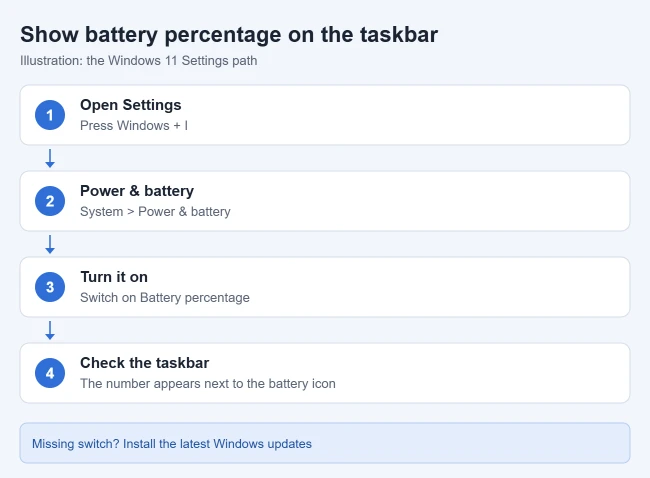
How to Show Battery Percentage on the Taskbar
- Press Windows + I to open Settings. You can also click Start and select Settings.
- Select System in the left pane.
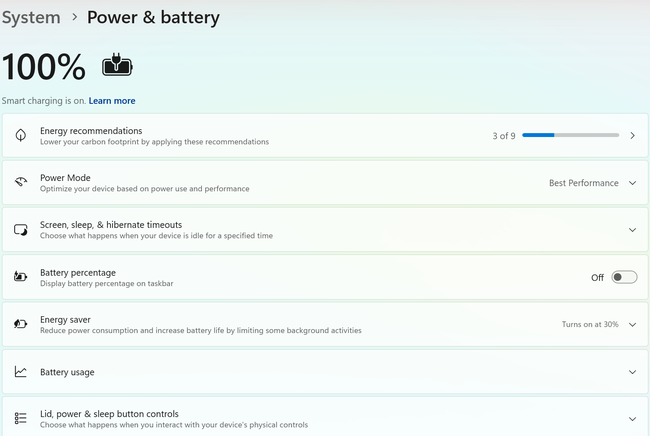
- Select Power & battery on the right. The page opens with your current charge level shown in large numbers at the top.
- Turn on Battery percentage. You may need to scroll down the page to find it. The number appears next to the battery icon in the system tray, the group of icons beside the clock, as soon as the switch is on.
For other ways to reach step 1, such as the Run box or the Start menu search, there’s a list of every way to open Settings in Windows 11.
Confirm It Worked or Turn It Off
Look at the bottom-right corner of the taskbar. You should see a number such as 87% beside the battery icon. If you moved the taskbar to the top or a side of the screen, the icon and the number move with it.
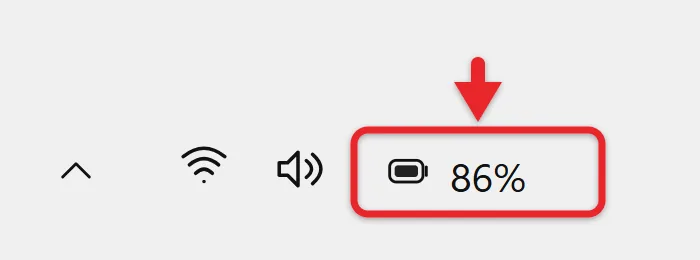
To hide the number again, return to Settings > System > Power & battery and turn Battery percentage off. The battery icon stays, and hovering over it still shows the exact level.
If You Don’t See the Battery Percentage Switch
Work through these checks in order:
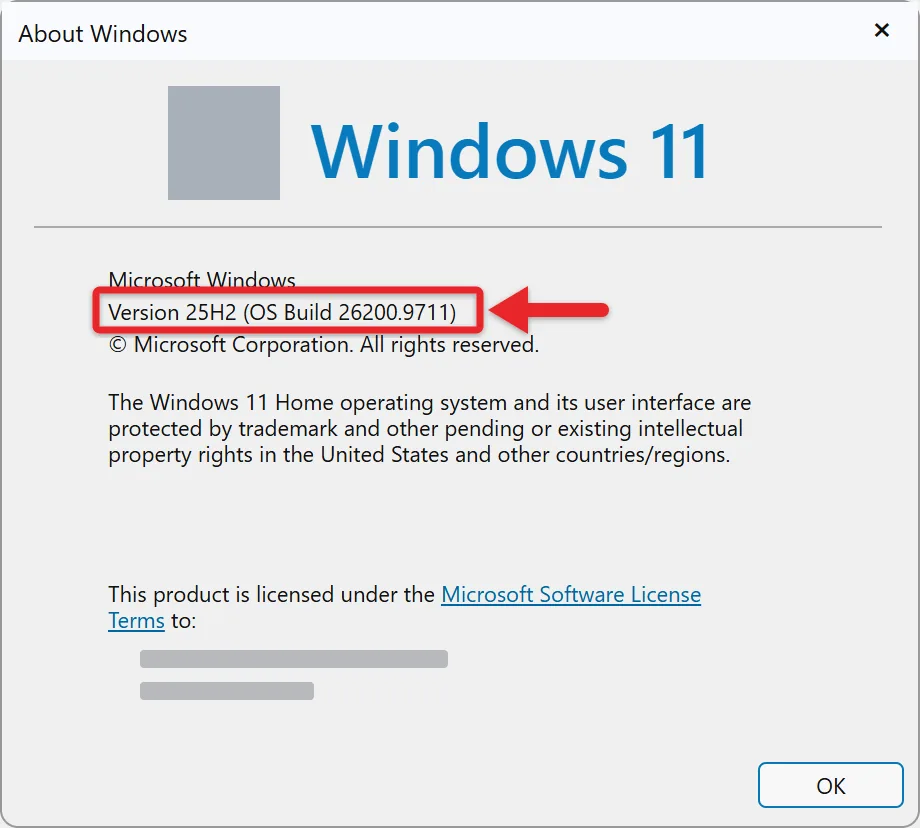
- Check your build. Press Windows + R, type
winver, and press Enter. If the OS build is lower than 26100.7019 or 26200.7019, your PC doesn’t have the switch yet.
- Install updates. Open Settings > Windows Update, select Check for updates, install everything offered, and restart. Microsoft releases new features to PCs in stages, so a fully updated PC can still get a feature a little later than others.
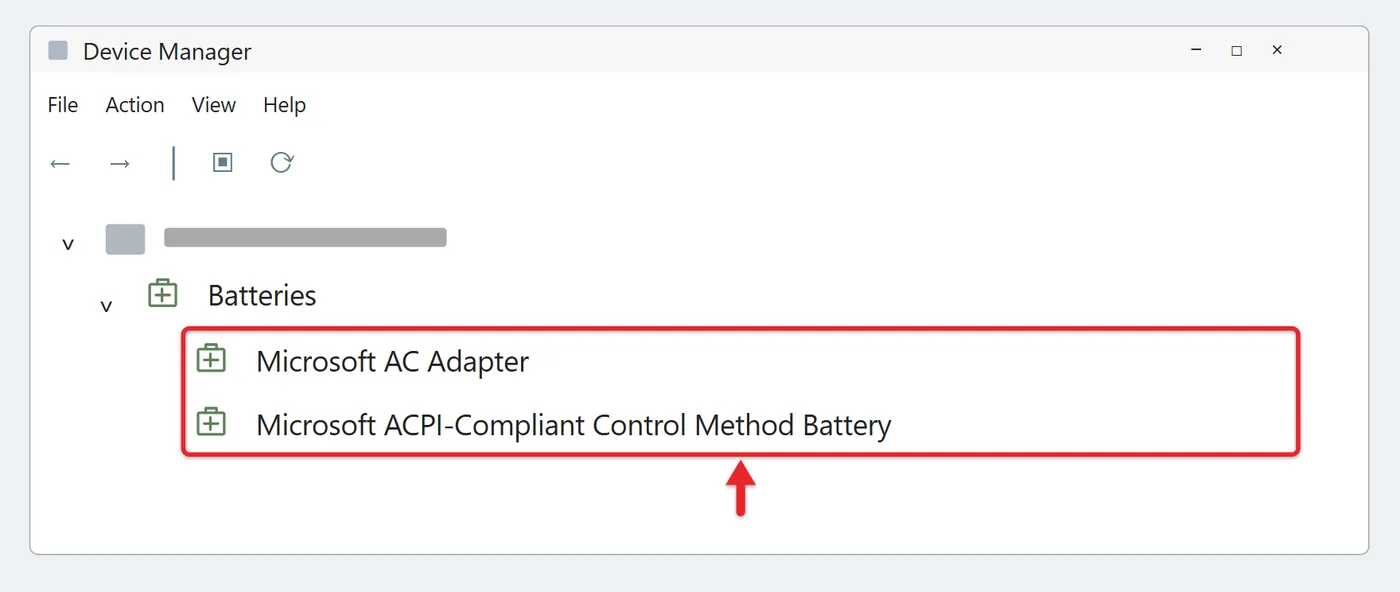
- Confirm Windows sees a battery. Right-click Start, select Device Manager, and expand Batteries. A laptop normally lists Microsoft AC Adapter and Microsoft ACPI-Compliant Control Method Battery. If the battery entry is missing or shows a warning icon, install the driver and firmware updates from your PC maker’s support site.
- Ask your IT department. On a work or school PC, your organization can control updates and taskbar settings, so the switch may arrive later or be hidden.
What the Battery Icon Colors Mean
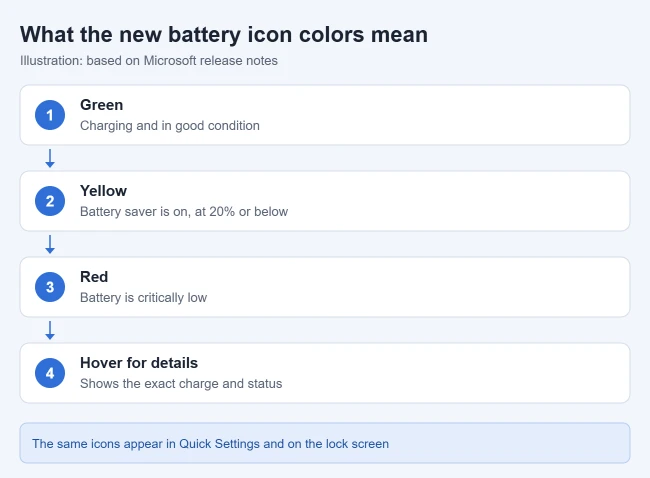
The same update redesigned the battery icon so you can read its state at a glance. Microsoft describes the colors this way in its Windows Insider announcement of the new icons and the KB5067036 notes:
| Icon color | What it means | What to do |
|---|---|---|
| Green | The PC is charging and the battery is in good condition. | Nothing. |
| Yellow | Energy saver is on because the charge is at 20% or below. | Plug in soon, or close demanding apps. |
| Red | The battery is critically low. | Plug in as soon as possible. |
The new icons appear in the system tray, in Quick Settings, and in Settings. Microsoft also says the icon, with its color and percentage, now shows in the lower-right corner of the lock screen, so you can check the charge before you sign in.
To choose which other icons stay next to the clock, customize the Windows 11 taskbar.
The yellow state follows your energy saver setting. To have energy saver start at a different level, change the battery saver threshold.
Other Ways to Check Your Battery Level
These work on every Windows 11 laptop, including PCs that don’t have the switch yet:
- Hover over the icon. Point at the battery icon on the taskbar. A small box shows the percentage and, when Windows can estimate it, the time remaining.
- Open Quick Settings. Press Windows + A, or click the battery, network, or volume icon. The battery level shows in the lower-left corner of the panel.
- Use the Settings page. The top of System > Power & battery shows the current charge, and Battery usage on the same page shows which apps use the most power.
- Run a battery report. For battery health rather than charge level, open Terminal and run
powercfg /batteryreport. Windows saves an HTML report in the folder shown in the window, as Microsoft’s powercfg reference explains. To read the report, follow the steps for checking battery health in Windows 11.
Want the same number on your phone? Learn how to show battery percentage on a Pixel.
Troubleshooting
- The switch is on, but no number appears. Press Ctrl + Shift + Esc to open Task Manager, find Windows Explorer under Processes, right-click it, and select Restart. The taskbar disappears for a moment and reloads. If that doesn’t fix it, restart the PC.
- The number disappears after an update or after sleep. Open Power & battery and check that the switch is still on. Then restart Windows Explorer as described above and install any newer updates.
- The battery icon is missing completely. Restart the PC first. If it’s still gone, check Device Manager > Batteries as described in the missing-switch section.
- The percentage looks wrong or jumps. Charge the laptop to 100%, then watch it for a while on battery. A battery report shows whether full-charge capacity has dropped well below the design capacity, which is a sign of an aging battery.
Related Battery Settings
- To make a charge last longer, learn how to extend battery life in Windows 11.
- To protect the battery by stopping at 80%, limit battery charge to 80%.
- To change when the screen turns off or the PC sleeps, adjust your power and sleep settings.
Frequently Asked Questions
Is the battery percentage on by default?
No. Windows 11 shows the battery icon by default, but the number stays off until you turn on Battery percentage.
Why does my battery icon show a plug?
A plug on the icon means the laptop is connected to power. With Battery percentage turned on, the number still shows beside it while the battery charges.
Can I show the time remaining on the taskbar instead?
No. The taskbar shows only the percentage. Hover over the battery icon to see Windows’ estimate of the time remaining.
Does showing the percentage use more battery?
No. It only changes what the taskbar displays. Screen brightness, running apps, and your power mode have far more effect on battery life.
Can I show the percentage on Windows 10?
No. Windows 10 doesn’t have this switch. Hover over the battery icon, or open Settings > System > Battery, to see the level.
Next, if your battery drains faster than it used to, run a battery report to see how much capacity it has left.

Matthew Burleigh is the founder, head writer, and editor of Solve Your Tech, which he launched in 2012. He has written technology tutorials since 2008 and worked in IT since 2003, including small-business support, IT management, and consulting. He holds Bachelor’s and Master’s degrees in Computer Science from Arizona State University.
Matthew writes practical guides for Windows, iPhone and iPad, Microsoft Office, Outlook, Google apps, and Android. Solve Your Tech’s guides are checked step by step against the device or app maker’s own documentation and tested on his own devices whenever he has the hardware or software, with clear steps, sources, and update dates.
Read more about Matthew and how Solve Your Tech writes and updates its guides, or report a correction.