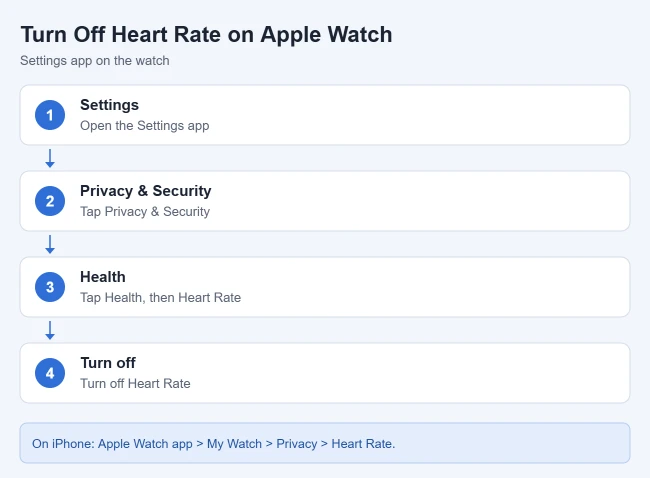
To turn off heart rate tracking on Apple Watch, open Settings on the watch, tap Privacy & Security > Health > Heart Rate, and turn off Heart Rate. You can also do it in the Apple Watch app on your iPhone under My Watch > Privacy. This stops heart rate data for the Heart Rate app, workouts, and Breathe and Reflect sessions.
This guide covers the main setting, the iPhone route, what changes when it’s off, and three other Apple-documented ways to limit heart rate readings: Low Power Mode, Continuous Measurements on newer models, and Wrist Detection. Everything here comes from Apple’s Heart Rate guide, its Monitor your heart rate with Apple Watch and Low Power Mode article articles, and If your Apple Watch locks unexpectedly (all current for watchOS 27).
How to Turn Off Heart Rate Tracking on Apple Watch
- Open Settings on your Apple Watch.
- Tap Privacy & Security.
- Tap Health, then Heart Rate.
- Turn off Heart Rate.
Result: the watch stops collecting heart rate data. Apple says that by default the watch monitors your heart rate for the Heart Rate app, workouts, and Breathe and Reflect sessions, so those are what you give up. Follow the same steps and turn it back on any time.
Turn it off from your iPhone
Open the Apple Watch app on your iPhone, tap My Watch > Privacy, and turn off Heart Rate. Apple lists this as the iPhone equivalent of the watch setting.
What You Lose When It’s Off
- Heart rate during workouts and in the Heart Rate app.
- Heart rate readings during Breathe and Reflect sessions.
- New heart rate readings for the Heart Rate app’s daily graphs (range, resting rate and walking average).
If what bothers you is the alerts rather than the tracking, you may not need to turn heart rate off at all. Apple notes that high, low and irregular rhythm notifications are something you turn on separately, so you can manage those on their own.
Other Ways to Limit Heart Rate Readings
Low Power Mode
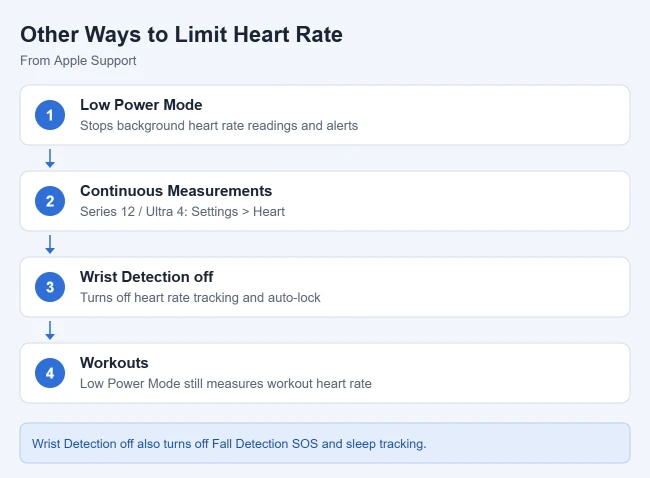
According to Apple’s Low Power Mode article, Low Power Mode turns off background heart rate measurements (including during sleep), heart rate notifications for irregular rhythm, high heart rate and low heart rate, and collection of heart data for hypertension notifications. Workouts still measure heart rate in Low Power Mode. Turn it on from Control Center by pressing the side button and tapping the battery percentage, or in Settings > Battery. Apple says it turns off automatically at 80% charge unless you picked a number of days.
Continuous Measurements (Series 12 and Ultra 4)
Apple says Apple Watch Series 12 and Apple Watch Ultra 4 use green LEDs throughout the day to measure as often as every five seconds. To turn that off, open Settings > Heart on the watch and turn off Continuous Measurements, or use the Apple Watch app on your iPhone under Apps > Heart.
Wrist Detection (not recommended)
Turning off Wrist Detection in Settings > Passcode also turns off heart rate tracking and notifications. But Apple lists a lot of other losses: your watch won’t lock or unlock automatically, Fall Detection won’t automatically start Emergency SOS, sleep tracking is unavailable, and blood oxygen and noise measurements stop.
Frequently Asked Questions
Does turning off heart rate save battery?
Apple doesn’t give a figure for the heart rate setting alone. For battery savings, it documents Low Power Mode, which turns off background heart rate measurements along with other features such as the Always On display.
How do I turn heart rate tracking back on?
Apple’s Turn on heart rate data steps are the same path: Settings > Privacy & Security > Health > Heart Rate, then turn on Heart Rate. Or use the Apple Watch app on your iPhone under My Watch > Privacy.
Related Guides
- How to turn on Low Power Mode on Apple Watch
- How to turn off Activity notifications on Apple Watch
- How to manage your Apple Watch passcode and Wrist Detection
- How to find your Apple Watch serial number

Matthew Burleigh is the founder, head writer, and editor of Solve Your Tech, which he launched in 2012. He has written technology tutorials since 2008 and worked in IT since 2003, including small-business support, IT management, and consulting. He holds Bachelor’s and Master’s degrees in Computer Science from Arizona State University.
Matthew writes practical guides for Windows, iPhone and iPad, Microsoft Office, Outlook, Google apps, and Android. Solve Your Tech’s guides are tested on current devices or checked against official product documentation, with clear steps, sources, and update dates.
Read more about Matthew and how Solve Your Tech writes and updates its guides, or report a correction.