In the Netflix iPhone app, Save Data lowers video quality so you can watch about 6 hours per GB of cellular data, while Maximum Data streams at the highest quality and can use 1 GB every 20 minutes or more. To change it, tap My Netflix, tap your profile name, tap App Settings, and select Cellular Data Usage.
These steps match the current Netflix app on iPhone and iPad as described in the Netflix Help Center in October 2026, and the iPhone Settings steps match iOS 27 (iOS 26 and iOS 18 use the same Cellular screen). The figures come from Netflix’s How to control how much data Netflix uses and How to download using mobile data instead of Wi-Fi help articles.
Netflix Cellular Data Options Explained
Netflix lists four mobile data usage settings:
- Automatic: the app picks a setting that balances data use and video quality. You can watch about 4 hours per GB.
- Wi-Fi Only: streams only while you’re connected to Wi-Fi.
- Save Data: about 6 hours per GB.
- Maximum Data: the highest possible quality for your device and the show or movie. It can use 1 GB per 20 minutes or more, depending on your device and network speed. It’s recommended only if you have an unlimited data plan.

What Those Numbers Mean for Your Plan
Netflix gives its figures as hours per GB. Turned around into data per hour, and applied to a common 10 GB monthly plan, they look like this:
| Setting | Data per hour (approx.) | One 45-minute episode | Viewing on 10 GB |
|---|---|---|---|
| Save Data | About 0.17 GB | About 125 MB | About 60 hours |
| Automatic | About 0.25 GB | About 190 MB | About 40 hours |
| Maximum Data | 3 GB or more | 2.25 GB or more | About 3 hours or less |
| Wi-Fi Only | No cellular data | No cellular data | No cellular data |
These are Netflix’s own estimates worked out by hand, not a guarantee. Real use changes with the show, your iPhone model, and your signal, and some independent tests have measured more data than Netflix’s figures. Treat the table as a rough budget and check your actual use in Settings, as shown later in this guide.
Which Setting Should You Pick?
- Small or capped plan: choose Save Data, or Wi-Fi Only if you’d rather not stream on cellular at all.
- Medium plan, mostly casual viewing: Automatic is a sensible middle ground.
- Truly unlimited plan: Maximum Data gives the sharpest picture. Many “unlimited” plans slow your speed after a set amount of use each month, so check your carrier’s terms before you leave it on.
- Travel or roaming: use Wi-Fi Only and download shows before you leave.
On a phone-sized screen, the drop in sharpness on Save Data is often easy to live with, especially for talk-heavy shows. It’s more noticeable on an iPad or when you watch fast action scenes.
How to Change the Netflix Cellular Data Setting on iPhone
- Open the Netflix app.
- Tap My Netflix in the lower right.
- Tap your profile name at the top.
- Tap App Settings.
- Under Video Playback, tap Cellular Data Usage.
- Turn off Automatic if needed, then choose Wi-Fi Only, Save Data or Maximum Data. Tap OK if prompted.
Your choice is now selected on that screen, and it applies the next time you stream away from Wi-Fi. The steps are the same on an iPad with cellular service.
You can’t change this setting while Automatic is on or while downloads are pending. If your choice is grayed out, turn off Automatic, or cancel or finish pending downloads, then try again.
If the app isn’t on your phone yet, follow how to set up Netflix on an iPhone first, then come back to App Settings.

How to Confirm It Worked
Go back to App Settings > Cellular Data Usage and check that the right option is selected. Then, after a day or two of normal viewing, compare Netflix’s total in your iPhone’s cellular data list (see “How to Check How Much Data Netflix Is Using” below). To undo the change, return to the same screen and turn Automatic back on.
How to Control Data for Netflix Downloads
Downloads have their own setting. In App Settings, under Downloads, turn Wi-Fi Only on to make downloads wait for Wi-Fi, or off to allow downloads over cellular.
If you see a “Waiting for Wi-Fi” message and want to download anyway, select Download Settings from the message and turn off Wi-Fi Only. The download won’t start right away, so tap the Downloads icon, then Download. Turn Wi-Fi Only back on afterward if you don’t want future downloads to use cellular data.
Downloading over Wi-Fi before you leave is the easiest way to save data, because a downloaded show plays without any internet connection. Start by downloading Netflix episodes to your iPhone while you’re on Wi-Fi.
Disney+ Premium subscribers can also download a movie in Disney Plus on an iPhone before a trip.
Choose the Download Video Quality
Netflix’s download video quality article says you can pick how large each download is:
- In the Netflix app, tap My Netflix, then tap your profile name.
- Tap App Settings.
- Tap Download Video Quality (on some versions it’s labeled Video Quality).
- Choose Standard or High (some versions say Higher).
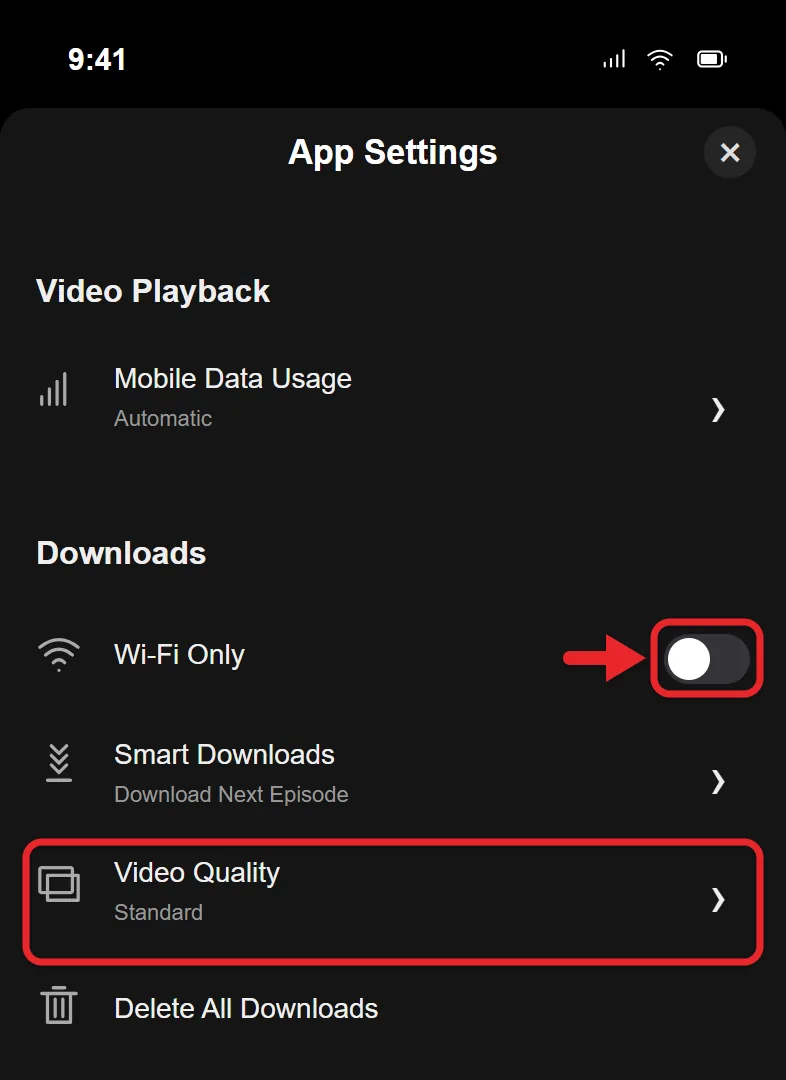
Standard downloads faster, uses less storage, and plays in standard definition. High takes longer, uses more storage, and plays at up to 1080p HD. If you ever download over cellular, Standard uses less of your plan.
Downloaded videos also take up storage. Disney Plus is no different, and you can check how much space its downloads use on an iPhone.
Smart Downloads
On iPhone and iPad, Netflix’s Smart Downloads can delete an episode you finished and download the next one (Download Next Episode), or download titles Netflix thinks you’ll like (Downloads for You). You’ll find both under App Settings > Downloads > Smart Downloads. The feature isn’t available on ad-supported plans.
Netflix’s help page doesn’t say whether automatic downloads skip cellular data. On a small plan, keep Wi-Fi Only turned on under Downloads, and turn Smart Downloads off if Netflix’s data total keeps climbing.
Turn Off Autoplay Previews
Trailers that play while you browse use data too. Netflix’s autoplay previews article gives these steps for iPhone:
- Tap My Netflix, then tap your profile name at the top.
- Tap Manage Profiles and select your profile.
- Turn off Autoplay Previews, then tap Done.
The setting is per profile, so repeat it for each profile that watches on cellular. iPads don’t support preview autoplay.
Account-Wide Data Usage Settings
Netflix also has a per-profile data setting you change in a web browser: go to your Account page, select Profiles, choose a profile, and select Playback settings. The available levels are:
- Low: basic video quality, up to 0.3 GB per hour.
- Medium: standard video quality, up to 0.7 GB per hour.
- High: best video quality, up to 1 GB per hour for standard definition, 3 GB for HD and 7 GB for 4K.
- Auto: adjusts to give the highest quality your connection allows.
The change saves automatically. Once this account data usage is set, streaming on mobile devices won’t exceed it. That makes it a useful backstop: for example, a profile set to Low won’t use more than about 0.3 GB per hour on any device, even if someone picks Maximum Data in the app.
Use iPhone Settings to Save More Data
The Netflix setting only covers Netflix. These iPhone settings add another layer.
Turn On Low Data Mode
Apple’s Low Data Mode article says the setting limits background network use, turns off Background App Refresh, and lowers streaming quality.
- Open Settings and tap Cellular.
- Tap Cellular Data Options.
- On an LTE plan, turn on Low Data Mode. On a 5G plan, tap Data Mode, then select Low Data Mode.
On a Dual SIM iPhone, tap the line you want under Cellular and turn on Low Data Mode there. In some regions the menu is called Mobile Data or Mobile Service instead of Cellular.
Watch Out for Personal Hotspots
If your iPhone joins another phone’s hotspot over Wi-Fi, that connection can count as Wi-Fi to Netflix, so the Wi-Fi Only setting may not stop it from using the other phone’s data. Apple lets you turn on Low Data Mode for a specific Wi-Fi network: go to Settings > Wi-Fi, tap the info button next to the hotspot, and turn on Low Data Mode. Choosing Save Data before you stream also helps.
How to Check How Much Data Netflix Is Using
- Open Settings and tap Cellular.
- Scroll down to the list of apps. The number under Netflix is the cellular data it has used in the current period.

- To start a fresh count, scroll to the bottom and tap Reset Statistics.
Apple’s cellular data usage article explains that the current period runs from the last reset, not from your billing date. Reset it on the first day of your billing cycle so the number lines up with your plan. Your carrier’s own figures are the ones that count for billing.
How to Stop Netflix From Using Cellular Data Completely
- Set Cellular Data Usage to Wi-Fi Only in the Netflix app.
- Turn on Wi-Fi Only under Downloads.
- For a system-wide block, open your iPhone’s Settings > Cellular, scroll to the list of apps, and turn Netflix off. When cellular data is off for an app, iPhone uses only Wi-Fi for it (the details are in Apple’s cellular data settings guide).
With step 3 in place, your iPhone shows a message that cellular data is turned off for Netflix when you open it away from Wi-Fi, and downloaded titles still play. The same switch works for other apps, for example when you turn off cellular data for YouTube on your iPhone.
When the Options Are Grayed Out
- The options are grayed out: turn off Automatic first, and cancel or finish any pending downloads.
- Netflix still uses a lot of data on Save Data: check that the right profile is open, since other people on the account may stream on the same phone. Then look at the Netflix total in Settings > Cellular after a reset.
- Netflix won’t play at all away from Wi-Fi: Wi-Fi Only is selected in the app, or Netflix’s switch is off in Settings > Cellular. Change either one back if you want to stream on cellular.
- The video looks blurry: Save Data or a Low playback setting on your account is doing its job. Pick Automatic, or raise the profile’s Playback settings in a browser.
- There’s no Cellular Data Usage option: update the Netflix app from the App Store, then look again under App Settings > Video Playback. A Wi-Fi-only iPad has no cellular settings.
Netflix Data Setting Questions
Is Save Data or Maximum Data better?
It depends on your plan. Save Data uses less data with lower quality. Maximum Data gives the best picture but can use 1 GB per 20 minutes or more, so it’s recommended only with unlimited data.
Why can’t I change Cellular Data Usage?
Turn off Automatic, or wait for pending downloads to finish. The setting can’t be changed while either one applies.
How much data does Netflix use on Automatic?
About 4 hours per GB, which works out to roughly 250 MB per hour.
Does Wi-Fi Only affect downloads?
No. Downloads have a separate Wi-Fi Only switch under Downloads in App Settings.
Does Save Data change my Netflix plan?
No. It only changes the quality Netflix streams over cellular on that device. Your plan, price, and Wi-Fi quality stay the same.
Do downloaded shows use data when I watch them?
No. Once a title has finished downloading, it plays without an internet connection, so watching it uses no cellular data.
For more ways to save data across your whole phone, see 10 ways to reduce cellular data usage on an iPhone. Watching on a tablet instead? Here’s how to watch Netflix on an iPad.
More Netflix guides: how to sign out of Netflix on iPhone.
Disney+ has a similar setting that lets you use less data when streaming Disney+ on an iPhone.
Pandora has a similar trade-off between sound and data. Higher quality uses more data, so keep your plan in mind before you increase audio quality in Pandora on an iPhone.

Matthew Burleigh is the founder, head writer, and editor of Solve Your Tech, which he launched in 2012. He has written technology tutorials since 2008 and worked in IT since 2003, including small-business support, IT management, and consulting. He holds Bachelor’s and Master’s degrees in Computer Science from Arizona State University.
Matthew writes practical guides for Windows, iPhone and iPad, Microsoft Office, Outlook, Google apps, and Android. Solve Your Tech’s guides are checked step by step against the device or app maker’s own documentation and tested on his own devices whenever he has the hardware or software, with clear steps, sources, and update dates.
Read more about Matthew and how Solve Your Tech writes and updates its guides, or report a correction.