An orange tint on your iPhone screen is almost always Night Shift, a feature that shifts the display to warmer colors from sunset to sunrise. To turn it off, open Control Center, touch and hold the brightness slider, and tap Night Shift. If the screen still looks warm, True Tone or a Color Filter is the likely cause.
These steps apply to iOS 27 and recent earlier versions of iOS, on any iPhone that runs them. They follow Apple’s Use Night Shift on your iPhone, Adjust the screen brightness and color on iPhone, Change display colors on iPhone and display and text size pages. A small orange dot near the clock is a different thing, covered further down.
Why your iPhone screen looks orange
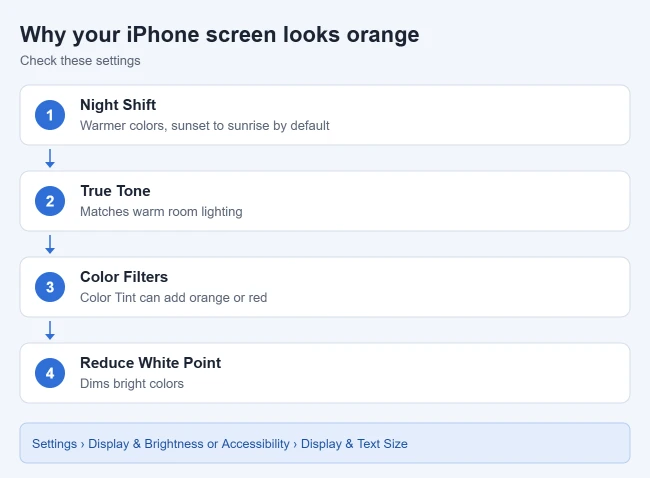
- Night Shift: Apple says it uses your clock and location to find sunset, then shifts colors to the warmer end of the spectrum until morning. By default it runs from sunset to sunrise.
- True Tone: adapts the color and intensity of the display to match the light around you, so the screen looks yellow under warm indoor lights.
- Color Filters: an accessibility setting. The Color Tint filter can tint the whole screen any color, including orange or red.
- Reduce White Point: tones down bright colors, which can make white look dull or warm.
Find the cause in 30 seconds
When the tint shows up tells you which setting to check first.
| What you notice | Most likely cause | Where to fix it |
|---|---|---|
| Orange in the evening, normal in the morning | Night Shift on a schedule | Settings > Display & Brightness > Night Shift |
| Orange all day, starting at a random moment | Night Shift turned on by hand, or a Color Tint filter | Control Center, then Accessibility > Display & Text Size |
| Yellowish only indoors under warm lamps | True Tone | Settings > Display & Brightness |
| Whites look dim and slightly warm all the time | Reduce White Point | Accessibility > Display & Text Size |
| Orange only inside one app | That app’s own reading or eye-comfort theme | The app’s settings |
| Orange in one corner or band, or after a drop | Display damage | Apple Support |
A quick test helps separate a display setting from a hardware problem. Night Shift, True Tone and color filters change how the screen shows colors, not the image itself, so a screenshot isn’t tinted. Take a screenshot and send it to another device. If it looks normal there, the cause is a setting on your iPhone.
How to turn off Night Shift
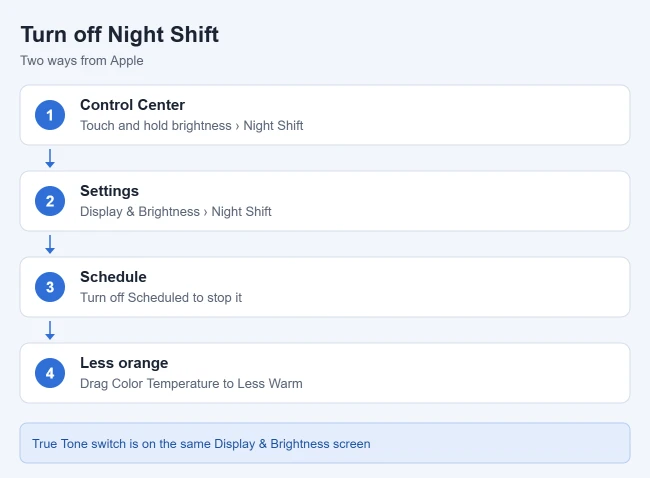
- Open Control Center: swipe down from the top-right corner, or up from the bottom on an iPhone with a Home button.
- Touch and hold the brightness slider.
- Tap the Night Shift button to turn it off.
The screen goes back to normal colors right away. If Night Shift is scheduled, it will turn on again at the next scheduled time. To change those hours, read about the Night Shift settings on iPhone.
If the brightness slider doesn’t show a Night Shift button when you hold it, open Control Center by swiping from the top-right corner and not the top center, which opens notifications instead. For the gestures on each model, read about using Control Center on iPhone.
How to stop Night Shift from turning on by itself
- Open Settings and tap Display & Brightness.
- Tap Night Shift.
- Turn off Scheduled. Or keep it on and tap From to pick Sunset to Sunrise or a Custom Schedule.
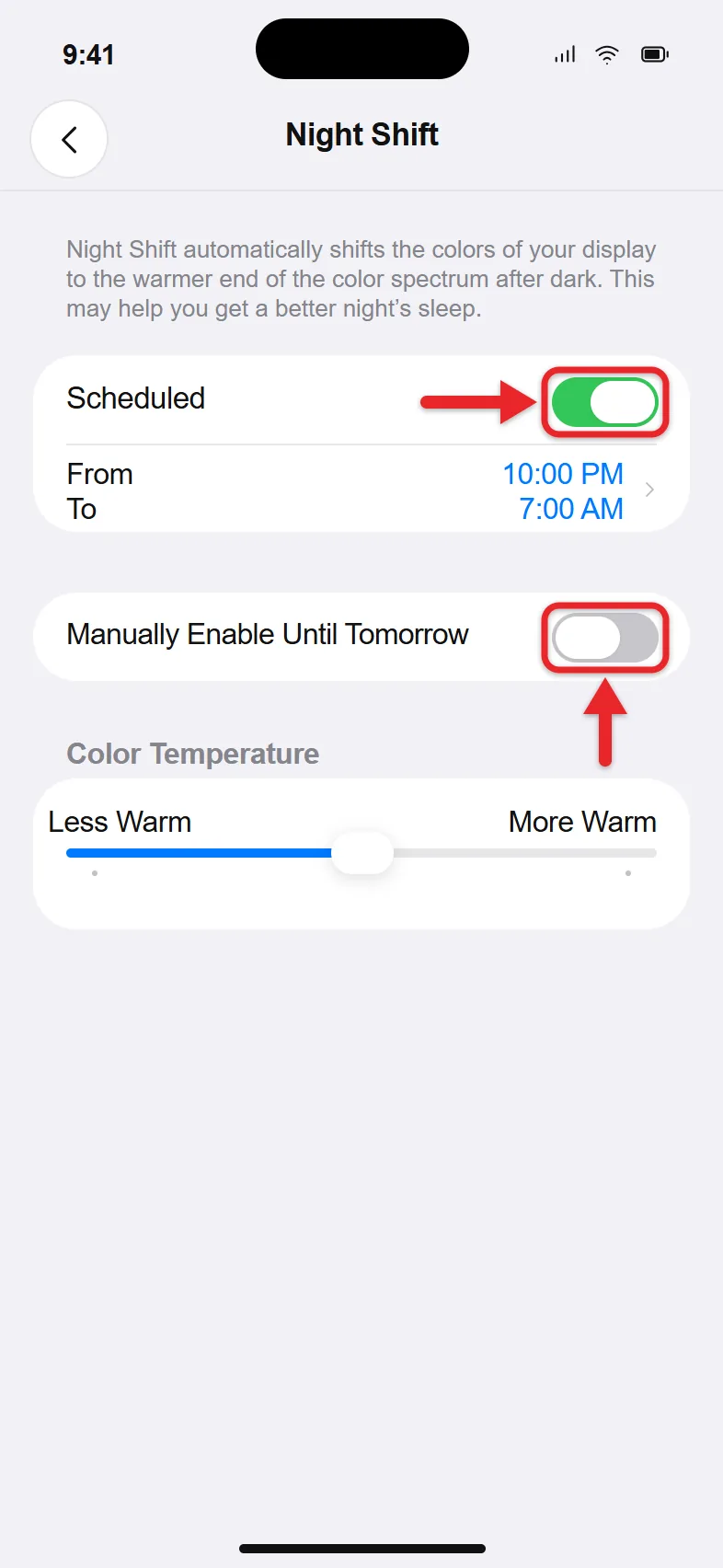
Night Shift no longer turns on automatically, or it only runs during the hours you chose. Sunset to Sunrise isn’t available if Location Services or Setting Time Zone is turned off.
On the same screen, check Manually Enable Until Tomorrow. If it is on, Night Shift stays on until the next morning even with Scheduled off, so turn it off too.
How to make Night Shift less orange
- Go to Settings › Display & Brightness › Night Shift.
- Drag the Color Temperature slider toward Less Warm.
Night Shift still runs on its schedule, but the tint is lighter. While you drag, the screen briefly previews the color. The slider sets one level for every Night Shift session, whether it starts on schedule or by hand.
This is a good middle ground if you like a warmer screen in bed but find the strongest setting too orange for reading or photos. Colors are less accurate while Night Shift is on, so turn it off before you edit pictures.
How to turn off True Tone
- Open Settings and tap Display & Brightness.
- Turn off True Tone. The screen loses its warm, room-matched tint right away.
You can also open Control Center, touch and hold the brightness slider, and tap True Tone. Apple’s display-color guide documents both routes. Turning off True Tone doesn’t change Auto-Brightness or a scheduled Night Shift.
If the screen is also hard to read, here is how to make apps and text bigger on iPhone.
True Tone is easy to mistake for Night Shift because both make the screen warmer. The difference is timing: True Tone changes with the light in the room, while Night Shift follows the clock. If your screen turns yellow when you walk from daylight into a lamp-lit room, it’s True Tone. If you don’t see a True Tone switch at all, your model doesn’t have the feature.
How to turn off a color filter or Reduce White Point
- Open Settings and tap Accessibility › Display & Text Size.
- Tap Color Filters and turn off Color Filters.
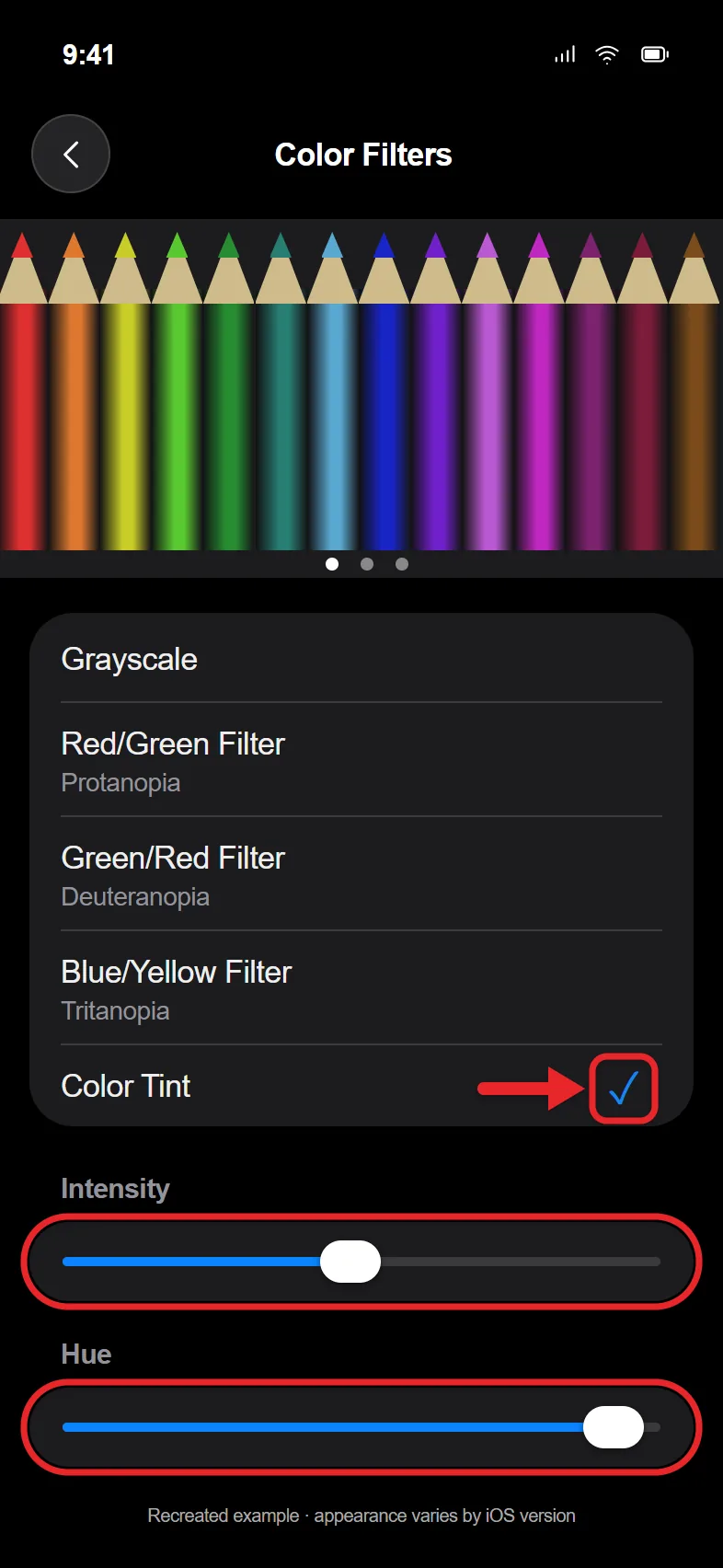
- Go back and turn off Reduce White Point if it is on.
The screen tint from the filter is removed. Night Shift automatically removes color filter effects other than grayscale, so a filter tint may show up only during the day.
If you use a color filter on purpose, you don’t have to turn it off. The Color Tint filter has sliders for hue and intensity, so you can lower the Intensity or move the hue away from orange instead. Reduce White Point also has its own slider; read more about dimming the iPhone screen with Reduce White Point.
Some display accessibility settings, including Invert Colors, Grayscale and Increase Contrast, might turn off Night Shift. If Night Shift keeps switching itself off, check those settings on the same screen.
Check the Accessibility Shortcut
A color filter or Reduce White Point can come back if it is set as your Accessibility Shortcut, because triple-clicking the side button (or the Home button) turns it on.
- Open Settings and tap Accessibility.
- Scroll to the bottom and tap Accessibility Shortcut.
- Tap Color Filters or Reduce White Point to remove the check mark.
After that, an accidental triple-click no longer tints the screen. If you set up Back Tap under Accessibility › Touch, check that it isn’t set to the Accessibility Shortcut either, since tapping the back of the phone can trigger it.
Orange dot or orange bubble near the clock
A small orange dot at the top of the screen isn’t a screen tint. The orange indicator means an app is using the microphone. If you turned on Differentiate Without Color, it shows as an orange square instead. A green dot means the camera is in use.
A colored bubble behind the time shows something running in the background, such as a call or a screen recording. To learn what each color means, read about the icons at the top of the iPhone screen.
If the screen is still orange
- Restart the iPhone to rule out a software glitch. On a Face ID iPhone, press and hold the side button and the volume down button until the power-off slider appears, drag it, then turn the phone back on with the side button.
- Install any waiting update in Settings > General > Software Update.
- Remove a tinted or amber “blue light” screen protector and compare.
- As a last step, go to Settings > General > Transfer or Reset iPhone > Reset > Reset All Settings. This returns display, accessibility, Wi-Fi and other settings to their defaults but keeps your photos, messages, apps and documents. You’ll need to re-enter Wi-Fi passwords afterward.
- If the tint shows in one area of the screen only, or stays when every setting is off, contact Apple Support. That may be a display problem.
Damage is more likely if the tint appeared after a drop or a crack, sits along one edge, or changes when you press near it. Back up the iPhone before you hand it in for repair.
How to confirm the fix worked
Open a plain white page, such as a new note in Notes, and look at it in daylight. White should look white, not cream or orange. If it looks right now but turns warm again in the evening, Night Shift is still scheduled; if it turns warm only indoors, True Tone is on.
Night Shift Questions
Is Night Shift bad for my iPhone?
No. Night Shift only changes the colors the display shows. Its purpose is to make the display easier on your eyes at night.
Which iPhones have Night Shift?
Night Shift works on iPhone 5s and later, so every iPhone that runs current iOS has it. Tablets have it too: here’s how to use Night Shift on iPad.
Why did my screen turn orange when I didn’t change anything?
Usually a schedule kicked in. Night Shift can be scheduled from sunset to sunrise, so the screen warms on its own each evening. Someone else with your passcode may also have turned it on.
Does Night Shift affect battery life?
Apple doesn’t describe Night Shift as a battery feature. It changes color, not brightness. Apple’s display guide points to dimming the screen to extend battery life, so brightness is the setting to change if battery is your concern.
Is it the same as Dark Mode?
No. Dark Mode changes backgrounds to black and dark gray but doesn’t tint the screen. You can use both at once.
Related: Why does my iPhone keep dimming?, How to turn on Dark Mode on iPhone, and How to invert colors on iPhone.

Matthew Burleigh is the founder, head writer, and editor of Solve Your Tech, which he launched in 2012. He has written technology tutorials since 2008 and worked in IT since 2003, including small-business support, IT management, and consulting. He holds Bachelor’s and Master’s degrees in Computer Science from Arizona State University.
Matthew writes practical guides for Windows, iPhone and iPad, Microsoft Office, Outlook, Google apps, and Android. Solve Your Tech’s guides are checked step by step against the device or app maker’s own documentation and tested on his own devices whenever he has the hardware or software, with clear steps, sources, and update dates.
Read more about Matthew and how Solve Your Tech writes and updates its guides, or report a correction.