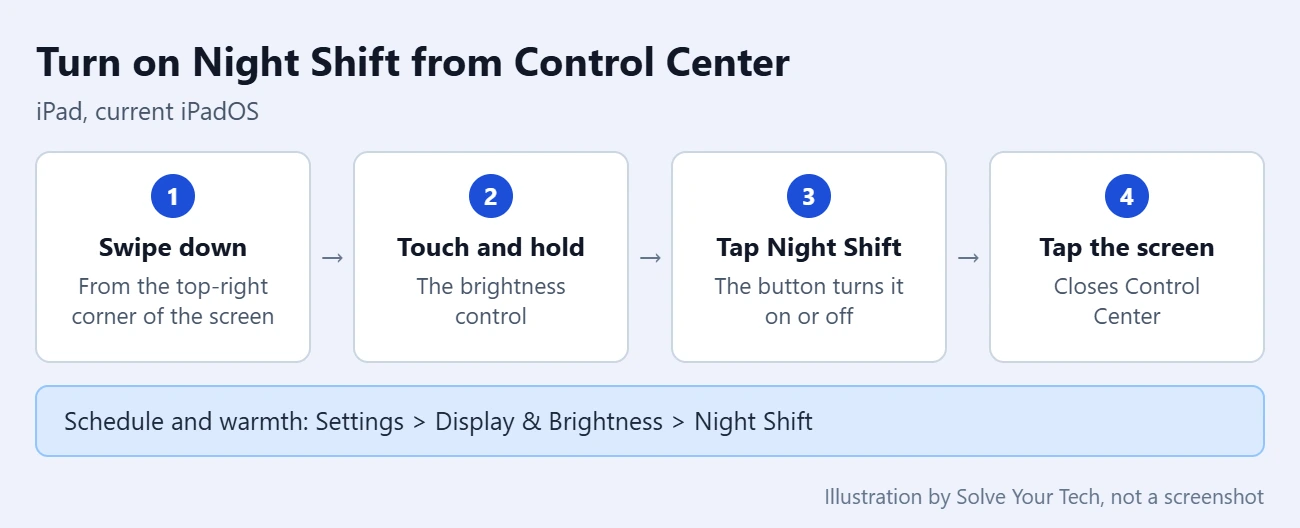
To use Night Shift on an iPad, swipe down from the top-right corner of the screen to open Control Center, touch and hold the brightness control, and tap Night Shift. To set a schedule or change how warm the screen looks, open Settings > Display & Brightness > Night Shift.
Night Shift moves the colors of the display toward the warmer end of the spectrum, which gives the screen an amber tint. Apple describes it as making the display easier on your eyes at night. It changes color balance only. It does not promise a screen with no blue light, and it is not a medical or sleep treatment.
What You Need
These steps are for iPads running current iPadOS, and they follow Apple’s present instructions. Apple lists Night Shift as available on these models:
- iPad Pro (all models)
- iPad (5th generation and later)
- iPad Air and later
- iPad mini 2 and later
An older iPad outside that list does not have the feature, and a software update will not add it. You do not need an internet connection or an Apple Account to switch Night Shift on. The automatic sunset schedule does rely on location settings, which are covered below.
Turn On Night Shift From Control Center
This is the shortest route when you want the warmer screen right now. Control Center is the panel of quick settings, such as Wi-Fi, volume, and brightness, that slides in over whatever you are doing.
- Swipe down from the top-right corner of the screen. Control Center opens.
- Touch and hold the brightness control, the slider with the sun symbol. It expands and shows extra display buttons.
- Tap the Night Shift button. The screen colors should turn noticeably warmer.
- Tap an empty part of the screen, or swipe up from the bottom, to close Control Center.
The first time you tap the button, your iPad may ask whether you want to schedule Night Shift or only turn it on for now. Pick the option that turns it on now, and set up a schedule later in Settings if you want one. The exact wording of that prompt can differ between iPadOS versions.
Apple notes that turning Night Shift on manually is helpful when you are in a darkened room during the day. Apple’s own pages for opening Control Center on iPad and using Night Shift describe the same route.
Schedule Night Shift in Settings
A schedule turns Night Shift on and off for you every day, so you do not have to remember it. By default, Apple says, Night Shift runs from sunset to sunrise.
- Open the Settings app.
- Tap Display & Brightness in the list on the left.
- Tap Night Shift.
- Turn on Scheduled. A From and To row appears below it.
- Tap From, then choose Sunset to Sunrise or Custom Schedule.
- If you chose Custom Schedule, tap the time options and set when Night Shift should turn on and when it should turn off.
With Sunset to Sunrise, the iPad uses its clock and location to work out when it is nighttime where you are, so the hours move with the seasons. A custom schedule suits a fixed routine, for example 9:00 PM to 7:00 AM.
Turning on Scheduled does not tint the screen right away if the start time has not arrived. Use the Control Center button when you want the warmer colors immediately. Some iPadOS versions also show a switch on this screen, labeled along the lines of Manually Enable Until Tomorrow, that does the same job.
Change How Warm the Screen Looks
If the tint is too orange, or too faint to notice, adjust it rather than giving up on the feature.
- Go to Settings > Display & Brightness > Night Shift.
- Find the slider under Color Temperature.
- Drag it toward the warmer end for a stronger amber tint, or toward the cooler end for a lighter one.
The setting is saved and is used every time Night Shift turns on, whether by schedule or by hand. Colors are less accurate while the tint is active, so switch Night Shift off for a while when you edit photos, draw, or compare colors.
Turn Night Shift Off
There are two different things to turn off, and they are easy to mix up.
- For now: open Control Center, touch and hold the brightness control, and tap Night Shift again. The screen returns to its usual colors.
- For good: go to Settings > Display & Brightness > Night Shift and turn off Scheduled. Without this step, Night Shift comes back at the next scheduled start time.
Nothing is lost either way. Your schedule times and color temperature stay as you left them, so you can turn the feature back on later with one tap.
Night Shift, Dark Mode, and True Tone
These three settings sit close together and are often confused. They do different jobs and can be used at the same time.
| Setting | What it changes | Where to find it |
|---|---|---|
| Night Shift | Shifts display colors warmer, on a schedule or by hand | Settings > Display & Brightness > Night Shift |
| Dark Mode | Gives the whole iPad a dark color scheme for low light | Settings > Display & Brightness > Dark |
| True Tone | On supported models, adjusts screen color to the lighting around you | Settings > Display & Brightness > True Tone |
| Brightness | Makes the screen dimmer or brighter | Control Center or Settings > Display & Brightness |

All of them are explained in Apple’s guide to adjusting the screen brightness and color on iPad. For comfortable reading at night, many people combine a lower brightness with Night Shift. If small text is the real problem, it can also help to make text bigger on your iPad.
Troubleshooting Night Shift on iPad
Sunset to Sunrise is missing
Apple says the Sunset to Sunrise option is not available if you turned off Location Services or Setting Time Zone. Go to Settings > Privacy & Security > Location Services to check the first one. Setting Time Zone is under System Services on that same screen. If you prefer to keep location off, use Custom Schedule instead. It works without location.
The Night Shift button does nothing or turns itself off
Apple warns that some display accessibility settings, including Invert Colors, Grayscale, and Increase Contrast, might turn off Night Shift or True Tone. Open Settings > Accessibility > Display & Text Size and see whether any of them are on. Only change these if you do not rely on them.
There is no Night Shift option at all
Check your model against the list near the top of this page. If your iPad is supported, make sure you are holding the brightness control in Control Center rather than tapping it, because the Night Shift button only appears in the expanded view. The option in Settings is inside Display & Brightness, not on the main Settings list.
Night Shift turned on, but the screen looks the same
The Color Temperature slider may be set near the cooler end, where the change is subtle. Drag it toward the warmer end. If Night Shift is scheduled, also confirm the current time falls inside the schedule.
The screen is orange and you did not ask for it
Night Shift is probably running on a schedule. Turn off Scheduled as described above. If display settings still look wrong after that, you can reset settings on the iPad without erasing your data, though that resets many other preferences too, so treat it as a last step.
Frequently Asked Questions
Does Night Shift remove all blue light from an iPad?
No. Night Shift shifts the display toward warmer colors, and Apple does not say it removes blue light completely. Lowering brightness and taking breaks from the screen are separate steps you can add.
Will Night Shift help me sleep?
Apple’s documentation only says Night Shift makes the display easier on your eyes. It makes no sleep claim, so treat the feature as a comfort setting. Talk to a doctor about ongoing sleep or eye problems.
Can I use Night Shift during the day?
Yes. Turn it on from Control Center whenever you like. Apple specifically mentions a darkened room during the day as a good use. You can also set a custom schedule that covers daytime hours.
Does Night Shift show up in screenshots?
Apple’s documentation does not cover this. Night Shift is described as a change to how the display shows colors, not to your content, so photos and files themselves are not altered.
Is Night Shift the same on iPhone?
The settings are the same, and Apple documents them together. The gesture for opening Control Center differs on some iPhone models. Our iPhone Night Shift guide covers those differences.
Next Step
Turn Night Shift on once from Control Center this evening to see whether you like the tint. If you do, set Scheduled to Sunset to Sunrise and adjust Color Temperature until the screen looks comfortable.

Matthew Burleigh is the founder, head writer, and editor of Solve Your Tech, which he launched in 2012. He has written technology tutorials since 2008 and worked in IT since 2003, including small-business support, IT management, and consulting. He holds Bachelor’s and Master’s degrees in Computer Science from Arizona State University.
Matthew writes practical guides for Windows, iPhone and iPad, Microsoft Office, Outlook, Google apps, and Android. Solve Your Tech’s guides are tested on current devices or checked against official product documentation, with clear steps, sources, and update dates.
Read more about Matthew and how Solve Your Tech writes and updates its guides, or report a correction.