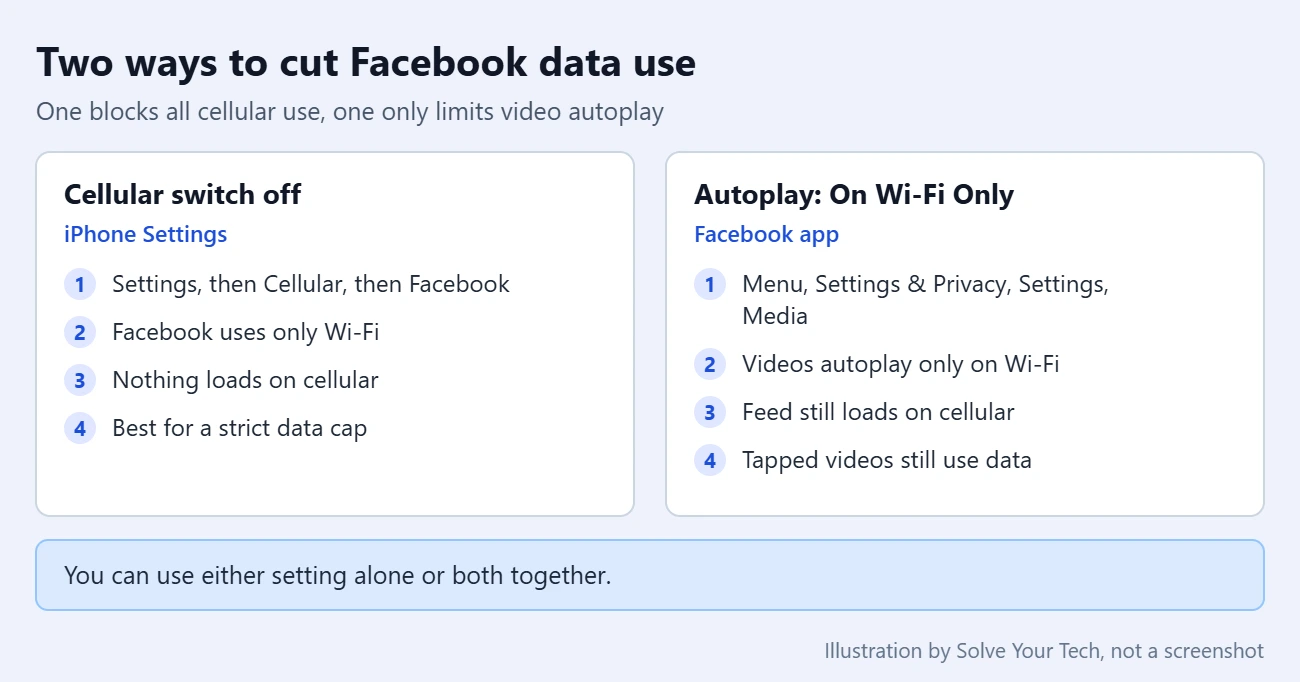
To only use Facebook on Wi-Fi on an iPhone, open Settings, tap Cellular, scroll to Facebook in the list of apps, and turn its switch off. Apple says that when cellular data is off for an app, the iPhone uses only Wi-Fi for it, so the Facebook app stops using your data plan.
The setting is part of iOS, not the Facebook app, and you can reverse it at any time. This guide covers the steps, a lighter option inside the Facebook app, and what to check if Facebook still seems to use cellular data.
iOS Versions These Labels Match
- Versions: the labels in this guide match Apple’s current iPhone documentation for iOS 27. The same per-app cellular switches exist in earlier iOS versions, although the layout of the Cellular screen has changed over the years.
- Regional names: in some regions the menu is called Mobile Data instead of Cellular. The steps are the same.
- What it affects: the switch applies to the Facebook app only. Messenger is a separate app with its own switch, and the Facebook website in Safari follows the Safari cellular data switch.
- What you lose: with the switch off, the Facebook app cannot load your Feed, photos, videos or new posts until you connect to Wi-Fi again.
How to Turn Off Cellular Data for Facebook on an iPhone
These steps follow Apple’s guide to viewing or changing cellular data settings on iPhone.
- Open the Settings app.
- Tap Cellular.
- Scroll down to the list of apps and services. Each app has its own switch. If you do not see Facebook, tap Show All to open the full list.
- Turn off the switch next to Facebook. The switch is off when it is no longer green.

You do not need to restart the iPhone or sign out of Facebook. Other apps keep using cellular data as before, because each one has a separate switch. Video apps are a common next target, and you can stop YouTube from using cellular data on your iPhone the same way.
How to Confirm It Worked and How to Undo It
Go back to Settings > Cellular and check that the switch next to Facebook is off. For a practical test, turn off Wi-Fi for a moment and open Facebook. The app should fail to load new content. Turn Wi-Fi back on when you are done.
To undo the change, return to Settings > Cellular and turn the Facebook switch back on. Facebook can then use cellular data whenever Wi-Fi is not available, and carrier charges may apply depending on your plan.
How to Check How Much Data Facebook Has Used
The same screen shows whether Facebook is really the problem. In Settings > Cellular, scroll to the list of apps and tap Show All. The amount of cellular data each app has used appears below its name.
That total does not follow your billing month. It counts from the last time the statistics were reset. To start a fresh count, scroll to the bottom of the Cellular screen and tap Reset Statistics. Your carrier has the most accurate usage figures for the current period.
If several apps are using a lot of data, here’s how to reduce cellular data usage on an iPhone.
A Lighter Option: Stop Facebook Videos From Autoplaying on Cellular
Blocking cellular data completely is strict. If you still want to read your Feed away from Wi-Fi, you can leave the cellular switch on and limit video autoplay instead. Autoplay means videos start on their own as you scroll, and videos use more data than other posts.
To change autoplay in the iPhone app:
- Open Facebook and tap Menu.
- Scroll down and tap Settings & Privacy, then tap Settings.
- Scroll down to Preferences and tap Media.
- Scroll down to Autoplay and select On Wi-Fi Only.
With On Wi-Fi Only selected, videos start automatically only while you are connected to Wi-Fi. Be aware of the limit: if you tap a video to play it on a mobile connection, it still uses mobile data. The rest of the app also keeps using cellular data. If you do not see Media in the settings, update the app.
Autoplay settings don’t remove videos from your Feed. To see fewer of them, read how to hide Reels on Facebook.
If the posts themselves are the problem rather than the data they use, you can reset your Facebook feed with Facebook’s own controls.
Other iPhone Settings That Limit Cellular Data
These settings affect more than Facebook, but they help when you are trying to stay under a data cap.
- Background App Refresh on Wi-Fi only: Background App Refresh lets apps check for new content while you are not using them. Go to Settings > General > Background App Refresh, tap Background App Refresh again, and choose Wi-Fi.
- Low Data Mode: go to Settings > Cellular > Cellular Data Options. Depending on your plan, turn on Low Data Mode there or tap Data Mode first. This mode pauses automatic updates and background tasks when the iPhone is not on Wi-Fi.
- Connectivity Assist: this feature uses cellular data along with Wi-Fi when the Wi-Fi connection is weak. It replaces the older Wi-Fi Assist setting. To turn it off, go to Settings > Wi-Fi and scroll down to Connectivity Assist.
FaceTime is another app that can use a lot of data. Read about using FaceTime on iPhone to see how it works with Wi-Fi and cellular connections.
If Facebook Isn’t in the List
- Facebook is not in the list: tap Show All under the app list. Also confirm the Facebook app is installed, and remember that Messenger appears as its own entry.
- You see Mobile Data instead of Cellular: that is the regional name for the same menu.
- The switch will not change: check that Cellular Data at the top of the screen is on. Then check Settings > Screen Time > Content & Privacy Restrictions > Cellular Data Changes, which must be set to Allow. A work or school device profile can also lock these settings.
- You have two lines (Dual SIM): the usage numbers shown are for the line currently selected for cellular data.
- Facebook will not load on Wi-Fi either: the cellular switch is not the cause. Check the Wi-Fi connection itself, then update the Facebook app from the App Store.
- Facebook will not load on cellular after you turn the switch back on: confirm the switch is green, then check that Cellular Data itself is on at the top of the Cellular screen.
Turn off the Facebook switch, then tap Reset Statistics so you can see within a week or two which apps are using the most data. Apple’s cellular data support article has more detail on the options on that screen.
Facebook Cellular Data Questions
Will I still get Facebook notifications when cellular data is off for the app?
Do not count on Facebook alerts while you are away from Wi-Fi. Even if a banner appears, the Facebook app cannot load the post or comment behind it until you are back on Wi-Fi.
Does turning off cellular data for Facebook also affect Messenger?
No. Messenger is a separate app with a separate entry in Settings > Cellular. Turn off its switch too if you want Messenger limited to Wi-Fi.
Can I use Facebook on Wi-Fi only without changing iPhone settings?
Not completely. The Facebook app’s On Wi-Fi Only option controls video autoplay only. The Feed, photos and any video you tap still use cellular data. The iPhone’s per-app cellular switch is the documented way to keep the whole app on Wi-Fi.
Does this setting delete anything from my Facebook account?
No. The switch only controls which type of connection the app may use. Your account, posts and login stay as they are, and the app works normally on Wi-Fi.
Can Facebook still use cellular data on a weak Wi-Fi signal?
When cellular data is off for an app, the iPhone uses only Wi-Fi for that app. Connectivity Assist can add cellular data for apps that are allowed to use it, so turn that feature off in Settings > Wi-Fi if you want to limit that for your other apps.

Matthew Burleigh is the founder, head writer, and editor of Solve Your Tech, which he launched in 2012. He has written technology tutorials since 2008 and worked in IT since 2003, including small-business support, IT management, and consulting. He holds Bachelor’s and Master’s degrees in Computer Science from Arizona State University.
Matthew writes practical guides for Windows, iPhone and iPad, Microsoft Office, Outlook, Google apps, and Android. Solve Your Tech’s guides are checked step by step against the device or app maker’s own documentation and tested on his own devices whenever he has the hardware or software, with clear steps, sources, and update dates.
Read more about Matthew and how Solve Your Tech writes and updates its guides, or report a correction.