To permanently delete your Facebook account, open Facebook’s settings, enter Accounts Center or Meta Account, and find Deactivation or deletion. Select your Facebook account or profile, choose the deletion option, and finish the confirmation prompts. Removing the Facebook app from your phone does not delete your account.
Facebook is gradually changing its account-management menus. Use the route that matches the settings you actually see, and check the selected profile before confirming. This guide covers the computer website and iPhone app; the settings labels can vary during the rollout.
Before You Delete Facebook
- Save the information you want to keep. In Settings & privacy > Settings, open Meta Account or Accounts Center, then Your information and permissions. Look for Export your information or the earlier download tool. In the current export tool, select Create export, your Facebook profile, and Export to device. Choose the information, date range, format, and media quality, then start the export. Wait until you have downloaded and checked the files before requesting deletion; our guide to saving all your Facebook photos shows where to find the pictures in the export. See Facebook’s export instructions.
- Check accounts that use Facebook Login. Set up another supported sign-in method with those services before losing access to Facebook Login. Deleting Facebook does not automatically create a replacement password for them.
- Check Pages and connected services. Facebook says Pages that only you control can also be deleted. If a Page should stay, arrange for another appropriate person to have full control first. Review Meta Quest consequences too if you use Facebook to sign into it.
Delete Your Account on the Facebook Website
- Sign into Facebook and select your profile picture at the top right. Choose Settings & privacy, then Settings.
- Open Meta Account or Accounts Center. The name depends on your rollout.
- If you see Manage account: open it, select Manage for the relevant Facebook entry, then open Deactivation or deletion.
- If you see Personal details: open Personal details > Account ownership and control > Deactivation or deletion.
- Choose the Facebook account or profile you intend to remove. Select Delete account or the displayed profile-deletion option, then Continue.
- Read the final confirmation, complete any requested password or verification step, and confirm deletion. Continue through the prompts until Facebook confirms your request; opening the deletion menu alone does not submit it.
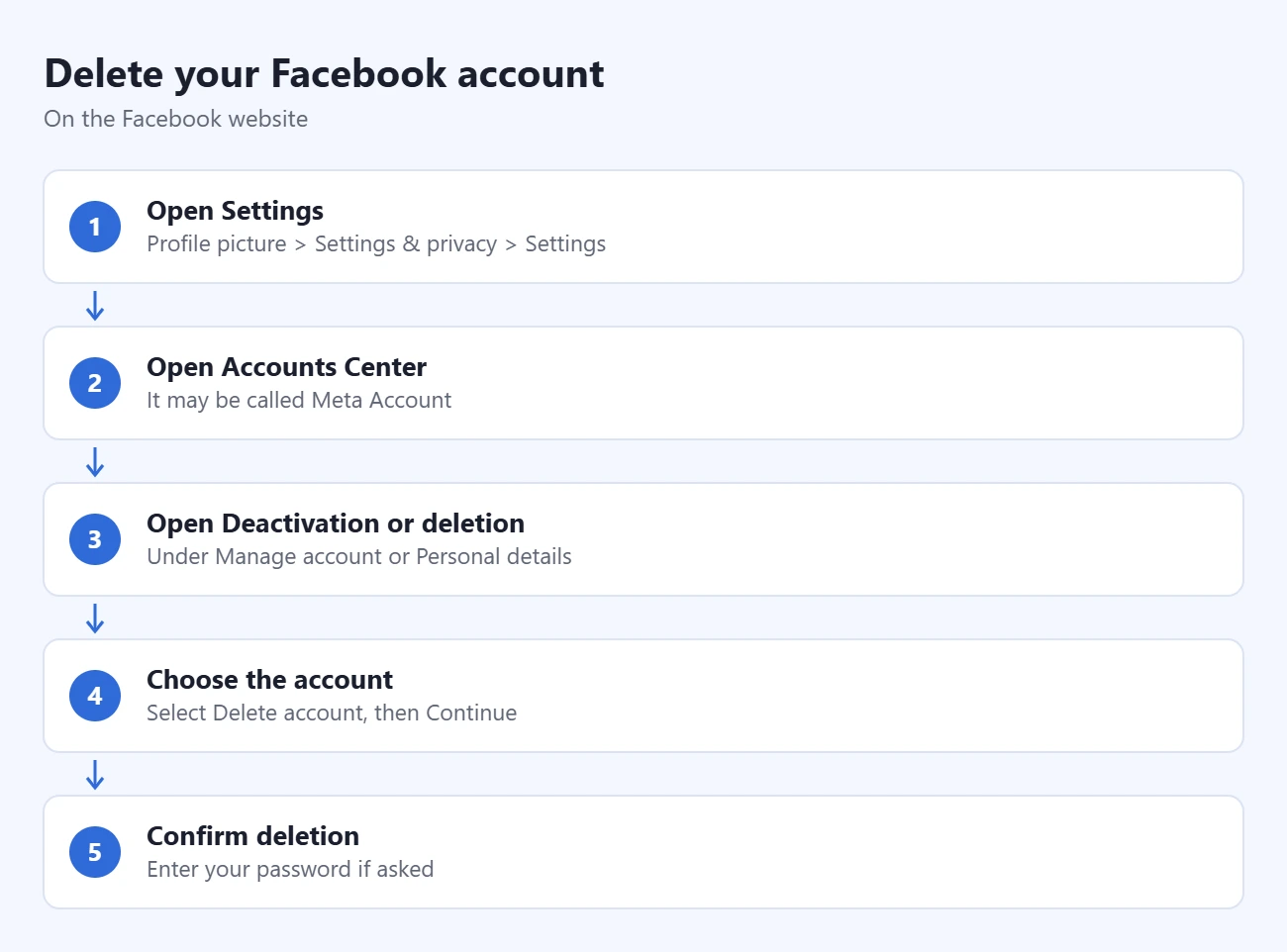
Use the Facebook deletion choice for the selected Facebook profile. If a screen instead proposes deleting your entire Meta Account or several services, stop and review its scope. Facebook’s current deletion help documents the two menu routes.
Delete Facebook in the iPhone App
- From your main Facebook profile, tap Menu at the bottom right. Expand Settings & privacy and tap Settings.
- Tap Meta Account or Accounts Center. If you see Manage account, open it, tap Manage, then Deactivation or deletion.
- For the Personal details layout, open Personal details > Account ownership and control > Deactivation or deletion instead.
- Select the correct Facebook account or profile, choose deletion, and follow Continue and the confirmation prompts. Check the profile name again before the final action.
Deletion, Deactivation, and Additional Profiles
Deletion is permanent after the cancellation period. Deactivation is a temporary break that lets you return. Facebook’s deactivation guidance explains that Messenger can remain active when you keep it active or are signed into it during deactivation. Permanent Facebook deletion ends Messenger access associated with that Facebook profile. For the temporary option, follow our guide to deactivate Facebook while keeping Messenger.
An additional Facebook profile is different from another service in Meta Account. Removing your main Facebook account can also affect its additional Facebook profiles. If you only want to remove a secondary Facebook profile, use the individual additional-profile controls and select that profile. Check the final list of affected profiles rather than assuming every entry is independent. Our guide to deleting a second Facebook profile walks through the selection and backup checks.
Can You Cancel Deletion?
Facebook generally allows cancellation within 30 days: sign back in and choose Cancel deletion. Its Help Center notes that this window can vary by region, so follow the deadline shown for your request. After that period, you cannot recover the deleted account or its content.
The cancellation window is separate from processing time. Facebook says removing posted content can take up to 90 days, and certain backup or retained records can remain longer. Deletion also does not erase copies of messages from other people’s inboxes. Our guide to finding deleted messages on Facebook Messenger explains what the other person keeps.
If the Deletion Option Is Missing
- Different menu labels: Check both account-management layouts above. An old guide’s Your Facebook information menu may no longer match your settings.
- Wrong profile: Return to the account/profile selection and confirm the name. A Page, an additional profile, and a main Facebook account require different choices.
- Cannot sign in or verify: Use Facebook’s login recovery prompts first. This guide does not bypass account ownership checks.
- Export not finished: Wait for and check the export before deleting. Facebook says an account scheduled for deletion may need cancellation before its information can be exported.
After Leaving Facebook
Keep the deletion confirmation and its cancellation deadline if you may need them. If you later want to read occasional public material, our guide explains what you can view on Facebook without an account, including the login limits that still apply.

Matthew Burleigh has been writing tech tutorials since 2008. His writing has appeared on dozens of different websites and been read hundreds of millions of times.
After receiving his Bachelor’s and Master’s degrees in Computer Science he spent several years working in IT management for small businesses. However, he now works full time writing content online and creating websites.
His main writing topics include iPhones, Microsoft Office, Google Apps, Android, and Photoshop, but he has also written about many other tech topics as well.