To find your own old Facebook posts without scrolling through years of your profile, open Activity log, select Activity history, and filter by Date and the type of activity. On Facebook’s computer interface, the date filter lets you select a year and then a month.
If you remember words from someone else’s post, use Facebook Search instead. Your activity log is a record of your own activity; it is not another person’s complete posting history.
Find Your Own Posts by Year or Month
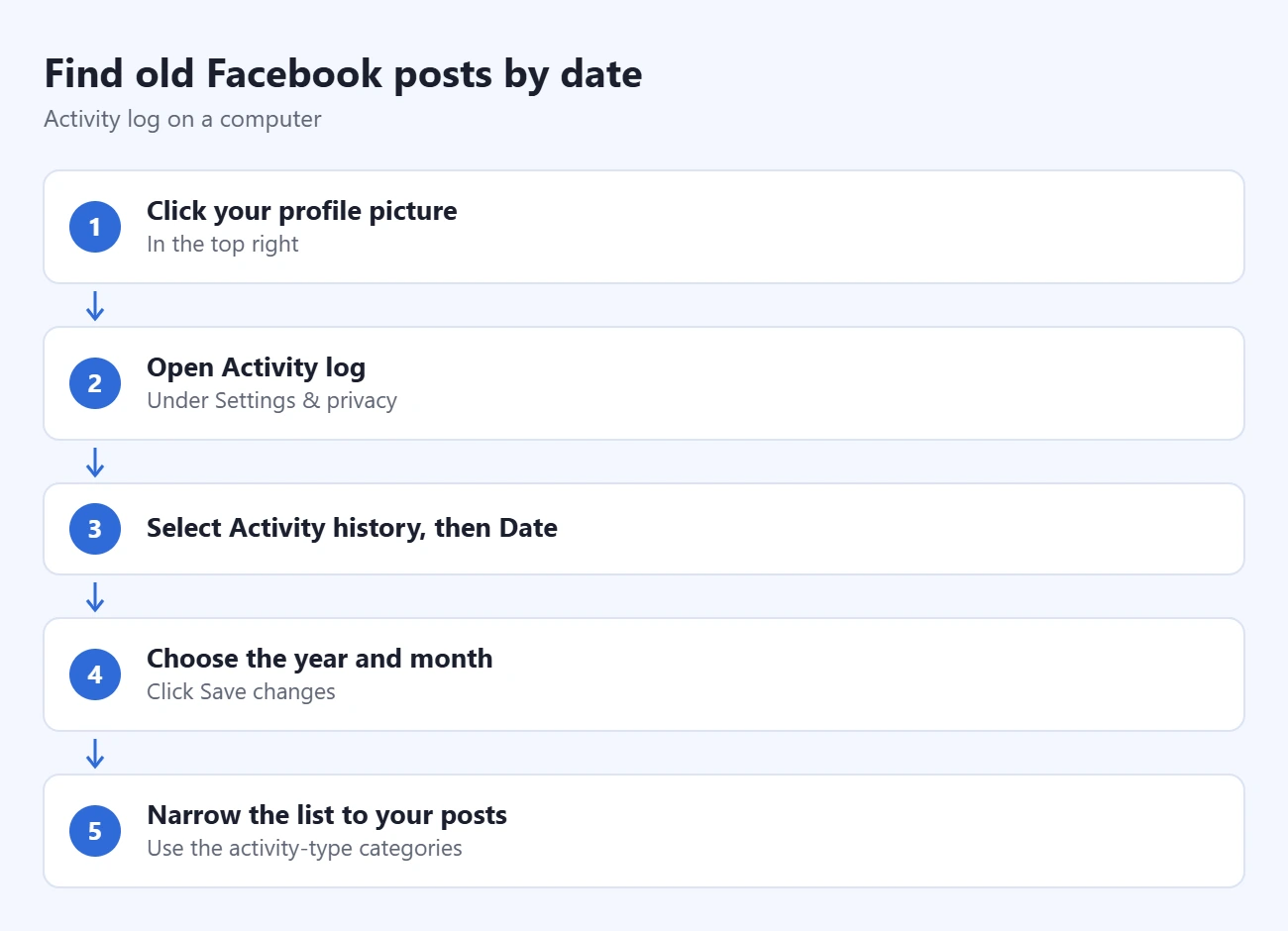
- On Facebook in a computer browser, click your profile picture in the top right.
- Choose Settings & privacy > Activity log.
- Select Activity history on the left, then Date.
- Choose the Year, optionally narrow it to a month, and click Save changes.
- Use the activity-type categories to narrow the list to your posts. Look under the category for your Facebook activity rather than leaving every activity type selected.
Facebook documents the Activity history date and category filters. These steps narrow the list; they do not run a keyword search inside every post. If your estimate is uncertain, start with the whole year, then narrow it after finding a nearby event.
For example, if you remember a graduation post but not its exact wording, choose the likely year and review your posts. If that month produces no results, broaden the date before concluding that the post is gone.
Choose the Correct Activity Category
A photo you uploaded, a friend’s post you commented on, and a post you were tagged in belong to different parts of your history. Facebook’s activity-log category guide distinguishes:
- Your posts: photos, videos, text, and status updates you shared.
- Activity you’re tagged in: posts, photos, and comments that mention you through a tag.
- Interactions: your likes, reactions, and comments.
- Groups and events: activity associated with those places.
Use the category that matches what you actually did. Selecting only your own posts can hide the result you need if you merely reacted to someone else’s update. A life event is listed according to when you added it to Facebook, which may differ from the date the event happened.
Use Facebook Search When You Remember Words
Enter a distinctive phrase, person’s name, or combination of remembered words in Search. Review the results, then choose the relevant content filter if it is offered. Facebook’s search instructions explain keyword searches and filtering results.
Start with a few recognizable words rather than an entire sentence you may remember incorrectly. If nothing matches, try another spelling or one unusual word. Check the author and date before treating a result as the original; a shared copy can have the same text.
Search filters vary by interface. Use a post or date filter when your results expose one, but do not assume every account has a universal custom date-range selector. For your own posts, Activity log provides a separately documented year-and-month route. If the post was never published, see where to find draft posts on Facebook instead.
Once you locate a post, our guide to see more Facebook comments and expand replies explains the All comments and Newest comments views, plus the limits of hidden or deleted comments.
Check Hidden, Archived, or Deleted Content
A Post Hidden from Your Profile
In Activity log, open the category for your Facebook activity, then Posts > Posts hidden from profile. Use its Date filter to narrow by year. Facebook’s hidden-post instructions explain that hiding a post from your profile does not necessarily remove it from Feed or Search for its original audience.
A Post You Archived
Check Archive in the Facebook app’s activity-management controls if you previously moved the post there. Archived content is visible only to you. Restoring it makes it visible to the audience selected before archiving, so check that audience before restoring anything.
A Post Moved to Trash or Recycle Bin
Facebook’s archive and deletion guidance says content moved to the recycle bin is automatically deleted after 30 days, unless you delete it earlier. During that window, eligible content can be restored. After deletion, that route cannot restore it. The wording may appear as Trash in your app.
Find and Restore a Post in Facebook Trash
For eligible content you moved to Trash, use the Facebook app for iPhone or Android. Meta’s Manage Activity instructions direct you to your profile, then Options > Activity Log > Trash at the top of the log. The label can appear as Recycle Bin in some interfaces. This is separate from Messenger message recovery.
Find the intended item, select the box beside it, tap Restore at the bottom, and tap Restore again to confirm. It returns to where you originally posted it with its previous audience. Review that audience after restoring. Move to Archive instead if you want supported content kept visible only to you.
Trash retains content for 30 days unless you delete it earlier. After permanent deletion this route cannot restore it. Not every activity-log item is eligible for Trash, so do not expect a complete recycle bin containing every deleted comment, message, or post. Check the correct profile and date before concluding an item is missing.
If You Still Cannot Find the Post
Confirm that you are using the intended account and profile. Reset an overly narrow category or date filter, then try again. Your activity log is private to you, while individual posts keep their own audience settings.
For another person’s post, search availability depends on what you can access. A missing result does not prove that the author deleted it, and finding an old link does not grant access to a restricted post.
Facebook’s missing activity-log information guidance notes that some information is unavailable through Activity log, falls outside the selected category or dates, or has been deleted. Its information-access and export tools can help review available account data; they are not a promise to recover deleted posts.
If you recently watched a video or interacted with someone else’s update, our recently viewed posts and watched reels guide covers that different task. Once you locate the old post you need, open it and verify its author, date, and content before bookmarking its link. A bookmark helps you return to an available post but cannot preserve access if the post later disappears.

Matthew Burleigh is the founder, head writer, and editor of Solve Your Tech, which he launched in 2012. He has written technology tutorials since 2008 and worked in IT since 2003, including small-business support, IT management, and consulting. He holds Bachelor’s and Master’s degrees in Computer Science from Arizona State University.
Matthew writes practical guides for Windows, iPhone and iPad, Microsoft Office, Outlook, Google apps, and Android. Solve Your Tech’s guides are tested on current devices or checked against official product documentation, with clear steps, sources, and update dates.
Read more about Matthew and how Solve Your Tech writes and updates its guides, or report a correction.