To find a comment someone made on Facebook, locate a post you can access, open its comments, and expand the discussion and replies. You cannot open another person’s Activity Log to get their complete comment history. If you do not know the post, use remembered words and Facebook Search to look for the discussion first.
These instructions focus on Facebook in a computer browser. Mobile menus may differ. Your account needs access to the post or group involved. A visible profile is not proof that every post or comment connected to that person is available to you.
Understand What You Can Find
Meta’s Activity Log instructions state that only the owner can see that log. The individual posts and comments it refers to can appear elsewhere according to their own visibility. Visiting someone’s profile does not give you a searchable copy of their private log.
Treat the task as finding a particular accessible discussion, not compiling every comment a person has ever written. Meta’s search-results guide explains that results depend on what you can see, your Facebook activity, and community signals. You can see results from a non-friend when you are in the post’s audience; friendship alone is not the only access rule.
If You Know the Post
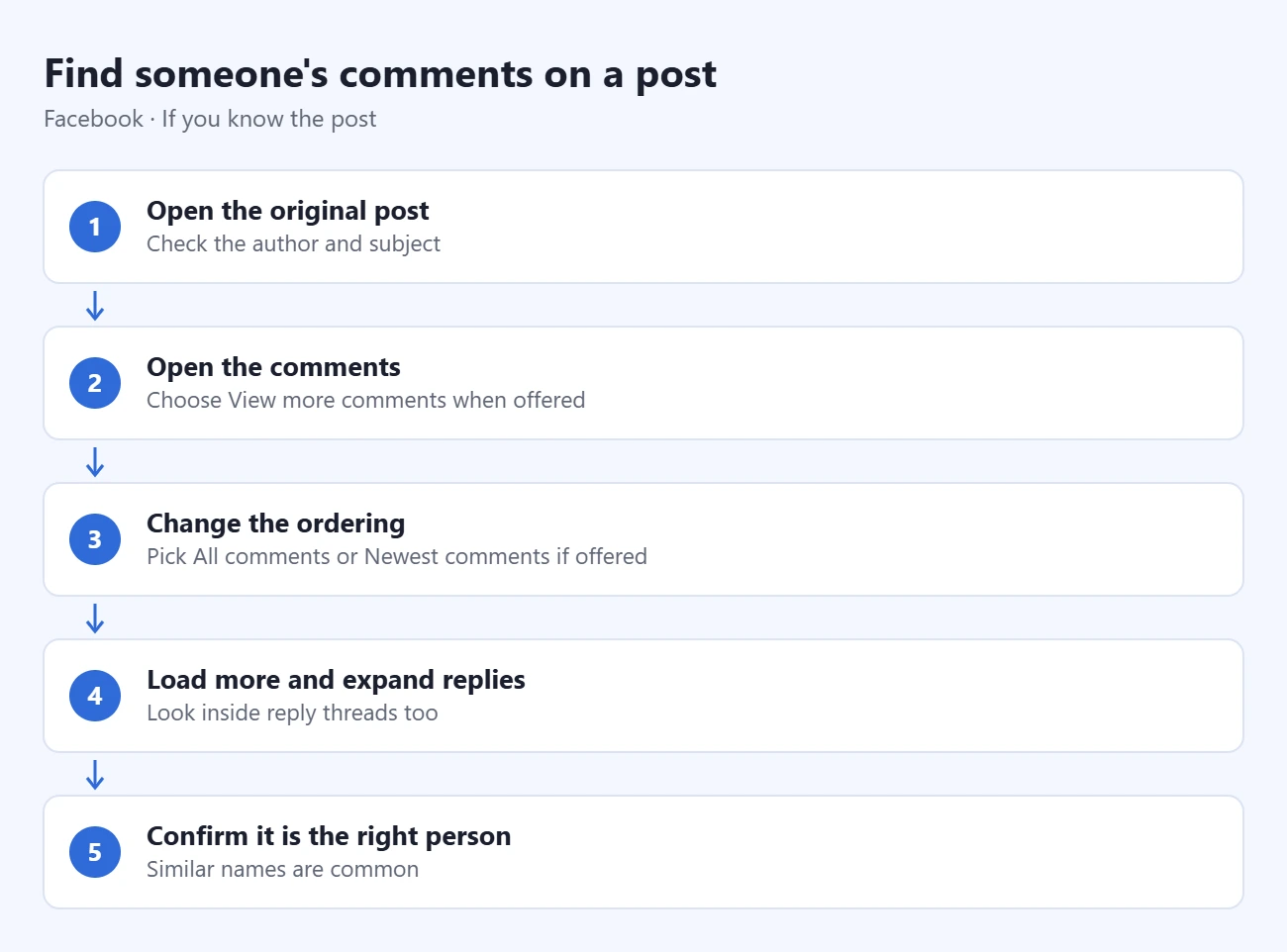
- Open the original post. Use the saved link, notification, Page, profile, or group where you remember the discussion. Check the author and subject; a shared copy can have a separate comment thread.
- Open the comments. Select the comment count or the available comments control. Choose View more comments when offered.
- Inspect the ordering control. If the post offers All comments or Newest comments, choose the view appropriate to your search. Not every profile or discussion exposes the same choices.
- Load more comments and expand replies. Look for the person’s name inside reply threads as well as top-level comments. A reply beneath another person’s comment may be easy to overlook.
- Confirm the identity and context. Compare the displayed name/profile and surrounding conversation with what you remember. Similar names are not sufficient proof that you found the intended person.
Meta’s comment-ordering guide says that All comments includes potential spam and still puts relevant comments first; Newest comments puts the latest comments first. Changing the view is temporary and affects your display. It does not create a record of that person’s comments across Facebook. Our full-comments and replies guide covers the available views and Page-management differences.
If You Do Not Remember the Post
- Open Facebook Search. Enter a distinctive topic, remembered phrase, or a relevant name and keyword. Use the post’s subject rather than assuming a name will retrieve every comment.
- Review the available result filters. Select a relevant content filter when offered. Search controls vary, so use the filters shown in your interface rather than looking for a universal comment-history button.
- Open plausible posts and inspect their comments. Verify the author, approximate date, and subject. Return to the known-post method to expand the actual discussion.
Meta documents keyword entry and result filtering in its Facebook Search guide. These steps help locate candidate content; they do not promise a complete search of every comment. If you remember only a Page or group, inspect that place for the related post. For date-based searching of your own content, see how to find old Facebook posts.
For example, knowing that a person discussed a local event on a particular Page gives you a better starting point than their name alone. Find the Page’s event post, confirm the date, then read the loaded comments and replies. Record the post link once found so you can return to the same discussion.
For Your Own Comments, Use Your Activity Log
Your own account has a different route. On a computer, choose your profile picture > Settings & privacy > Activity log, then Activity history. Use Date to select a year and month, and narrow Activity type to the relevant interaction category available in your interface. Meta documents these filters in the Activity Log guide linked above.
The log can help locate your own interaction with a post. It is not a way to inspect another account’s log, and its presence does not grant access to a post whose audience has changed. If you used more than one profile, first confirm that you are viewing the intended one.
Why You May Still Not Find the Comment
A search result or comment list is not evidence of a complete history. The post may be unavailable to your account, the comment may be in a reply you have not expanded, or the author or moderator may have removed it. Absence alone does not establish which explanation applies.
Start with the same account and original post. Let it finish loading, use additional comment-loading controls, and compare an available ordering option. If you cannot open the post itself, solve the access question first. Changing comment order cannot provide permission to read a restricted discussion.
When the exact comment matters and these methods do not locate it, ask the person for the post link or context. Avoid treating an extension or a third-party “comment finder” as proof of complete access. This guide does not recommend an unverified tool or claim that it can reveal private or removed content.
Common Questions
Can I search another person’s Activity Log?
No. Meta says only that account’s owner can view its Activity Log. Read comments on posts available to you instead.
Does All comments show every comment the person made?
No. It is a view within one post’s discussion. You still need to load additional comments and replies, and it does not provide a cross-site history.
Does being friends make every comment visible?
No. Access depends on the particular post’s audience and other availability limits. Meta also says search can show posts from non-friends when you are included in the audience.
Begin with the most specific remembered post or topic. Find the discussion, expand its comments and replies, and verify the identity and context before drawing conclusions from a match or a missing result.

Matthew Burleigh is the founder, head writer, and editor of Solve Your Tech, which he launched in 2012. He has written technology tutorials since 2008 and worked in IT since 2003, including small-business support, IT management, and consulting. He holds Bachelor’s and Master’s degrees in Computer Science from Arizona State University.
Matthew writes practical guides for Windows, iPhone and iPad, Microsoft Office, Outlook, Google apps, and Android. Solve Your Tech’s guides are tested on current devices or checked against official product documentation, with clear steps, sources, and update dates.
Read more about Matthew and how Solve Your Tech writes and updates its guides, or report a correction.