To turn off cellular data for Safari on iPhone, open Settings, tap Cellular, scroll down to the app list, and turn off the switch next to Safari (tap Show All if it isn’t listed). Safari then loads websites only on Wi-Fi, while calls, texts and your other apps keep using cellular data as usual.
These steps apply to iPhone with iOS 27 and iOS 26, and the same switch has been in the Cellular screen for many earlier versions. In some regions the menu is called Mobile Data instead of Cellular. On an iPad with cellular service, the screen is called Cellular Data.
Why Turn Off Cellular Data for Safari
Web browsing can use more data than you expect. News sites autoplay video, image-heavy pages load several megabytes each, and a few minutes of watching clips in Safari can take a real bite out of a small plan. Blocking Safari from cellular is a simple way to keep browsing on Wi-Fi while leaving maps, messaging and music free to use your plan. Traveling soon? Browsing abroad is where data costs climb fastest, so also turn off data roaming on your iPhone before you land.
It’s also handy if you share a phone with a child or want to stop yourself from scrolling the web on a commute. The setting is per app, so it only affects Safari.
How to Turn Off Cellular Data for Safari
- Open the Settings app.
- Tap Cellular (or Mobile Data). The top of the screen shows the main Cellular Data switch and your plan details.
- Scroll down to the list of apps under Cellular Data. Each app shows how much data it has used. If you don’t see Safari, tap Show All at the bottom of the list.
- Turn off the switch next to Safari. The switch turns gray.

The change takes effect right away, and you don’t need to restart the iPhone or close Safari. Apple’s cellular data settings guide says that when cellular data is off for an app or service, iPhone uses only Wi-Fi for it.
If you have two lines (Dual SIM), the usage figures in the list are for the line currently used for cellular data.
What Happens After You Turn It Off
- On Wi-Fi: Safari works normally. Nothing changes at home, at work or on any other Wi-Fi network.
- Away from Wi-Fi: Safari won’t load pages. When you try, iOS shows a message that cellular data is turned off for Safari, with a shortcut to Settings so you can turn it back on.
- Other apps: apps such as Mail, Maps, Messages and Chrome keep using cellular data. Each app has its own switch in the same list.
- Websites you visit in Safari: anything you open in Safari is covered, including a site like Facebook or YouTube when you use its website instead of its app.
How to Turn Cellular Data Back On for Safari
- Open Settings and tap Cellular.
- Scroll to Safari in the app list.
- Turn the switch back on. It turns green, and Safari can load pages over cellular again right away.
You can also tap Settings in the message Safari shows when you try to browse without Wi-Fi. It takes you straight to the Cellular screen.
How to See How Much Data Safari Uses
- Go to Settings > Cellular.
- Scroll to the app list and tap Show All if the list is shortened.
- Look under Safari for the amount of cellular data it has used.
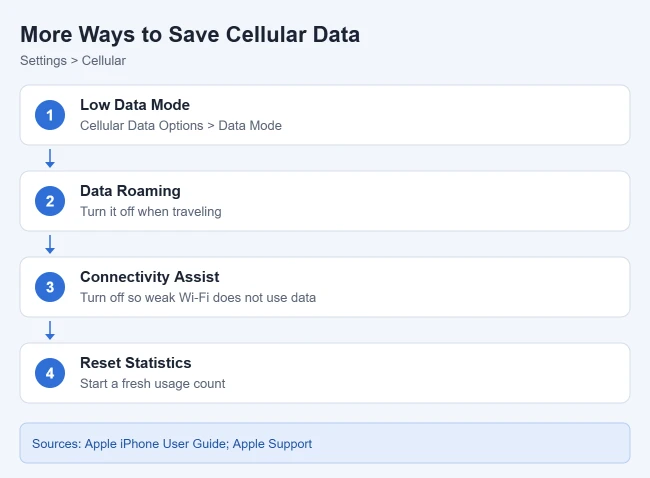
The total covers the current period, which runs from the last time the statistics were reset, not necessarily your billing cycle. To start a fresh count, scroll to the bottom and tap Reset Statistics. Doing this on the day your plan renews makes the numbers easier to compare with your bill. Apple’s cellular data support article notes that your carrier has the most accurate usage figures for your billing period.
A practical approach: check Safari’s number after a week or two. If it’s one of the biggest totals in the list, blocking it will save a lot. If it’s small, leave Safari on and look at video and social apps first.
Other Ways to Cut Data Use Without Blocking Safari
If you still want to browse on cellular now and then, these settings reduce data use without turning Safari off completely:
- Low Data Mode: go to Settings > Cellular > Cellular Data Options and turn on Low Data Mode (on a 5G plan, tap Data Mode and choose Low Data Mode). Apple says it pauses automatic updates and background tasks when you’re not on Wi-Fi. It doesn’t block Safari.
- Connectivity Assist: this feature uses cellular data alongside Wi-Fi when Wi-Fi is weak, which can add to your usage in other apps. On iOS 27, open Settings > Wi-Fi and turn off Connectivity Assist near the bottom. Apple’s Connectivity Assist article explains that it replaced Wi-Fi Assist, which on iOS 26 and earlier is at the bottom of the Cellular screen.
- Background App Refresh: limit background updates to Wi-Fi in Settings > General > Background App Refresh. Learn more about turning Background App Refresh on or off.
- Data Roaming: when traveling abroad, turn off Data Roaming in Cellular Data Options to avoid roaming charges. If you have an international plan, your carrier may need it on.
- Turn off all cellular data: switch off Cellular Data at the top of the Cellular screen, or tap the cellular button in Control Center. Email, web browsing and notifications then use Wi-Fi only, while regular calls and texts still work.
For a full list of data-saving settings, including streaming quality and iCloud Photos, see 10 ways to reduce cellular data usage on an iPhone.
If you browse with Microsoft Edge, you can also turn on the Edge ad blocker on your iPhone so most ads do not load.
When Safari Is Missing or Grayed Out
Safari isn’t in the app list
Tap Show All at the bottom of the list, which expands it to every app and service. If Safari still doesn’t appear, make sure the main Cellular Data switch at the top is on. When it’s off, every app is already blocked from cellular, so there’s nothing extra to change for Safari.
The Safari switch is grayed out
A Screen Time restriction or a work or school management profile can lock cellular settings. If the iPhone is managed by a parent, employer or school, ask that person or administrator to allow the change. On your own phone, check Settings > Screen Time > Content & Privacy Restrictions for a limit on cellular data changes.
Safari still loads pages away from home
Check whether you’re actually connected to Wi-Fi. A saved public network, such as a store or carrier hotspot, can connect automatically. Swipe down to Control Center or open Settings > Wi-Fi to see the network name. Pages already open in a tab can also stay on screen without loading anything new.
Safari won’t load anything on cellular
That’s the setting doing its job. Connect to Wi-Fi, or turn the Safari switch back on in Settings > Cellular when you need to browse.
Data use is still high
Look at the rest of the app list and the System Services entry above it. You can see what system services use, but you can’t turn cellular data off for individual system services. Personal Hotspot, iCloud Drive syncing and video apps are common causes.
Safari Cellular Data Questions
Does this block websites in other browsers?
No. The switch only applies to Safari. Chrome, Firefox and other browsers appear as separate apps in the same list, each with its own switch. Turn those off too if you want all web browsing on Wi-Fi only.
Is Low Data Mode better than turning Safari off?
They do different jobs. Low Data Mode reduces background activity across the whole phone but still lets Safari load pages. Turning off Safari’s cellular data stops Safari from using cellular at all. Use Low Data Mode if you want to browse sometimes; use the Safari switch if you want a hard stop.
Will turning off Safari’s cellular data affect my Wi-Fi browsing?
No. Safari behaves exactly the same on Wi-Fi, including bookmarks, open tabs, saved passwords and Reading List.
Can I do the same thing on an iPad?
Yes, on an iPad with cellular service. Open Settings > Cellular Data, scroll to the app list, and turn off Safari. A Wi-Fi-only iPad has no cellular data to block.
Does this stop other apps from using data?
No. Each app needs its own switch. For example, here’s how to stop X (Twitter) from using cellular data on your iPhone.
Next, check the top few apps in your Cellular list and turn off any others you only need on Wi-Fi.

Matthew Burleigh is the founder, head writer, and editor of Solve Your Tech, which he launched in 2012. He has written technology tutorials since 2008 and worked in IT since 2003, including small-business support, IT management, and consulting. He holds Bachelor’s and Master’s degrees in Computer Science from Arizona State University.
Matthew writes practical guides for Windows, iPhone and iPad, Microsoft Office, Outlook, Google apps, and Android. Solve Your Tech’s guides are checked step by step against the device or app maker’s own documentation and tested on his own devices whenever he has the hardware or software, with clear steps, sources, and update dates.
Read more about Matthew and how Solve Your Tech writes and updates its guides, or report a correction.