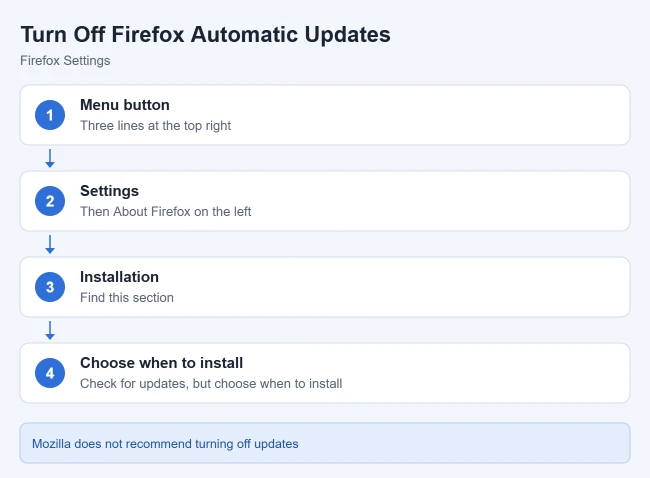
To stop Firefox from installing updates on its own, click the menu button, choose Settings, select About Firefox on the left, and under Installation select Check for updates, but choose when to install. Firefox keeps checking for new versions, but nothing is installed until you approve it.
Mozilla says this choice turns off automatic updates and does not recommend it, because only an up-to-date browser has the latest security fixes. If you make the change, plan to install updates yourself on a regular schedule.
Before You Start
- Where this applies: Firefox for Windows, Mac, and Linux computers that was downloaded from Mozilla. Labels in this guide match Mozilla’s support pages as they read in October 2026.
- Microsoft Store copies: Mozilla notes that Firefox installed from the Microsoft Store gets its updates through the Store, so the steps here do not control it.
- Linux packages: Firefox installed through a Linux distribution’s software manager is generally updated by that system instead of by Firefox, so the update options may be missing.
- No complete off switch in Settings: the old Never check for updates option was removed in Firefox 63. Mozilla’s release notes point to an enterprise policy as the substitute, which is covered later in this guide.
- Work or school computers: an administrator may control updates. In that case the setting can be locked or missing.
These steps follow Mozilla’s support articles on updating Firefox, background updates on Windows, and managing updates in organizations.
How to Turn Off Automatic Updates in Firefox
- Open Firefox and click the menu button (three horizontal lines) at the right side of the toolbar.
- Choose Settings. The Settings page opens in a new tab.
- Select About Firefox in the list on the left. The About Firefox panel opens and shows your version number.
- Find the Installation section.
- Select Check for updates, but choose when to install.
- Close the Settings tab. There is no Save button; the change applies as soon as you make the selection.
Result: Firefox still looks for new versions. When it finds one, it shows a notification asking for permission to download and install it instead of doing so by itself. On Windows, Mozilla notes that this choice also turns off background updates.
If Your Settings Page Looks Different
Older Firefox versions do not have an About Firefox panel in Settings. There, the same control is in the General panel:
- Click the menu button and choose Settings.
- Stay on the General panel and scroll down to Firefox Updates.
- Select Check for updates but let you choose to install them.
If you cannot find either layout, type update in the search box at the top of the Settings page. You can also type about:preferences in the address bar and press Enter to open Settings directly.
How to Stop Only Background Updates on Windows
A background update is one that Firefox installs while the browser is closed. On Windows, Mozilla explains that this feature adds a Firefox Background Update entry to Windows Task Scheduler, which checks for updates every 7 hours when the browser is not in use.
If you are fine with Firefox updating while it is open but do not want it working while closed:
- Go to Settings > About Firefox.
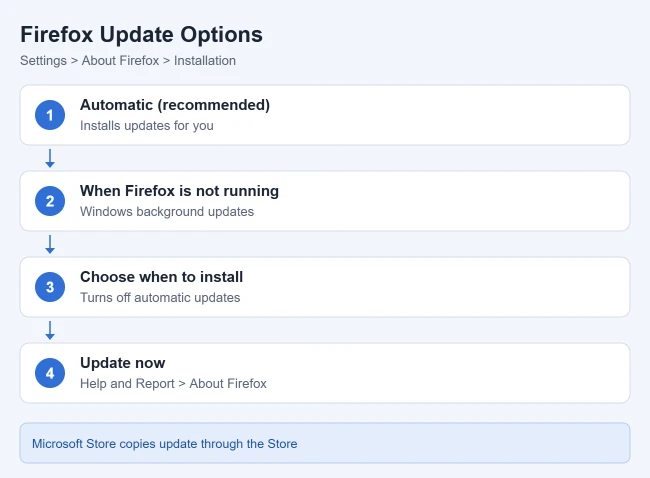
- Under Installation, keep Automatically install updates (recommended) selected.
- Clear the When Firefox is not running checkbox underneath it.
Result: Firefox keeps itself current, but only while it is running. This is the safer middle ground, since security fixes still arrive without any action from you.
How to Confirm the Change and Install Updates Yourself
To confirm the setting, reopen Settings > About Firefox and check that Check for updates, but choose when to install is still selected. From then on, updating is your job:
- Click the menu button.
- Go to Help and Report and select About Firefox. The About Mozilla Firefox window opens and checks for an update.
- Wait for the download to finish.
- Click Restart to update Firefox.
Updates are applied only after Firefox restarts. Our guide on how to check for updates in Firefox covers this window in more detail.
How to Turn Automatic Updates Back On
Return to Settings > About Firefox and select Automatically install updates (recommended). On Windows, check When Firefox is not running if you also want updates installed while the browser is closed.
Mozilla lists several requirements for background updates to run:
- Firefox was installed with the installer, not from a ZIP file.
- The Mozilla Maintenance Service is installed and not disabled. This is the default with the Firefox installer.
- Firefox has a default profile and has run with it at least once since the feature was enabled.
- No language pack is installed.
- Firefox connection settings use the system proxy, which is the default.
Advanced: Update Policies
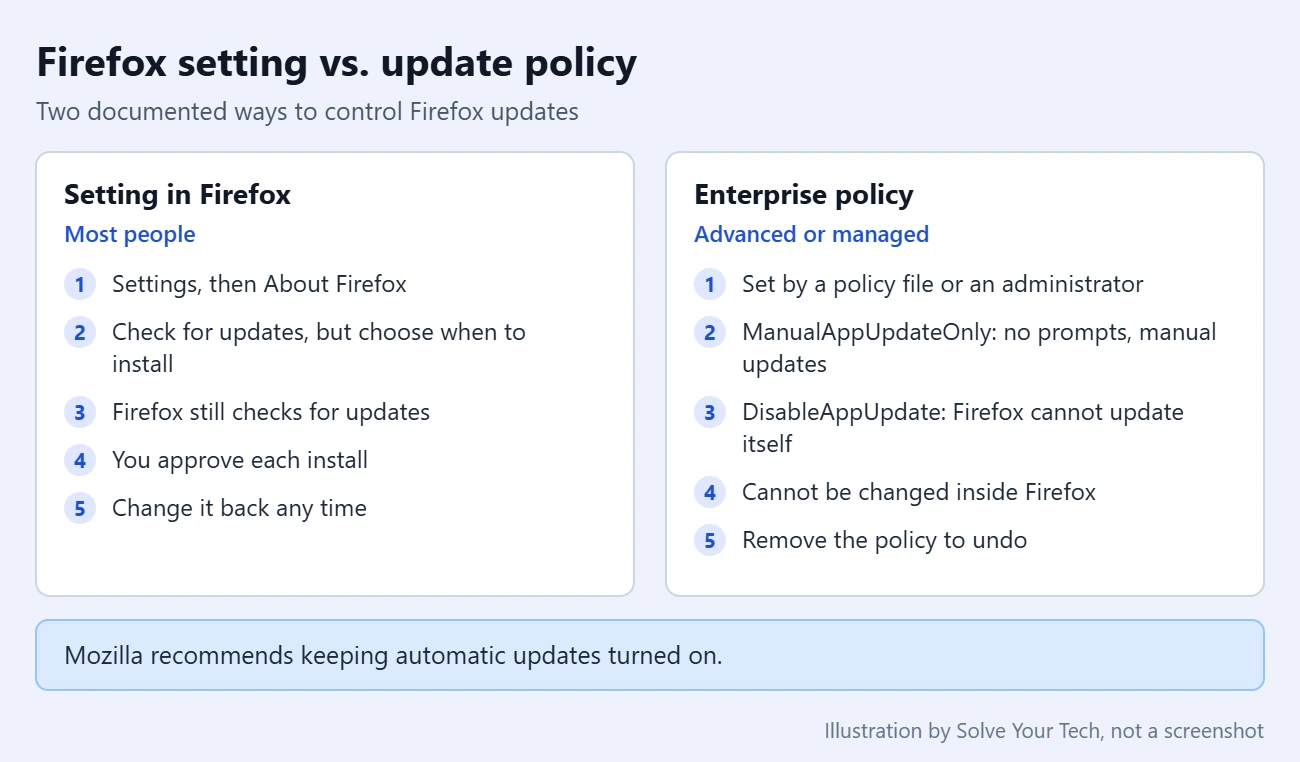
A policy is a rule that Firefox reads from outside the browser, normally set by an organization’s IT staff. Mozilla documents two that affect updates. Because they can keep updates from being installed, they cannot be switched on or off from inside Firefox.
| Policy | What Mozilla says it does |
|---|---|
| ManualAppUpdateOnly | Firefox never prompts you to update and does not check in the background. It checks only when you open an update screen such as About Firefox, where you can still update by hand. |
| DisableAppUpdate | Stops Firefox from updating itself. Neither automatic nor manual updating works. |
Warning: with DisableAppUpdate set, Firefox stays on its current version until the policy is removed, so it receives no security fixes. Mozilla describes ManualAppUpdateOnly as intended mainly for advanced users, and it is the less drastic of the two because the About Firefox window keeps working.
Policies can be set with a file named policies.json. Mozilla’s article on customizing Firefox with policies.json gives the locations:
- Windows: a folder named distribution in the same folder as the Firefox program file.
- Mac:
Firefox.app/Contents/Resources/distribution. - Linux: a distribution folder inside the Firefox installation directory, or
/etc/firefox/policiesfor the whole system.
The file for manual-only updates contains this text: { "policies": { "ManualAppUpdateOnly": true } }
Creating folders next to the Firefox program usually needs an administrator account. Mozilla also notes that the file method does not work if Firefox is already managed through Group Policy. To undo the change, delete the policies.json file, or remove the line from it, and restart Firefox. Do not edit policies on a computer your employer or school manages.
Want Fewer Updates Instead of None?
If frequent large updates are the real complaint, Mozilla points to Firefox Extended Support Release (ESR). According to Mozilla’s update channel article, regular Firefox gets major updates every two weeks, while ESR gets major updates about once a year on average and still receives security and crash fixes in between. Mozilla recommends regular Firefox for most people.
Troubleshooting
- The update options are missing or grayed out. A policy is probably in control. On a work or school computer, ask your IT department. Administrators can turn updates off with DisableAppUpdate or make them install silently with AppAutoUpdate.
- There is no When Firefox is not running checkbox. Mozilla describes background updates as a Windows feature, so do not expect the checkbox on a Mac or on Linux.
- Firefox still asks about updates. That is expected. With Check for updates, but choose when to install, Firefox keeps checking and notifies you when a new version is ready.
- About Firefox says it is up to date, but an update appears later. Mozilla notes that Firefox may still be downloading an update in the background while that window says the browser is current.
- An update will not install. Mozilla suggests downloading the Firefox installer, closing Firefox, and running the installer, which keeps your data. Restarting Firefox and the computer can also help.
Frequently Asked Questions
Is it safe to turn off Firefox updates?
Mozilla does not recommend it. Updates deliver security improvements, new features, and compatibility with websites, so a browser that falls behind is more exposed. If you switch to manual installs, check for updates regularly. Some older software has no updates left at all, as our article on automatic updates for Adobe Flash Player explains.
Can I make Firefox never check for updates?
Not from Settings. Mozilla removed the Never check for updates option in Firefox 63. The only documented ways to stop the checks are the ManualAppUpdateOnly and DisableAppUpdate policies described above.
Does changing app.update settings in about:config still work?
Many older guides suggest changing preferences such as app.update.enabled on the about:config page. Mozilla’s current instructions do not use that method; they point to the Settings option and to policies instead, so treat about:config advice as outdated.
Will turning off automatic updates stop add-on updates too?
No. The setting in this guide covers the Firefox application itself. Extensions and themes have their own update control in the Add-ons and themes manager. That is also where you can disable or delete a Firefox add-on.
Does this work on Firefox for iPhone or Android?
No. These steps are for the desktop browser. Mobile apps are updated through the App Store or Google Play, and app updates are controlled in those stores’ settings.
More Firefox Guides
If you changed the setting because an update moved things around, these guides can help you put Firefox back the way you like it.
- How to change Firefox tab settings
- How to switch to dark mode in Firefox
- How to show the menu bar in Firefox

Matthew Burleigh is the founder, head writer, and editor of Solve Your Tech, which he launched in 2012. He has written technology tutorials since 2008 and worked in IT since 2003, including small-business support, IT management, and consulting. He holds Bachelor’s and Master’s degrees in Computer Science from Arizona State University.
Matthew writes practical guides for Windows, iPhone and iPad, Microsoft Office, Outlook, Google apps, and Android. Solve Your Tech’s guides are tested on current devices or checked against official product documentation, with clear steps, sources, and update dates.
Read more about Matthew and how Solve Your Tech writes and updates its guides, or report a correction.