To show formulas in Google Sheets, press Ctrl + ~ (the same shortcut on Windows, Mac, and Chromebook), or click View > Show > Formulas. Every cell that holds a formula then displays the formula instead of its result, and doing the same thing again switches back to results.
These steps are for Google Sheets in a web browser on a Windows PC, Mac, or Chromebook. The shortcut comes from Google’s list of Sheets keyboard shortcuts, where it’s called “Show all formulas.” The Sheets app for iPhone, iPad, and Android doesn’t have this whole-sheet view, but you can still check a formula one cell at a time, as covered below.
Show All Formulas in a Sheet
- Open the spreadsheet in Google Sheets.
- Press Ctrl + ~. On most US keyboards, the ~ key is the same key as the backtick (`), just left of the 1 key, so you don’t need to hold Shift. Mac users also press Ctrl, not Command.
- Or click View in the menu bar, point to Show, and click Formulas. A check mark appears next to Formulas when the view is on. If your Google account language is set to English (UK), the same item is labeled Formulae.
 Formulas selected” class=”wp-image-171141″/>
- Look over the sheet. Cells with formulas now show the formula text, and the columns widen so the formulas fit. Cells that contain plain numbers or text don’t change.
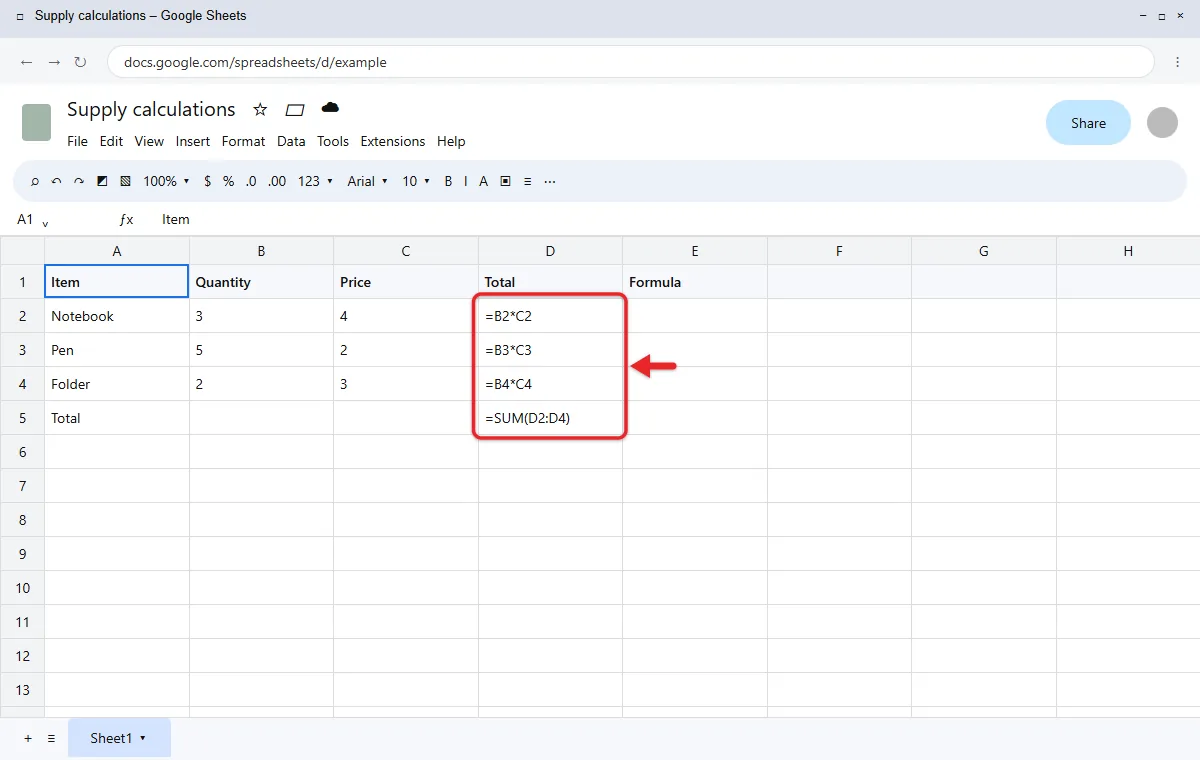
- Press Ctrl + ~ again, or click View > Show > Formulas again, to go back to the calculated results.
For example, a total cell that showed 1,250 now shows something like =SUM(B2:B10). While the view is on, you see formulas in place of results, not both at once. If you need the two side by side, use FORMULATEXT, covered below.
The formula view stays on until you turn it off. It only changes what you see; your formulas, values, and formatting stay exactly the same.
Formulas also stay hidden when you publish a sheet, so readers see only results if you embed a Google Sheet in WordPress.
Check a Single Formula
You don’t need to switch the whole sheet just to read one formula.
- Click the cell.
- Read the formula in the formula bar, the long box marked fx just above the column letters.
- To edit it, double-click the cell or click inside the formula bar. Sheets color-codes each cell reference in the formula and outlines the matching cells in the same color, which makes it easy to see which cells feed the result.
While you edit, Sheets may show a small preview of the result above the cell. Google’s shortcut list says F9 turns these formula result previews on or off (Fn + F9 on many Mac keyboards).
If formula pop-ups get in the way while you edit, you can turn off autocomplete and formula suggestions in Sheets.
If you don’t see a formula bar, click View > Show > Formula bar to turn it back on.
If the View menu itself is missing, unhide the menu in Google Sheets first.
On a phone or tablet: open the spreadsheet in the Google Sheets app and tap the cell. The formula appears in the formula bar. Tap the formula bar to edit it.
Show a Formula Next to Its Result With FORMULATEXT
Sometimes you want the formula and the result visible at the same time, for example when you’re documenting a sheet, teaching someone how a calculation works, or printing a copy that shows your work. According to Google’s FORMULATEXT help page, the FORMULATEXT function returns the formula in a cell as text. If D2 holds a formula, typing =FORMULATEXT(D2) in E2 shows the text of that formula in E2, while D2 keeps showing its result.
- Click an empty cell next to the one you want to document. In this example, that’s E2.
- Type the FORMULATEXT formula with the address of the formula cell inside the parentheses, then press Enter. The cell now shows the formula as text.
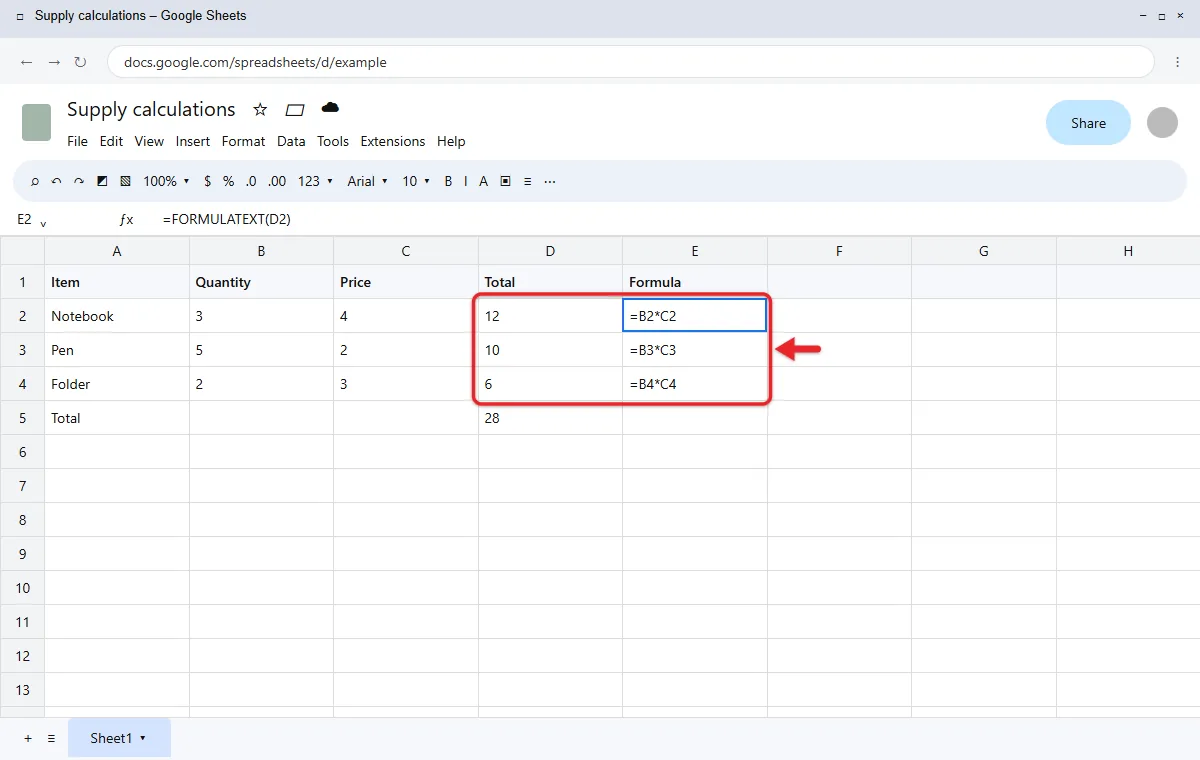
- To do the same for a whole column, click E2, then drag the small blue square at its bottom right corner down the column. Each row shows the formula from its own D cell.
If the referenced cell holds a plain value instead of a formula, FORMULATEXT returns an #N/A error. Because FORMULATEXT shows up like any other cell content, it’s also the most reliable way to get formulas onto a printout.
Type or Copy a Formula as Text With an Apostrophe
If you want a cell to display a formula without calculating it, type an apostrophe first. Typing '=SUM(A1:A5) makes the cell show =SUM(A1:A5) as plain text, and Sheets doesn’t run it. The apostrophe doesn’t appear in the cell, but you can still see it in the formula bar. Delete it from the formula bar when you want the formula to calculate again.
To copy an existing formula into another cell as text, click the formula cell, select the formula in the formula bar, and press Ctrl + C (Command + C on a Mac). Then click an empty cell, type an apostrophe, and press Ctrl + V (Command + V). This is a fixed copy, so unlike FORMULATEXT it won’t update if the original formula changes later.
Highlight Every Cell That Contains a Formula
In a large sheet, the formula view can be hard to scan. Conditional formatting can shade every formula cell instead, so you can see at a glance which cells are calculated and which hold typed values. The rule uses Google’s ISFORMULA function, which checks whether a cell contains a formula. If your range starts at A1, the custom formula is =ISFORMULA(A1); use the top-left cell of your own range in place of A1, with no dollar signs, so the rule checks each cell in turn.
- Select the range you want to check, such as A1:Z1000.
- Click Format > Conditional formatting. The rules panel opens on the right.
- Under Format rules, open the Format cells if menu and choose Custom formula is.
- Type the ISFORMULA formula in the Value or formula box.
- Pick a fill color under Formatting style and click Done. Every cell in the range that contains a formula is now shaded.
Delete the rule from the same panel when you no longer need it. Google’s conditional formatting help page has more on custom formula rules.
If Formulas Don’t Show
Ctrl + ~ does nothing
On some keyboard layouts, such as UK, German, or French keyboards, the ~ and backtick characters sit on a different key, so the shortcut doesn’t fire. Use View > Show > Formulas instead; it does exactly the same thing. Some websites list Ctrl + ‘ (apostrophe) as the shortcut, but the official one is Ctrl + ~. Also make sure your cursor isn’t inside a cell you’re editing, and that a browser extension isn’t using the same shortcut.
A cell shows a formula even with the view turned off
The cell is stored as text. This happens when a cell was formatted as Plain text before you typed the formula, or when the formula starts with an apostrophe or a space. Select the cell, click Format > Number > Automatic, then click into the formula bar, remove any leading apostrophe or space, and press Enter.
The formula view shows a value, not a formula
That cell holds a typed value, not a formula. This often happens after someone uses Paste special > Values only, which replaces formulas with their results. Use File > Version history to find an older version if you need the original formulas back.
Sheets Formula View Questions
Does showing formulas change my data?
No. It only changes the display on your screen. Your formulas and results stay the same, and you can switch back at any time.
Is there a way to show formulas on the Google Sheets mobile app?
Not for the whole sheet. Tap any cell to see its formula in the formula bar, or add a FORMULATEXT column on a computer so the formulas are visible in the app too.
Can other people see my formulas?
Yes. Anyone who can open the spreadsheet can click a cell and read its formula in the formula bar. Protecting a sheet with Data > Protect sheets and ranges only limits editing, and Google’s protection help page says it shouldn’t be used as a security measure. To share only the results, make a copy of the file with File > Make a copy. In the copy, select the cells, press Ctrl + C, then right-click and choose Paste special > Values only before you share it. You can also review how to share or unshare a Google Sheets file to control who can open it.
Can I print formulas in Google Sheets?
The dependable way is to add FORMULATEXT columns next to the cells you want to document, then print with File > Print. If the formulas make your columns too wide, you can print on one page in Google Sheets.
Why do my formula results look out of date?
Showing formulas doesn’t affect calculation. If results that use functions like NOW or TODAY aren’t updating when you expect, check the recalculation settings in Google Sheets.

Matthew Burleigh is the founder, head writer, and editor of Solve Your Tech, which he launched in 2012. He has written technology tutorials since 2008 and worked in IT since 2003, including small-business support, IT management, and consulting. He holds Bachelor’s and Master’s degrees in Computer Science from Arizona State University.
Matthew writes practical guides for Windows, iPhone and iPad, Microsoft Office, Outlook, Google apps, and Android. Solve Your Tech’s guides are checked step by step against the device or app maker’s own documentation and tested on his own devices whenever he has the hardware or software, with clear steps, sources, and update dates.
Read more about Matthew and how Solve Your Tech writes and updates its guides, or report a correction.