To remove sheet or range protection in Google Sheets, open the spreadsheet on a computer, click Data > Protect sheets and ranges, click the protection you want to remove in the panel on the right, and click the delete (trash can) button. You need edit access to the spreadsheet, and an editor cannot take permissions away from the file owner.
The steps below follow Google’s Protect, hide & edit sheets help page as it reads in October 2026. They apply to Google Sheets in a desktop web browser, with a personal Google Account or a work or school account.
Before You Start
A protection is a rule that limits who can edit a whole sheet (one tab of the spreadsheet) or a range (a block of cells). It is separate from sharing, which decides who can open the file at all. Check these points first:
- Use a computer. Google’s help pages for Android, iPhone and iPad say to use Google Sheets on a computer for sheet and range protection, so plan to make this change in a desktop browser.
- You need edit access. Google says people who can only view or comment on a spreadsheet cannot make any changes to protections.
- Owners have the final say. If you own the spreadsheet, you decide who can change ranges and sheets. If you are an editor, you can decide who edits ranges and sheets, but you cannot take permissions away from the owner.
- The file must be a Google Sheets file. An Excel file opened in Office editing mode does not show the protection menu. If you opened an Excel file, save it as a Google Sheets file first.
Warning: deleting a protection takes effect for everyone. Once it is gone, every person with edit access to the spreadsheet can change those cells, including formulas. If only one or two people need access, change who can edit the range instead of deleting it.
How to tell a sheet is protected
A tab with sheet protection usually shows a small lock icon next to its name at the bottom of the window. Range protections do not change the tab, so the quickest check for both kinds is View > Show > Protected ranges, which puts a striped background on every protected cell.
How to Remove Protection in Google Sheets
- Open the spreadsheet in Google Sheets on your computer.
- Click Data in the menu at the top, then click Protect sheets and ranges. A panel opens on the right side of the window. For a protected tab, you can also right-click the tab name and choose Protect sheet to open the same panel.
- If the panel opens on a form for adding a new protection, click Cancel. This shows the full list of ranges and sheets that have protections.
- Click the protection you want to remove. Each entry shows the sheet or cell range it covers, along with a description if someone added one.
- Click the delete (trash can) button next to the name.
- In the box that asks if you are sure, click Remove.
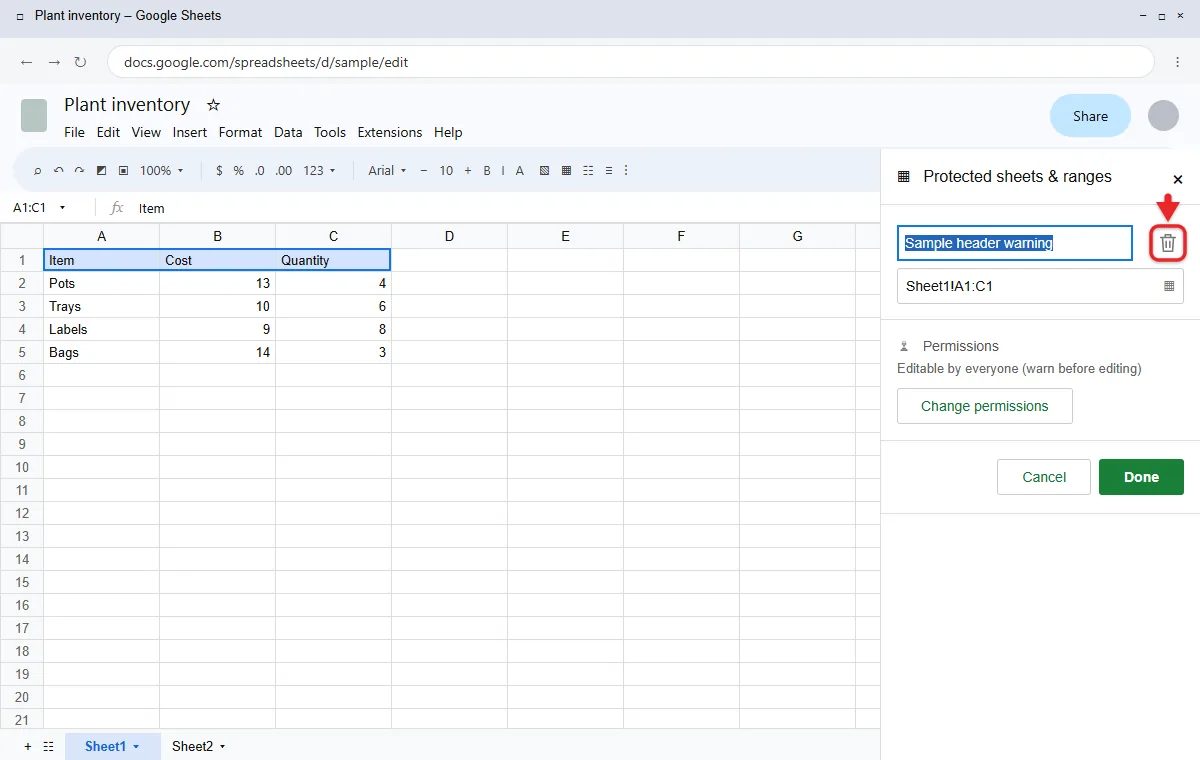
The protection disappears from the list in the panel, and the lock icon leaves the tab if that was the sheet protection. Anyone who can edit the spreadsheet can now change those cells. Each protection is removed separately, so repeat steps 4 to 6 for every sheet or range you want to unlock.
Sheet protection and range protection are removed the same way
The panel lists both kinds of protection together. A sheet protection covers a whole tab, sometimes with a few cells left open. A range protection covers specific cells, such as A1:G10 or a whole column. The removal steps are identical for both. Make sure you click the right entry, because a single tab can have a sheet protection and several range protections at the same time.
How to Change Who Can Edit Instead of Removing Protection
You do not have to delete a protection to let someone work in those cells. Editing the permissions keeps the lock in place for everyone else.
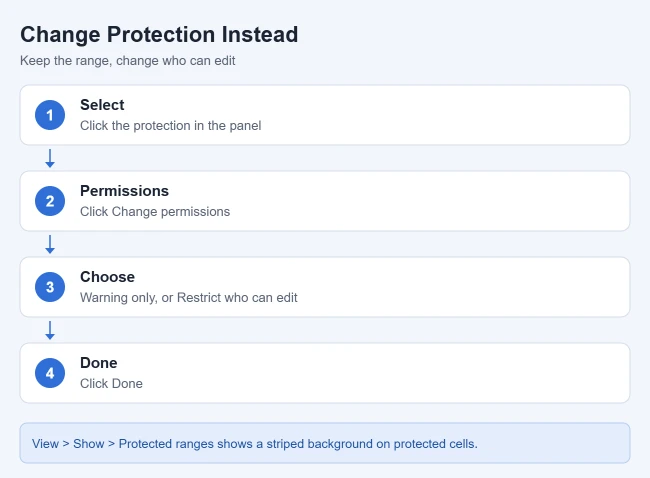
- Click Data > Protect sheets and ranges, then click the protection in the panel.
- Click Change permissions.
- To keep a limit on who can edit, select Restrict who can edit this range and choose an option from the list (described in the table below). To add one person, choose Custom and check the box next to their name, or type their email address.
- To replace the lock with a reminder, select Show a warning when editing this range instead.
- Click Done.
| Option | What Google says it does |
|---|---|
| Only you | Only you, plus the owner if you are not the owner, can edit the range or sheet. |
| Only domain | For work or school accounts. Only people in your domain can edit. It is offered only when everyone in your domain can edit the spreadsheet. |
| Custom | Only the people you choose can edit the range or sheet. |
| Copy permissions from another range | Reuses the permissions you already set up on a different range or sheet. |
| Show a warning when editing this range | Does not block anyone. People get a message asking them to confirm the edit. |
The protection stays in the list, and the people you picked can edit the cells. Protection only narrows editing, so a person also needs edit access to the spreadsheet itself, which is set with the Share button.
Unprotect only part of a sheet
When the protection covers a whole sheet, click it in the panel and check the box next to Except certain cells. Then pick the cells that should stay open. The rest of the sheet remains locked, which works well for a form or template where people should fill in only a few cells.
How to Confirm the Protection Is Gone
Click View > Show > Protected ranges. Google Sheets places a striped background over every cell that is still protected. Cells without stripes have no protection on them.
You can also reopen Data > Protect sheets and ranges and read the list. If the entry you deleted is missing, the removal worked. If a cell is still striped, another protection overlaps it, and you need to remove that one too.
How to Put Protection Back
Deleting a protection does not delete any data, so you can add the rule again at any time.
- Click Data > Protect sheets and ranges.
- Click Add a sheet or range.
- Click Range to protect specific cells, or Sheet to protect a whole tab.
- Click Set permissions and choose how to limit editing.
- Click Save or Done.
The new protection has to be set up from scratch, so note the range and the list of editors before you delete one you might want back. If someone changed the cells while they were unlocked, you can undo it by restoring an older version of the file.
What to Do If You Can’t Remove Protection
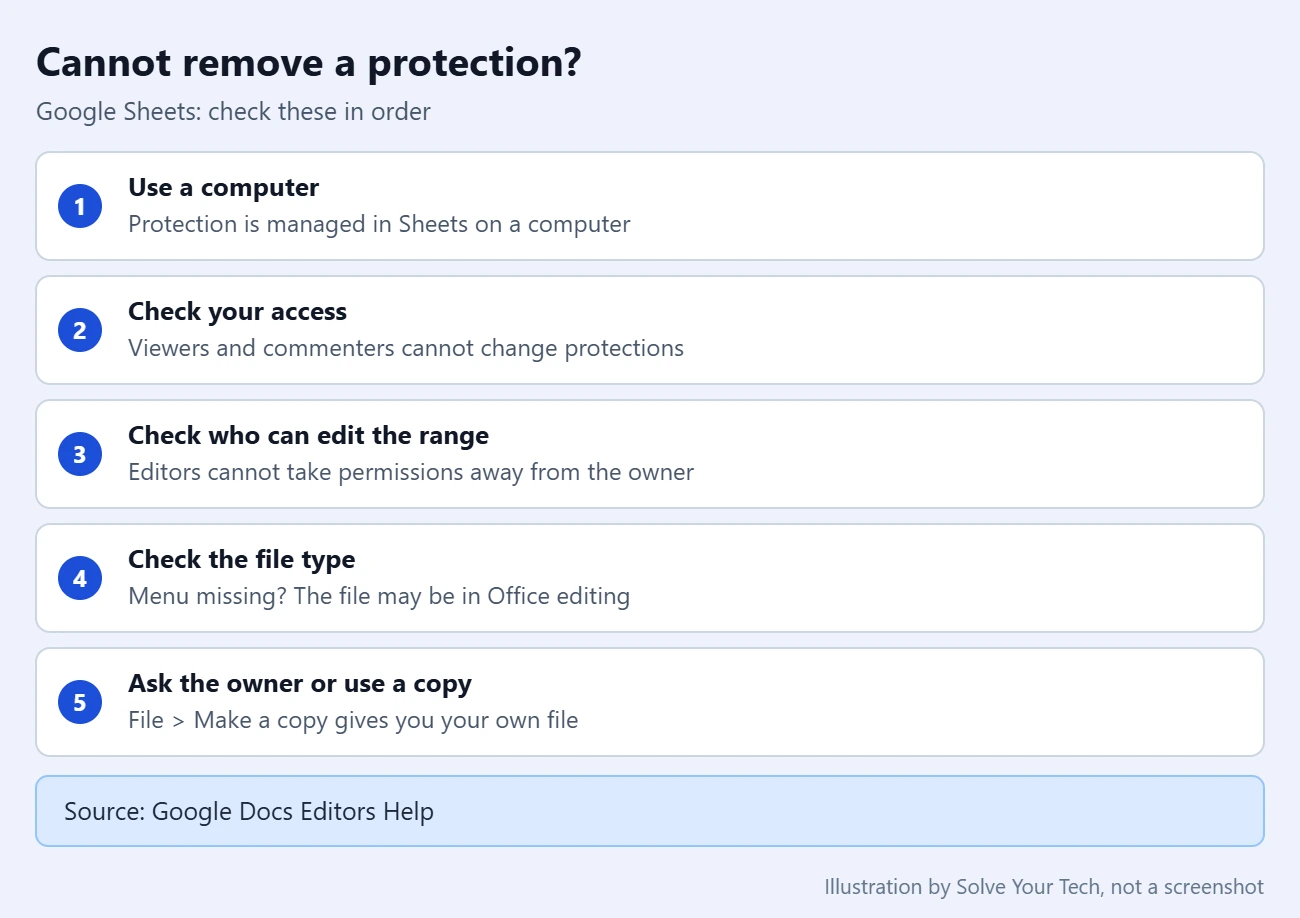
Work through these in order. Each one matches a known limit of sheet protection.
You can only view or comment
Viewers and commenters cannot change protections. Ask the owner to make you an editor, or ask them to remove the protection for you. Click Share at the top right of the spreadsheet to see who the owner is.
You are an editor, but the range is restricted to someone else
Editors cannot take permissions away from owners. If the owner limited a range to themselves or to a custom list that leaves you out, ask the owner or one of the listed people to add you with Change permissions. Protection is the owner’s decision, so asking is the right route rather than looking for a way around it.
The Protect sheets and ranges option is missing
When this option is not visible, you are likely in Microsoft Office editing. That is the mode Sheets uses when you open an Excel file, such as an .xlsx file, without converting it. To get the option, click File > Save as Google Sheets. This saves a copy in Google Sheets format, and you work in that new file. Google’s Work with Office files using Office editing page explains this mode, and there are other ways to open an XLSX file if you’d rather not convert it.
You are on a phone or tablet
Google’s Android and iPhone & iPad help pages both say to use Google Sheets on a computer for protecting a sheet or range. Open the spreadsheet in a desktop browser and follow the steps above.
You just need to work with the data
Making a copy is the fallback for people who cannot edit a protected sheet. If you can view but not edit, you can make a copy of the spreadsheet. If you can edit, you can also copy the protected sheet, copy the workbook, or upload a new version.
- Open the spreadsheet and click File > Make a copy.
- Type a name and choose where to save it in Google Drive.
- Click the button to finish. Google’s steps label it OK.
The copy is a separate file that you own. Your edits there do not change the original, and later changes to the original do not appear in your copy. This is not a way around the owner’s wishes for the original file: it stays protected, and an owner can turn off the option for viewers and commenters to download, print, and copy a file. If Make a copy is unavailable, the owner has likely done that, and asking for access is the only route. Google’s steps are in Create, view, or download a file.
If you only need to sort or filter the data for yourself, a filter view may be enough, and you do not need to change protection at all. To set one up, create a filter in Google Sheets.
What Sheet Protection Does Not Do
- It is not a security feature. Protection should not be used as a security measure. People can still print, copy, paste, import, and export copies of a protected spreadsheet. Only share spreadsheets with people you trust.
- There is no password. Sheet protection cannot protect data with a password. Nobody can “forget the password” to a protected sheet, because access is tied to Google Accounts.
- It does not hide anything. Protected cells stay visible to everyone who can open the file. Hiding is a separate feature, and all editors can unhide hidden sheets. You can also rename, add, or hide a sheet tab.
- Excel protection does not carry over. When a protected Excel workbook or worksheet is brought into Google Sheets, its locked and hidden cells become viewable and editable.
To take individual columns out of view instead, hide and unhide a column in Google Sheets.
<p>If the spreadsheet is an Excel workbook that needs a real password to open, see <a href=”https://www.solveyourtech.com/password-protect-excel-file/”>how to password protect an Excel file</a>.</p>Frequently Asked Questions
Does removing protection change who the spreadsheet is shared with?
No. Protection only controls which editors can change certain cells. The list of people who can open the file stays the same. To change that list, use the Share button. From there you can share or unshare the Google Sheets file.
Can I remove protection from a Google Sheet I don’t own?
Yes, if you are an editor and the protection does not restrict you. Editors can decide who can edit ranges and sheets, but cannot take permissions away from owners. If you can only view or comment, you cannot change protections at all.
Why do I get a warning when I edit a cell?
The range uses the Show a warning when editing this range setting. This setting does not block edits. It shows a message asking you to confirm that you really want to make the change. To stop the message, delete that protection with the steps above.
Can I lock formatting but still let people type in the cells?
No. Protecting a sheet cannot lock the formatting of cells while still letting users edit the input values.
Can I remove all protections at once?
The Protect sheets and ranges panel has no “remove all” button, so you delete entries one at a time. For a spreadsheet with dozens of protections, Google’s Apps Script reference for the Protection class includes a sample script that removes every range protection you have permission to edit. A script cannot remove protections you are not allowed to change, and it acts on the whole file, so make a copy first and only run code you understand.
How can I tell which cells are protected?
Click View > Show > Protected ranges. Protected cells get a striped background.
Next Step
Once the cells are unlocked, check that any formulas in them still look right before other editors start typing. Turning on formula view makes that quick, so show formulas in Google Sheets and scan them.

Matthew Burleigh is the founder, head writer, and editor of Solve Your Tech, which he launched in 2012. He has written technology tutorials since 2008 and worked in IT since 2003, including small-business support, IT management, and consulting. He holds Bachelor’s and Master’s degrees in Computer Science from Arizona State University.
Matthew writes practical guides for Windows, iPhone and iPad, Microsoft Office, Outlook, Google apps, and Android. Solve Your Tech’s guides are checked step by step against the device or app maker’s own documentation and tested on his own devices whenever he has the hardware or software, with clear steps, sources, and update dates.
Read more about Matthew and how Solve Your Tech writes and updates its guides, or report a correction.