To view or hide gridlines in Google Sheets on an iPhone, open the spreadsheet in the Sheets app, tap the name of the sheet tab at the bottom of the screen, then tap the switch next to Gridlines. The change applies only to that sheet tab, and you can switch it back the same way at any time.
Gridlines are the faint gray lines that separate the cells in a spreadsheet. They make rows and columns easier to follow, but they can make a finished report, form, or dashboard look cluttered. This guide covers the iPhone steps, how gridlines differ from borders, what to do when the setting is missing, and how to make the same change on a computer.
Before You Start
- The app. You need the Google Sheets app, signed in to the Google account that can open the file. If you do not have it, Google Sheets is a free download in the App Store.
- Edit access. Hiding or showing gridlines changes the sheet itself, so you need to be able to edit the file. If someone shared it with you as view only or comment only, ask the owner for edit access or make your own copy.
- One sheet at a time. Google treats gridlines as a property of each individual sheet, not of the whole file. A spreadsheet with three sheet tabs has three separate gridline settings.
- It is shared. Because the setting is saved in the file, other people who open that sheet see the same result. It is not a private view that only affects your phone.
A note on versions: Google updates the Sheets app often, and its iPhone help pages describe the sheet tab menu without listing every item in it. The labels below match the menu as this site has shown it and as other current guides describe it, but a label or icon can look slightly different in your version of the app.
How to View or Hide Gridlines in the Google Sheets iPhone App
- Open the Sheets app on your iPhone.
- Tap the spreadsheet you want to change. It opens with the sheet tabs in a row at the bottom of the screen.
- Tap the sheet tab you want to change so it is the active one. The active tab is highlighted.
- Tap that same tab name again, or tap the small Down arrow on the tab. A menu of options for that sheet opens. Google documents this menu as the place to duplicate, rename, or delete a sheet on iPhone and iPad.
- Find Gridlines in the menu. You may need to scroll down a little to see it.
- Tap the switch to the right of Gridlines. Switch it off to hide the gridlines, or on to show them.
- Tap anywhere on the spreadsheet to close the menu.
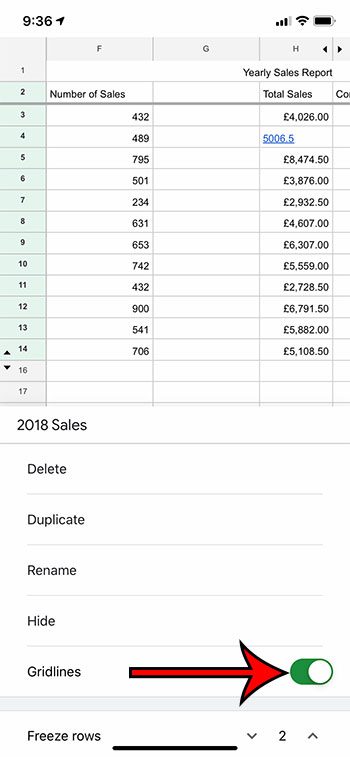
The screenshot above comes from an earlier version of the app, so the colors and spacing on your iPhone may not match it exactly. The item to look for is still the Gridlines switch in the sheet tab menu.
How to Confirm It Worked
Look at an empty area of the sheet. With gridlines hidden, blank cells run together as one plain background and only your data, fill colors, and borders remain. With gridlines shown, you see the light gray lines around every cell again. There is no save button. Google Sheets saves the change for you.
How to Undo It
Open the same sheet tab menu and tap the Gridlines switch again. Nothing is deleted when you hide gridlines. Your values, formulas, and formatting stay exactly as they were.
Gridlines vs. Borders in Google Sheets
These two kinds of lines look similar, and mixing them up is the most common reason the gridlines switch seems not to work.

Gridlines are a display setting for a whole sheet. They are either all on or all off, and you cannot change their color or thickness. Borders are formatting that you apply to specific cells, with a style and color you choose. When Google first added the option to hide gridlines, it described the result as leaving only the borders that had been put there. That is still how it works: borders stay visible after gridlines are hidden.
This is useful. If you want lines around a table but nowhere else, hide the gridlines and then add borders to just that table. Google lists the iPhone steps in its guide to editing and formatting a spreadsheet: select the cells, tap Format, open the Cell tab, and use Borders, Border style, and Border color. Our guide on how to add or remove borders in Google Sheets walks through those options in more detail.
How to Hide Gridlines for Only Some Cells
There is no setting that hides gridlines for part of a sheet. The switch covers the entire sheet tab. You have two workable options on an iPhone.
- Hide everything, then add lines back. Turn off Gridlines, select the cells that should have lines, and apply borders to them from Format > Cell > Borders.
- Cover the gridlines in a small area. Leave gridlines on, select the cells you want to look blank, and give them a white cell fill color or white borders from the same Cell tab. This does not turn anything off. It only places formatting over the lines, so you will need to remove that formatting later if you want the gridlines back in that area. Our guide on how to remove fill color in Google Sheets covers that step.
The first option is usually cleaner, because you are not left with hidden formatting that someone else has to find later.
How to Show or Hide Gridlines on a Computer
If you cannot find the setting in the app, or you have many sheet tabs to change, a computer is quicker.
- Open the spreadsheet at sheets.google.com in a web browser.
- Click the sheet tab you want to change at the bottom of the window.
- Click View in the menu at the top.
- Point to Show.
- Click Gridlines. A check mark next to it means gridlines are visible. No check mark means they are hidden.
Because the setting lives in the file, the sheet looks the same the next time you open it in the iPhone app. Our article on how to show formulas and gridlines in Google Sheets covers the rest of that Show menu.
Gridlines When You Print or Export
The on-screen setting and the printed page are not always the same thing. In the web version of Google Sheets, the print settings have their own gridlines option under Formatting, so a sheet can show gridlines on screen and still print without them.
On an iPhone, Google describes printing as tapping More, then Share & export, then Print, and then choosing your print settings. Its instructions for printing from Google Sheets do not mention a gridlines option on iPhone, so check the preview before you print. If the lines matter for a printed copy, the dependable choice is to print from a computer, or to add borders to the cells, since borders are part of the cell formatting. See our guide on how to print a Google Sheet on one page for the other print settings. The same advice applies if you convert a Google Sheet to PDF or Excel: open the exported file and confirm the lines look the way you expect.
Troubleshooting: The Gridlines Setting Is Missing or Does Not Work

- You do not see Gridlines in the menu. Make sure you opened the sheet tab menu at the bottom of the screen, not the More menu at the top. Scroll within the menu. If it is still not there, update Google Sheets in the App Store and try again.
- The menu does not open, or the switch is grayed out. You probably have view-only or comment-only access. Ask the owner for edit access. A file that is still in Microsoft Excel format can also behave differently from a native Google Sheets file.
- Lines are still there after you hide gridlines. Those are cell borders. Select the cells, tap Format, open the Cell tab, and clear the borders.
- Gridlines are on, but some cells have no lines. A cell fill color, including white, can cover the gridlines, and merged cells do not show lines inside the merged area. Reset the fill color for those cells to bring the lines back.
- Only one tab changed. That is expected. Repeat the steps on each sheet tab.
- Someone else changed it back. Anyone with edit access can flip the same switch. Agree on the look with the people you share the file with.
Frequently Asked Questions
Does hiding gridlines in Google Sheets delete anything?
No. Hiding gridlines only changes how the sheet looks. Your data, formulas, and formatting are untouched, and you can turn the gridlines back on with the same switch.
Can I hide gridlines on every sheet at once on an iPhone?
No. The gridlines setting belongs to each sheet tab, so you have to open the sheet tab menu and tap the Gridlines switch on each tab you want to change.
Can I change the color of gridlines in Google Sheets?
No. Gridlines can only be shown or hidden. If you want darker or colored lines, hide the gridlines and add cell borders in the color and style you want.
Will other people see the gridlines I hid?
No, they will see the sheet without gridlines too. The setting is saved in the spreadsheet, so it follows the file to every device and every person who opens that sheet.
Are the steps the same on an iPad?
Google publishes one set of Sheets instructions for iPhone and iPad, and the sheet tab menu works the same way on both. The larger iPad screen may place the menu differently.
Next Step
Once the gridlines look the way you want, you can keep tidying the sheet from your phone. Add borders around the tables that need them, or see how to insert a picture in Google Sheets if the sheet needs a logo or photo.

Matthew Burleigh has been writing tech tutorials since 2008. His writing has appeared on dozens of different websites and been read hundreds of millions of times.
After receiving his Bachelor’s and Master’s degrees in Computer Science he spent several years working in IT management for small businesses. However, he now works full time writing content online and creating websites.
His main writing topics include iPhones, Microsoft Office, Google Apps, Android, and Photoshop, but he has also written about many other tech topics as well.