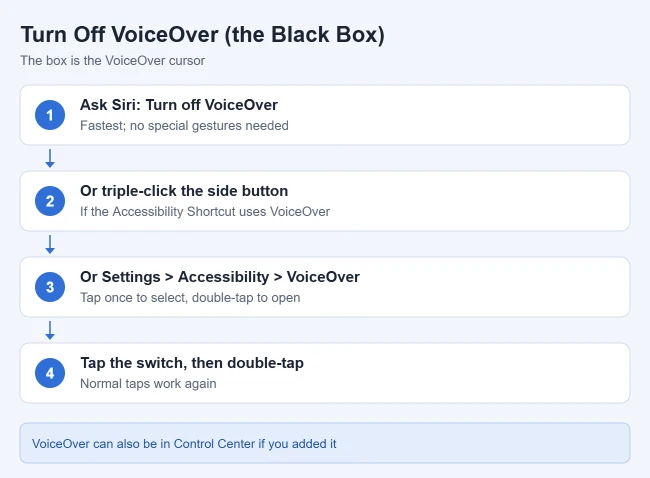
A black box around icons on your iPhone usually means VoiceOver is turned on. The box is the VoiceOver cursor, and it shows which item the phone is reading out loud. The fastest way to turn it off is to ask Siri, “Turn off VoiceOver.” You can also go to Settings > Accessibility > VoiceOver and turn it off.
This guide covers iPhones running iOS 27. The same Settings paths work on iOS 13 and later; on older versions, such as the iOS 10 that an iPhone 5 runs, Accessibility is under Settings > General instead. If your box looks different, such as a magnified window, a floating gray button or a blue box that moves by itself, use the table below to find the right fix.
Which Box Do You Have?
| What you see | Most likely cause | Quick fix |
|---|---|---|
| Black outline jumps to whatever you touch, and the phone talks | VoiceOver | Ask Siri to turn off VoiceOver |
| Part of the screen is magnified inside a box, sometimes with a small handle | Zoom (Window Zoom) | Double-tap the screen with three fingers |
| A dark gray square or circle floats on the screen | AssistiveTouch | Settings > Accessibility > Touch > AssistiveTouch |
| A box moves around the screen on its own, highlighting items one at a time | Switch Control | Triple-click the side or Home button |
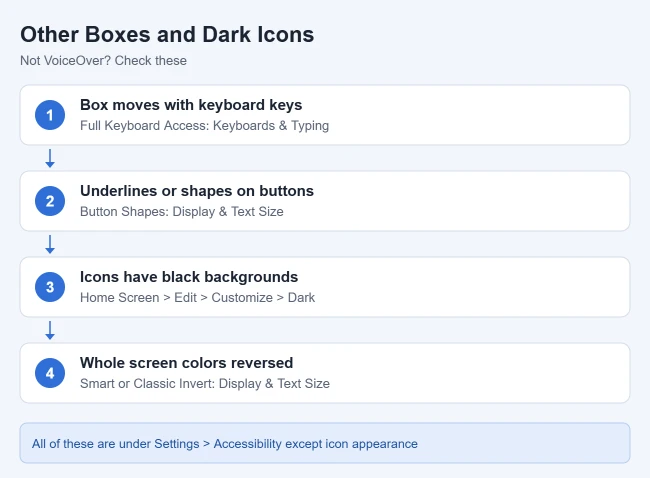
| A box moves only when you press keys on a keyboard | Full Keyboard Access | Turn it off in Keyboards & Typing |
| Icons themselves are dark, with no outline | Dark app icon appearance | Customize the Home Screen |
Why the iPhone Feels Hard to Use Right Now
Apple’s Turn on and practice VoiceOver guide explains that VoiceOver is a gesture-based screen reader, and that when it’s on, you must use VoiceOver gestures to operate iPhone. From Apple’s VoiceOver gestures guide, the ones you need right now are:
- Tap once to select an item and hear its name. The black box moves to it.
- Double-tap anywhere to open or press the selected item.
- Swipe with three fingers to scroll a page.
- Split-tap: touch and hold an item with one finger, then tap the screen with another finger, instead of double-tapping.
If a double-tap doesn’t work, Apple suggests trying a quicker movement. To unlock a locked iPhone while VoiceOver is on, tap the passcode digits once each to select them and double-tap to enter them, or use Face ID as usual.
If you keep VoiceOver on but it talks too fast, you can slow down the VoiceOver speaking rate in its settings or with the rotor.
How to Turn Off VoiceOver and Remove the Black Box
Option 1: Ask Siri
Press and hold the side button (or say “Siri” or “Hey Siri”), then say “Turn off VoiceOver.” Siri is the easiest way to turn VoiceOver on or off because you don’t need any special gestures.
Option 2: Use Settings
- Tap Settings once to select it, then double-tap to open it. Settings opens.
- Tap Accessibility, then double-tap. Accessibility settings open.
- Tap VoiceOver, then double-tap. VoiceOver settings open.
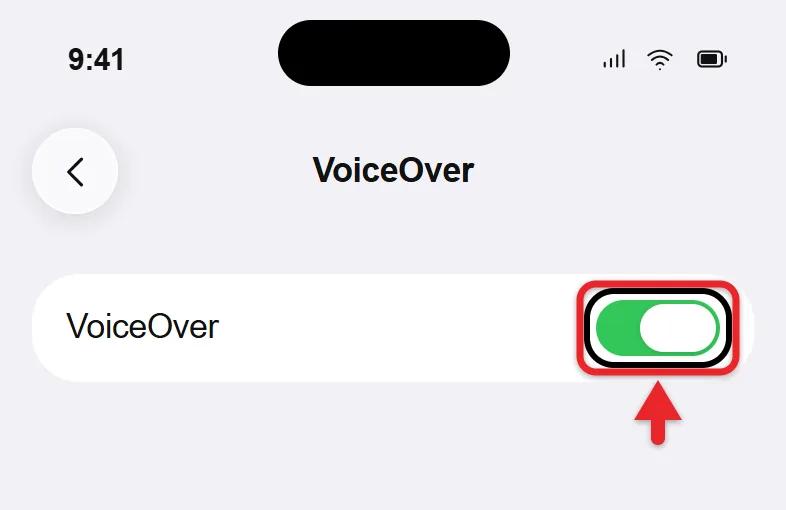
- Tap the VoiceOver switch, then double-tap to turn it off. The black box disappears and single taps work normally again.
Option 3: Triple-click the side button
If the Accessibility Shortcut is set to VoiceOver, triple-click the side button (or the Home button on iPhones with one) to turn it off. If more than one feature is assigned to the shortcut, a menu appears; select VoiceOver and double-tap it. The same shortcut can also switch on Voice Control, and turning off Voice Control, VoiceOver or Siri covers each feature in one place.
Option 4: Use Control Center
You can also turn VoiceOver off from Control Center if you’ve added the VoiceOver control there.
How VoiceOver Got Turned On
It’s usually the Accessibility Shortcut. A triple-click of the side button can turn VoiceOver on by accident, for example when the phone is in a pocket or you press the button while putting on a case. To stop that, go to Settings > Accessibility > Accessibility Shortcut and uncheck VoiceOver. If you want to keep a shortcut for another feature, leave that one checked. On an iPad that is locked with VoiceOver running, the steps for turning off VoiceOver on a locked iPad cover the triple-click, Siri and passcode entry.
Other Boxes That Aren’t VoiceOver
A magnified box or lens (Zoom)
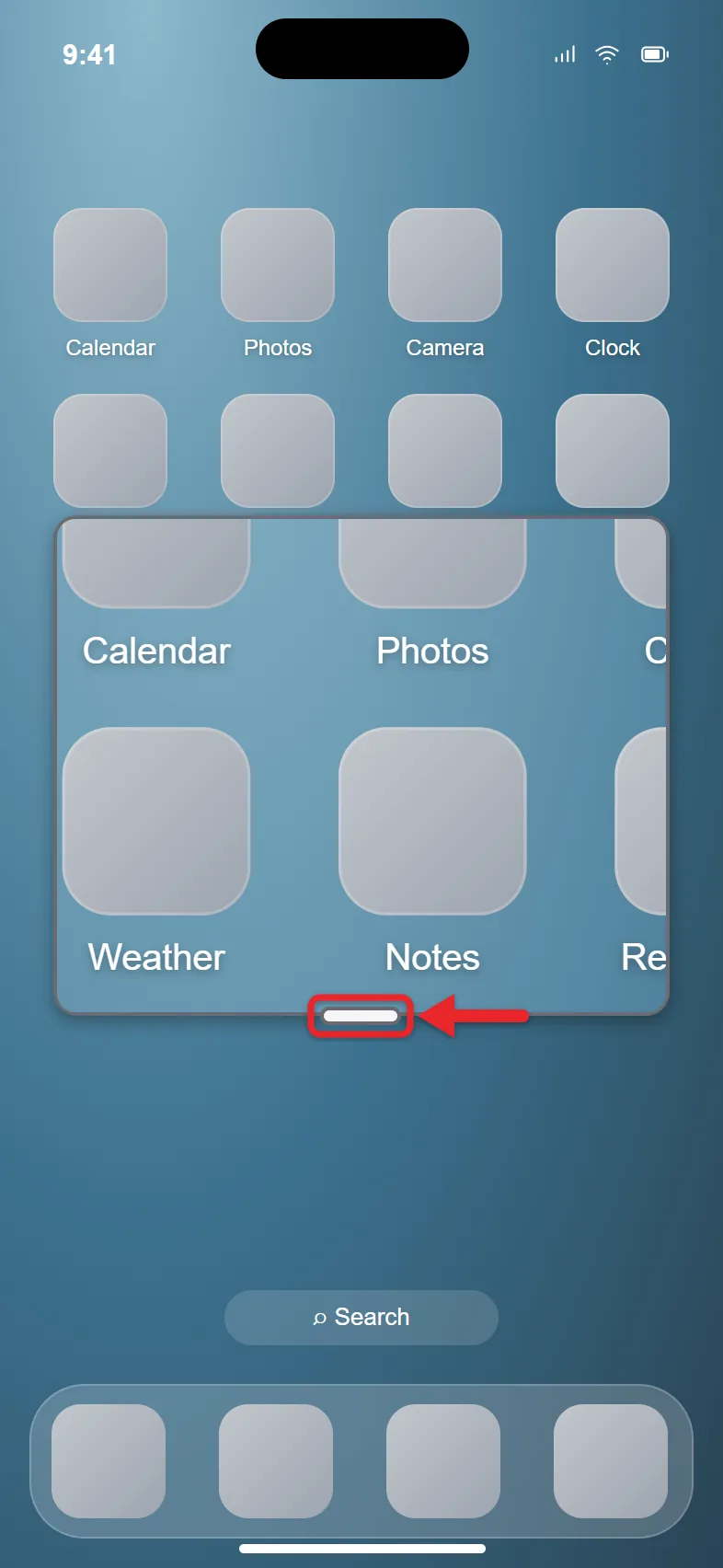
If part of the screen is enlarged inside a frame, Zoom is on with Window Zoom selected. Apple’s article on magnified Home Screen icons gives three ways out:
- Double-tap the screen with three fingers. The magnification turns off.
- To turn Zoom off for good, go to Settings > Accessibility > Zoom and turn off Zoom.
- If the screen is too magnified to reach Settings, connect the iPhone to a computer, select it in Finder on a Mac (or iTunes on a Windows PC or an older Mac), choose Configure Accessibility, uncheck Zoom and click OK.
The small handle at the edge of the zoom window is the Zoom controller. It goes away when Zoom is off. To limit how far Zoom can magnify instead of turning it off, you can adjust the maximum zoom level on an iPhone.
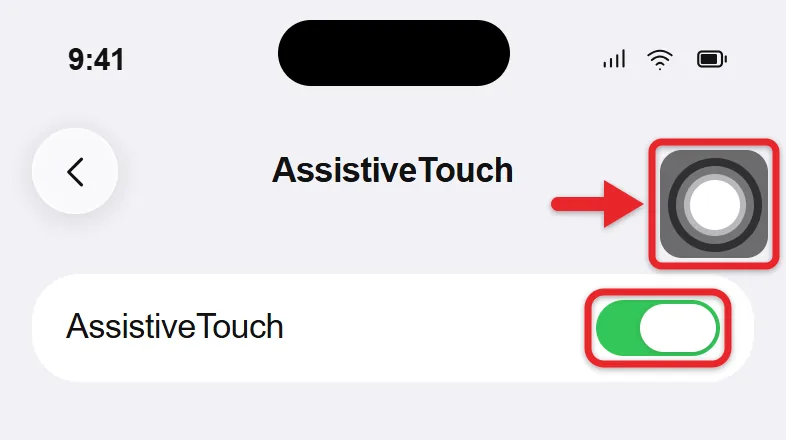
A floating gray square or circle (AssistiveTouch)
AssistiveTouch adds an onscreen button that opens a menu of controls. To remove it, Apple’s AssistiveTouch article points to Settings > Accessibility > Touch > AssistiveTouch. Turn off AssistiveTouch and the button disappears. You can also ask Siri to turn it off. If it keeps coming back, check whether it’s selected under Accessibility Shortcut.
A box that moves around the screen by itself (Switch Control)
Switch Control scans the screen and highlights items or groups one at a time so people who use a switch can select them. Apple’s Switch Control article says you can exit it at any time by triple-clicking the Home button or the side button on certain models. Then go to Settings > Accessibility > Switch Control and turn it off.
A box that moves when you press keys
If you use a Bluetooth or Magic Keyboard, Full Keyboard Access may be on. Apple’s external keyboard guide says it highlights the item that has focus. Turn it off in Settings > Accessibility > Keyboards & Typing > Full Keyboard Access.
Outlines or underlines around buttons
If you see underlines or shapes around buttons and links, but no black box and no voice, that’s Button Shapes. Apple covers it on the Use display and text size preferences page. Turn it off in Settings > Accessibility > Display & Text Size > Button Shapes.
App icons with black backgrounds
If the icons themselves look dark rather than boxed, your Home Screen is probably set to a dark appearance. Apple’s Home Screen customization guide explains: touch and hold the Home Screen background until the icons jiggle, tap Edit, then choose Customize. Dark gives icons a dark look all the time, and Auto switches to dark at night. Choose the light appearance instead if you want the colorful icons back.
Menus and backgrounds follow a separate setting, so you may also want to turn Dark Mode on or off on iPhone.
Colors look reversed everywhere
That’s Invert Colors. Go to Settings > Accessibility > Display & Text Size and turn off Smart Invert or Classic Invert. To learn the difference between the two, read about inverting colors on iPhone.
If the Box Is Still There
If none of the settings above are on and a box or rectangle stays frozen on the screen, the display may be stuck rather than a feature being active. Try these in order:
- Restart the iPhone. On an iPhone with Face ID, press and hold the side button and a volume button until the slider appears, drag it, then turn the phone back on. For frozen screens and other models, here’s how to turn off or force restart an iPhone.
- Update iOS. Go to Settings > General > Software Update and install any update shown.
- Reset All Settings as a last resort. Go to Settings > General > Transfer or Reset iPhone > Reset > Reset All Settings. Apple’s Reset All Settings article says this keeps your photos, apps, messages and contacts, but it returns accessibility and display settings to their defaults and also removes Wi-Fi passwords, Bluetooth pairings, Apple Pay cards and your Apple Watch pairing. Only use it if you’re prepared to set those up again.
If the box still shows in the same spot after a restart, on the Lock Screen and in every app, it may be a display problem. Contact Apple Support or an Apple Authorized Service Provider.
VoiceOver Black Box Questions
Will turning off VoiceOver delete anything?
No. It only turns off the screen reader. Your apps and data aren’t affected.
Can I practice VoiceOver instead of turning it off?
Yes. Apple’s VoiceOver Tutorial and VoiceOver Practice options are in Settings > Accessibility > VoiceOver.
Why did the box come back after I turned VoiceOver off?
The Accessibility Shortcut is probably still set to VoiceOver, so another accidental triple-click turned it back on. Uncheck VoiceOver in Settings > Accessibility > Accessibility Shortcut.
Do I need an app to remove the box?
No. Every box described here comes from a built-in iPhone setting, and you can turn each one off in Settings for free. You don’t need repair software.
Does Apple Watch have the same feature?
Yes. Here’s how to turn on VoiceOver on Apple Watch. If apps on your watch are hard to find, here’s how to switch your Apple Watch to list view.

Matthew Burleigh is the founder, head writer, and editor of Solve Your Tech, which he launched in 2012. He has written technology tutorials since 2008 and worked in IT since 2003, including small-business support, IT management, and consulting. He holds Bachelor’s and Master’s degrees in Computer Science from Arizona State University.
Matthew writes practical guides for Windows, iPhone and iPad, Microsoft Office, Outlook, Google apps, and Android. Solve Your Tech’s guides are checked step by step against the device or app maker’s own documentation and tested on his own devices whenever he has the hardware or software, with clear steps, sources, and update dates.
Read more about Matthew and how Solve Your Tech writes and updates its guides, or report a correction.