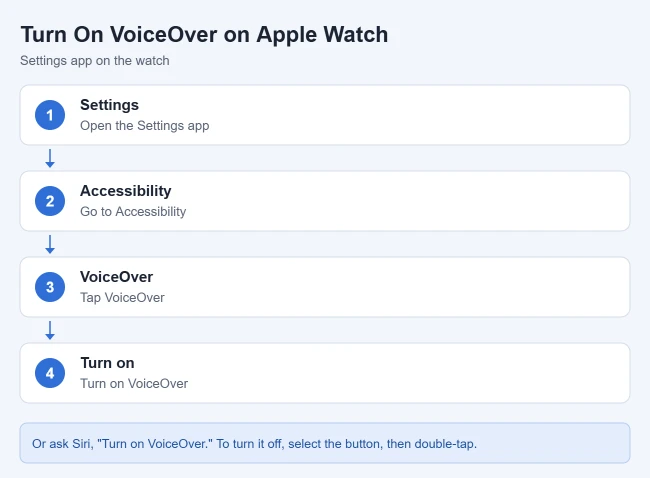
To turn on VoiceOver on Apple Watch, open Settings on the watch, tap Accessibility > VoiceOver, and turn it on. You can also ask Siri, “Turn on VoiceOver.” VoiceOver reads out loud whatever you touch on the screen, and you double-tap to open or select items.
This guide covers turning VoiceOver on from the watch, your iPhone, Siri, or a triple-click shortcut. It also covers how to turn it off again, the gestures you need, and the settings worth changing. Steps and gestures come from Apple’s VoiceOver guide for Apple Watch and Apple’s Accessibility Shortcut guide (watchOS 27).
How to Turn On VoiceOver on Apple Watch
- Open the Settings app on your Apple Watch.
- Tap Accessibility.
- Tap VoiceOver.
- Turn on VoiceOver.
Result: the watch starts speaking each item you touch. From now on, a single tap only selects an item, and a double tap opens it or flips a switch.
Turn it on from your iPhone
Open the Apple Watch app on your iPhone, tap My Watch, go to Accessibility, then tap VoiceOver and turn it on. This is the easiest route if you’re setting it up for someone else.
Turn it on with Siri or a triple-click
Ask Siri something like “Turn on VoiceOver.” For a shortcut you can use any time, go to Settings > Accessibility > Accessibility Shortcut and put a checkmark next to VoiceOver. Then press the Digital Crown quickly three times to turn VoiceOver on or off. According to Apple’s Accessibility Shortcut guide, if you’ve picked more than one feature, you choose one and tap Done.
How to Turn Off VoiceOver
Because a single tap only selects things, turning it off takes two steps. Apple says to select the VoiceOver button, then double-tap anywhere on the display. You can also ask Siri, “Turn off VoiceOver,” or triple-click the Digital Crown if you set up the shortcut.
If VoiceOver turned on by accident and you’re stuck, you can follow the same path by touch: press the Digital Crown to see your apps, select Settings and double-tap, then do the same for Accessibility, VoiceOver and the switch. If the watch is locked, tap each passcode digit once to select it and double-tap to enter it. If your iPhone is nearby, you can also turn it off in the Apple Watch app instead.
Basic VoiceOver Gestures
These come from Apple’s VoiceOver guide for Apple Watch:
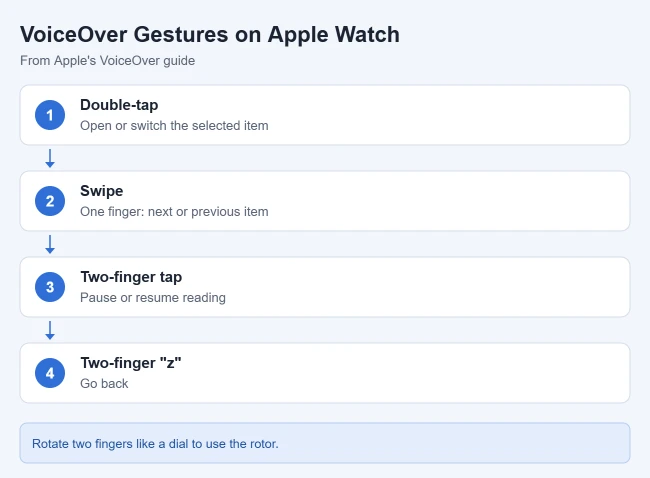
- Explore: move one finger around the screen to hear each item.
- Select next item: swipe left or right with one finger.
- Open or activate: double-tap.
- See other pages: swipe with two fingers.
- More actions: when you hear “actions available,” swipe up or down, then double-tap.
- Go back: draw a “z” with two fingers.
- Pause or resume reading: tap with two fingers.
- Change volume: double-tap and hold with two fingers, then slide up or down.
Result: you can move around the watch without looking at it. To use the rotor, rotate two fingers on the screen like a dial to choose Words, Characters, Actions, Headings, Volume or Speaking Rate, then swipe up or down to adjust.
VoiceOver Settings Worth Changing
On the watch, go to Settings > Accessibility > VoiceOver. Apple lists these options, and the same ones appear in the Apple Watch app on your iPhone:
- Speaking rate and Speech (voice, pitch and clarity).
- Audio (VoiceOver volume and audio ducking).
- Screen Curtain, which turns off the display for privacy while you use VoiceOver.
- Hand Gestures, which let you control VoiceOver with hand gestures such as a clench or double clench instead of taps.
- VoiceOver hints, which you can turn off once you know the gestures.
Frequently Asked Questions
Can I use VoiceOver while setting up my watch?
Yes. Apple says to triple-click the Digital Crown during setup. See Set up Apple Watch using VoiceOver for the full walkthrough.
Does VoiceOver work with the Always On display?
Yes. Apple notes that you can tap the dimmed display and VoiceOver focuses on the item under your finger.
Related Guides
- How to turn off the black and white screen and Reduce Motion
- How to change Apple Watch volume and haptics
- How to turn off Siri on Apple Watch
- How to find your Apple Watch serial number

Matthew Burleigh is the founder, head writer, and editor of Solve Your Tech, which he launched in 2012. He has written technology tutorials since 2008 and worked in IT since 2003, including small-business support, IT management, and consulting. He holds Bachelor’s and Master’s degrees in Computer Science from Arizona State University.
Matthew writes practical guides for Windows, iPhone and iPad, Microsoft Office, Outlook, Google apps, and Android. Solve Your Tech’s guides are tested on current devices or checked against official product documentation, with clear steps, sources, and update dates.
Read more about Matthew and how Solve Your Tech writes and updates its guides, or report a correction.