To turn off VoiceOver on a locked iPad, triple-click the Home button (or the top button) or ask Siri to turn VoiceOver off. If neither works, get past the Lock Screen with VoiceOver gestures, then turn it off in Settings > Accessibility > VoiceOver.
Your iPad is talking to you on the Lock Screen and a single tap only puts a box around the numbers instead of typing your passcode. That box means VoiceOver is on.
Why Taps Stop Working When VoiceOver Is On
VoiceOver is the built-in screen reader in iPadOS. It reads aloud whatever is under your finger so people who are blind or have low vision can use the iPad. To make that possible, Apple changes the basic gestures. According to Apple’s list of VoiceOver gestures, a single tap selects an item and reads it, and a double tap activates the selected item.
So when you tap the number 4 on the passcode screen, VoiceOver draws a box around it and says “four.” Nothing gets typed until you double-tap. The box around icons and buttons is the clearest sign VoiceOver is on (the same box shows up on iPhone, as covered in getting rid of the black box around iPhone icons).
A few other gestures matter here:
| Gesture with VoiceOver on | What it does |
|---|---|
| Tap once | Selects the item and reads it |
| Double-tap | Activates the selected item (like a normal tap) |
| Swipe right or left with one finger | Moves to the next or previous item |
| Three-finger swipe up | Scrolls down one page |
| Three-finger double-tap | Mutes or unmutes VoiceOver speech |
| Three-finger triple-tap | Turns the screen curtain on or off (the screen goes black) |
Apple notes that if a gesture doesn’t work, you should try a quicker movement, and for multi-finger gestures, leave some space between your fingers.
Fastest Ways to Turn VoiceOver Off From the Lock Screen
Try these first. Neither one needs your passcode typed in with VoiceOver gestures.
Triple-Click the Home Button or Top Button
The Accessibility Shortcut lets you switch a feature on or off by triple-clicking a button. Apple’s page on turning accessibility features on or off quickly says to triple-click the Home button on an iPad that has one, or the top button on other iPad models.
- Wake the iPad so the Lock Screen is showing.
- Press the Home button three times quickly. On an iPad without a Home button, press the top button three times quickly.
- Listen. If VoiceOver was the only feature assigned to the shortcut, it turns off right away and the speech stops.
- If a menu appears instead, more than one feature is assigned. Tap VoiceOver to select it, then double-tap to turn it off.
If nothing happens, the shortcut probably isn’t set to VoiceOver. An accidental triple-click can also turn VoiceOver on if it is set as the shortcut, so this is worth trying even if you don’t remember setting anything up.
Ask Siri
Apple’s page on turning VoiceOver on or off lists Siri as one of the ways to control VoiceOver. Say “Siri” or “Hey Siri” (whichever your iPad responds to), then “Turn off VoiceOver.” You can also press and hold the Home button, or the top button on a Touch ID iPad, to bring up Siri.
This only works if Siri is turned on and allowed to respond on your iPad. Some people restrict Siri when the iPad is locked, and in that case Siri may ask you to enter your passcode first. Siri also needs an internet connection. If Siri doesn’t respond, move on to the next section.
Use Control Center If You Added VoiceOver There
Apple also says you can use Control Center if you’ve added VoiceOver to it. With VoiceOver on, open Control Center by dragging one finger down from the top edge of the screen until you hear two rising tones. Tap the VoiceOver control to select it, then double-tap it. Most people haven’t added this control, so don’t worry if it isn’t there.
Get Past the Lock Screen With VoiceOver On
If the shortcut, Siri and Control Center don’t help, you’ll need to get to the Home Screen with VoiceOver still running. Apple’s guide to operating iPad when VoiceOver is on gives the method for each type of iPad:
| iPad type | How to open it with VoiceOver on |
|---|---|
| iPad with a Home button | Press the Home button with the finger you registered for Touch ID |
| iPad with Touch ID in the top button | Rest the registered finger on the top button |
| iPad with Face ID | Wake the iPad, glance at it, then drag one finger up from the bottom edge until you hear two rising tones |
If the iPad asks for your passcode at this point, which is common after a restart or if Touch ID or Face ID doesn’t recognize you, use the next section.
The one-finger drag on a Face ID iPad is the step most people miss. A normal quick swipe up does nothing useful with VoiceOver on, and a three-finger swipe up only scrolls. Place one finger at the very bottom edge, slide it up slowly, and wait for the two tones before lifting your finger.
Enter Your Passcode While VoiceOver Is Talking
Each digit takes two touches: one to select it and one to type it.
- Tap the first digit of your passcode. VoiceOver puts a box around it and reads it aloud.
- Double-tap to enter the selected digit.
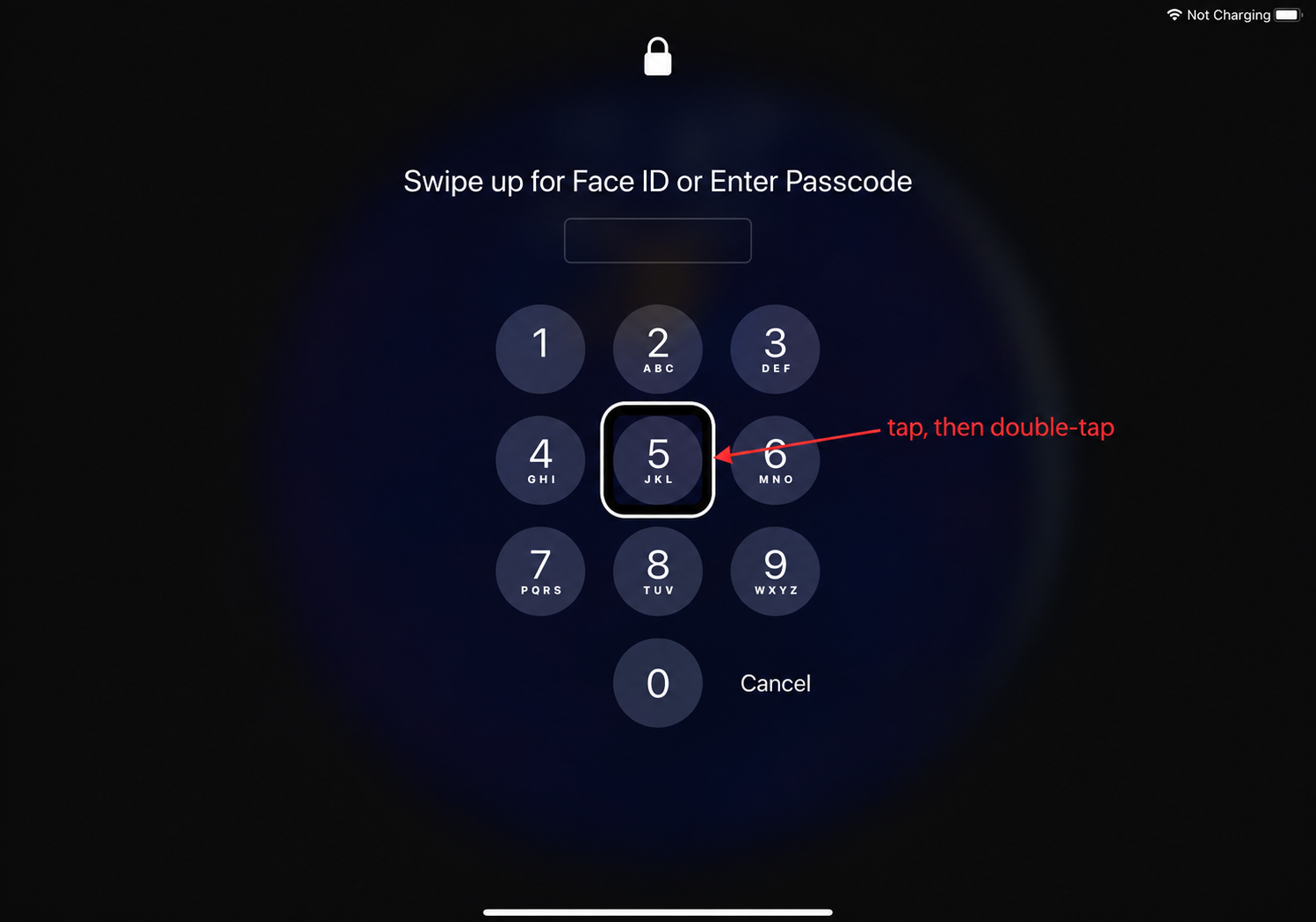
- Repeat for each digit. If you select the wrong number, just tap the correct one before you double-tap.
- If your passcode uses letters, the keyboard works the same way: tap a key to select it, then double-tap to type it.
- If the iPad doesn’t open by itself after the last character, find the Done or Enter key, tap it, then double-tap.
VoiceOver speaks each digit as you select it. If other people are nearby, Apple offers a quieter option: handwriting mode. You write each character on the screen with your finger instead of selecting it. To use it, turn the rotor (twist two fingers on the screen like a dial) until you hear “Handwriting,” then write the characters on the passcode screen. Apple’s page on writing with your finger in VoiceOver says to add Handwriting to the rotor in Settings > Accessibility > VoiceOver > Rotor if it’s missing, which you can’t do while locked. If it isn’t in the rotor, use the tap-and-double-tap method.
Worked example: Elena’s passcode is 2580 and her iPad has a Home button. She presses the Home button once to wake the iPad, then rests her finger on it. Touch ID doesn’t match because the iPad just restarted, so the passcode screen appears. She taps 2, double-taps, taps 5, double-taps, and so on through 0. The Home Screen opens, still with VoiceOver on, and she moves to the steps below.
Turn VoiceOver Off in Settings
Once you’re on the Home Screen, VoiceOver gestures still apply until it’s switched off.
- Tap the Settings icon to select it, then double-tap to open it.
- Tap Accessibility in the sidebar, then double-tap it.
- Tap VoiceOver, then double-tap it.
- Tap the VoiceOver switch at the top, then double-tap it. The box disappears once VoiceOver is off.
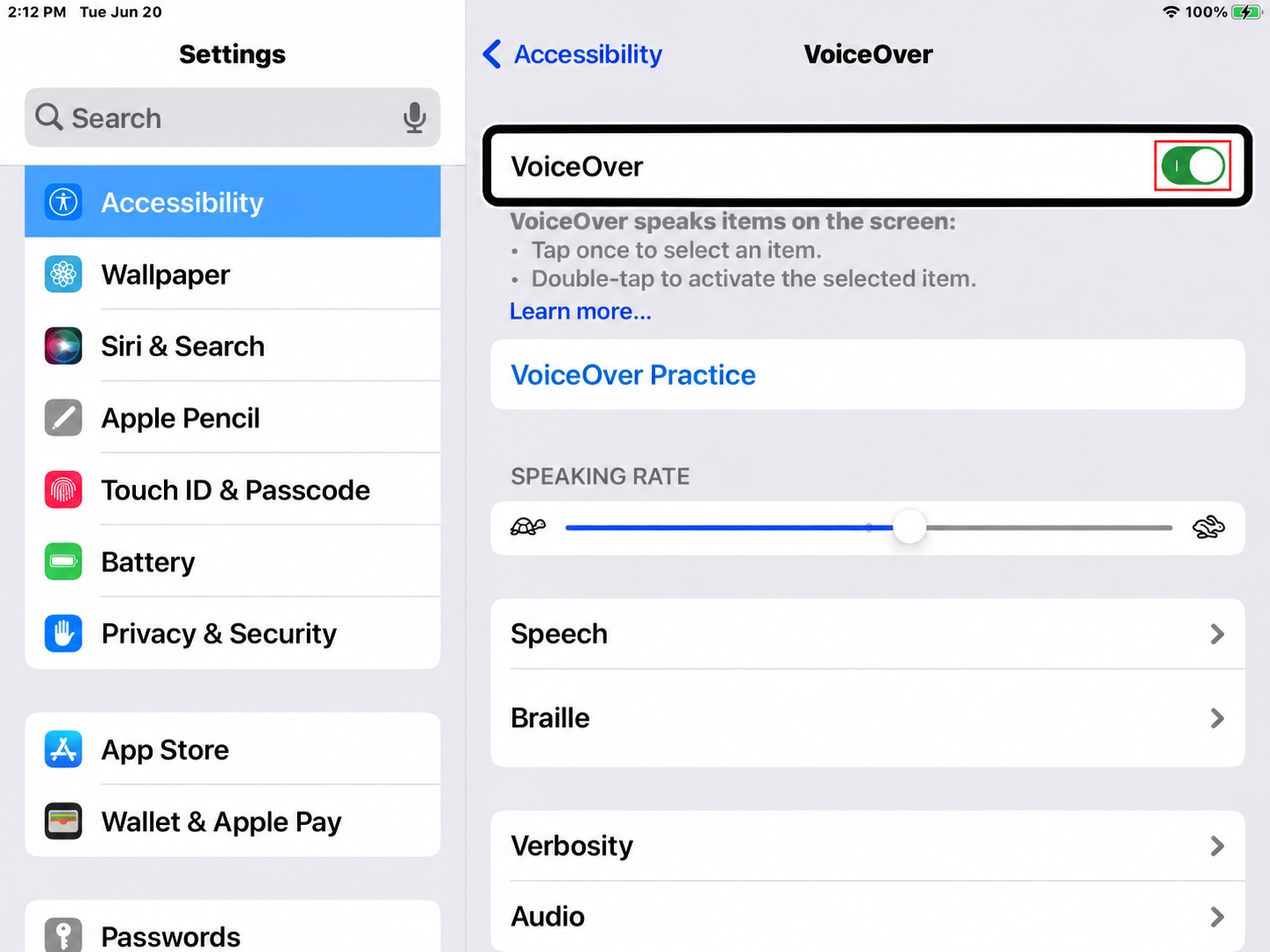
- Tap something once to confirm normal taps work again.
If you need to scroll to find Accessibility, use a three-finger swipe up or down. Accidentally opening the wrong item doesn’t hurt anything. The back button at the top left works the same way: tap it, then double-tap.
Stop VoiceOver From Turning Back On
Turning VoiceOver off fixes the moment, but if it switched on by accident, the cause is usually still set up.
- Open Settings > Accessibility > Accessibility Shortcut.
- If VoiceOver has a check mark, tap it to remove the check.
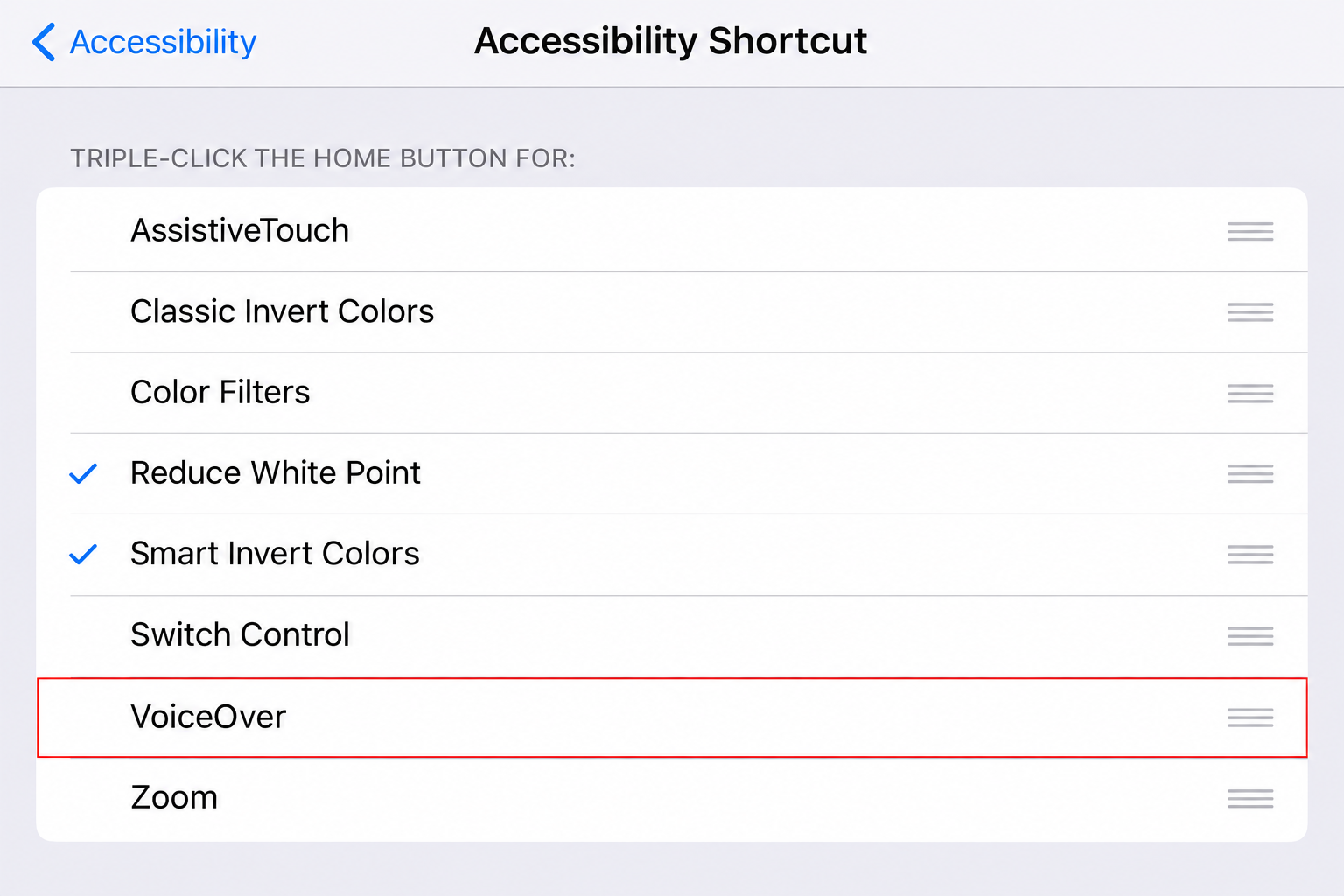
- Leave any features you actually use, such as Zoom or Guided Access, checked.
If you still want a quick way to turn VoiceOver back on, keep it in the shortcut but get used to how a triple-click feels. Apple’s accessibility shortcut page also mentions settings for the top or Home button where you can choose a slower click speed, which helps if a triple-click is hard to get right.
You can also remove VoiceOver from Control Center if you added it there and keep bumping it.
If someone else in your home relies on VoiceOver, talk to them before removing it from the shortcut, because that is often how they turn it on.
If Nothing Seems to Work
A few situations look like VoiceOver is stuck when something else is going on.
- The screen is black but the iPad is talking. That’s the screen curtain, which hides the display while VoiceOver keeps working. Do a three-finger triple-tap to turn it off. Apple says to use a three-finger quadruple-tap instead if Zoom is also on.
- The speech stopped, but taps still only select things. A three-finger double-tap mutes VoiceOver without turning it off. Do the same gesture again to bring the voice back, then turn it off in Settings.
- The triple-click does nothing. Click faster and evenly, or check whether the shortcut is set to a different feature once you’re in.
- You don’t know the passcode. VoiceOver isn’t the real obstacle here. Getting back into an iPad without its passcode generally means erasing it, so read about resetting an iPad without its passcode before you start.
More VoiceOver Questions
Why did VoiceOver turn on by itself?
A common cause is a triple-click of the Home button or top button with the Accessibility Shortcut set to VoiceOver. It can also be turned on through Siri, Control Center or Settings. If it keeps happening, remove VoiceOver from the Accessibility Shortcut as shown above.
Will turning off VoiceOver delete anything?
No. It only changes how the screen responds to touch and stops the spoken feedback. Your apps, photos and settings stay as they were.
Can I practice the gestures without getting stuck again?
Yes. In Settings > Accessibility > VoiceOver, Apple includes a VoiceOver Tutorial and VoiceOver Practice so you can try gestures in a safe space. Both are used with VoiceOver turned on, so you practice with the same gestures described above. That’s a good idea if a family member uses VoiceOver and you sometimes need to help them.
Does Auto-Lock make this harder?
It can, because the screen may lock while you’re slowly selecting items. If you need more time while you sort things out, see making the iPad wait longer before it locks.
Can I switch to a passcode that’s easier to enter?
Yes, once you’re in. A shorter passcode means fewer select-and-double-tap steps, but it’s less secure. The options are in Settings, and the walkthrough for setting a new iPad passcode shows where they are.
After VoiceOver is off, take a minute to open Settings > Accessibility > Accessibility Shortcut so the next accidental triple-click doesn’t start this all over again.
Apple documentation checked November 6, 2026. Button names and options can vary slightly by iPadOS version.

Matthew Burleigh is the founder, head writer, and editor of Solve Your Tech, which he launched in 2012. He has written technology tutorials since 2008 and worked in IT since 2003, including small-business support, IT management, and consulting. He holds Bachelor’s and Master’s degrees in Computer Science from Arizona State University.
Matthew writes practical guides for Windows, iPhone and iPad, Microsoft Office, Outlook, Google apps, and Android. Solve Your Tech’s guides are checked step by step against the device or app maker’s own documentation and tested on his own devices whenever he has the hardware or software, with clear steps, sources, and update dates.
Read more about Matthew and how Solve Your Tech writes and updates its guides, or report a correction.