You can no longer enable or disable Google Cloud Print in Google Chrome. Google ended the service at the end of 2020, and its help pages say that from January 1, 2021, devices on every operating system can’t print with it. There is no Google Cloud Print section in current Chrome settings to switch on or off.
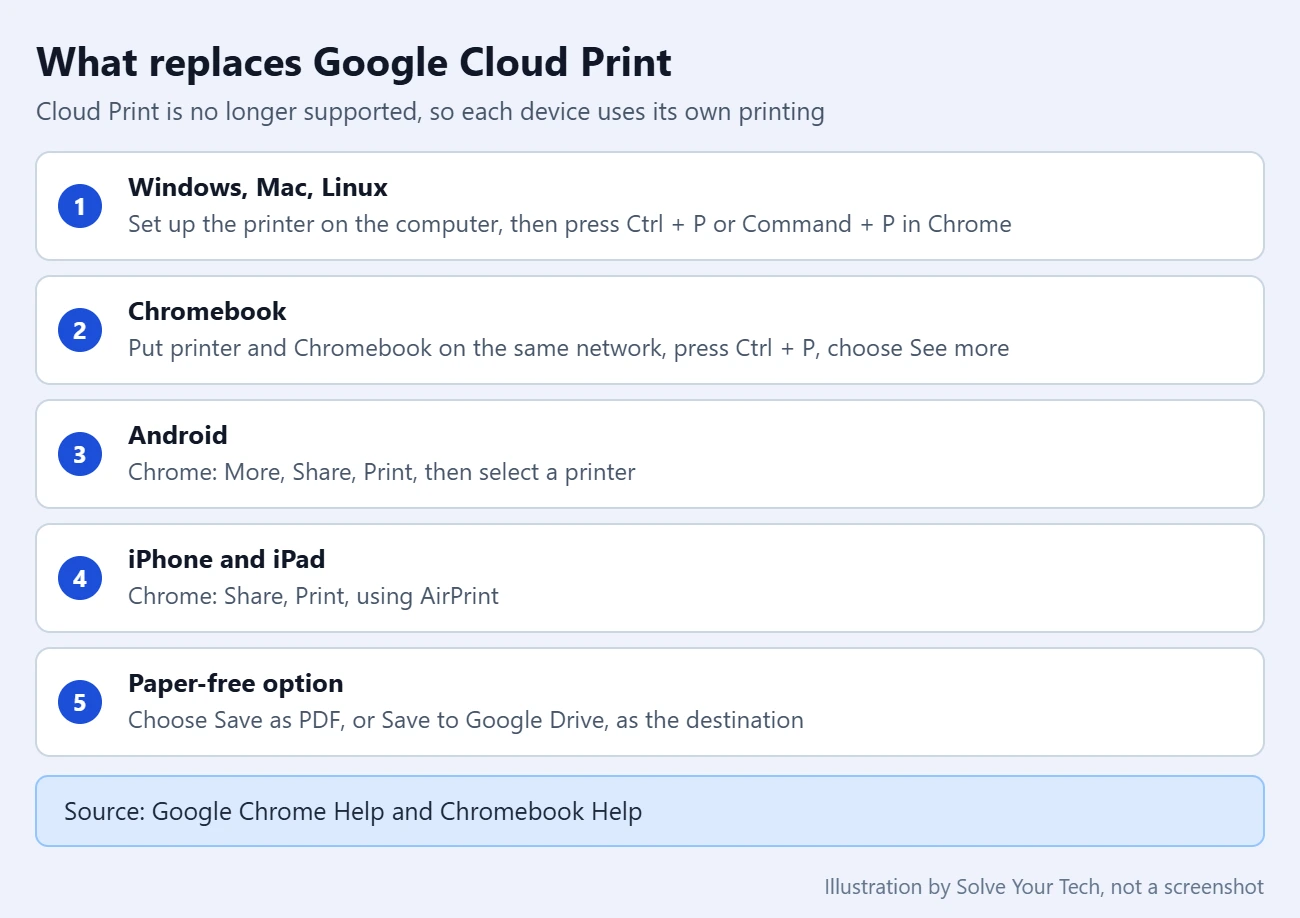
To print from Chrome now, set up the printer on the device you are using, open the page in Chrome, and press Ctrl + P (Windows, Linux, Chromebook) or Command + P (Mac). The steps below cover current Chrome on Windows 11, macOS and Linux, ChromeOS, Android, and iPhone or iPad, and they also apply to Windows 10, which reached end of support on October 14, 2025.
What Google Cloud Print Was
Google Cloud Print was a free service that linked printers to your Google Account. Once a printer was linked, you could send a job to it over the internet from Chrome, a Chromebook, or a phone, even when that device was not on the same network as the printer. For older printers, the computer the printer was installed on had to stay on and pass the jobs along.
Older versions of Chrome had a Google Cloud Print section in the advanced settings. An Add printers button there shared the printers installed on that computer with your account, and a Disconnect printers button turned the sharing off. Those are the controls people mean when they talk about enabling or disabling Cloud Print in Chrome.
That is all history now. Google’s Migrate from Cloud Print page for Chrome administrators says the service was deprecated in January 2021 and is no longer supported, and it recommends moving to a different way of printing. Google’s Android version of that page gives the same advice for phones.
What This Means for You
You can’t turn Cloud Print back on, and you don’t need to turn it off. Your printer still works through the normal printing system on your computer, Chromebook, or phone. The only thing that went away for good is Google’s free way to print from a different network, and the options for that are covered further down.
Here is the quick version for each device:
| Device | How Chrome prints now | What the printer needs |
|---|---|---|
| Windows, Mac, Linux | Through the printers installed on the computer | Installed on that computer (USB or network) |
| Chromebook | Directly to network or USB printers | Same network as the Chromebook, or a USB cable |
| Android | Through a print service added on the phone | Can receive jobs over Wi-Fi or a mobile network |
| iPhone or iPad | Through AirPrint | Supports AirPrint and is on the same Wi-Fi network |
How to Print From Chrome on Windows, Mac, or Linux
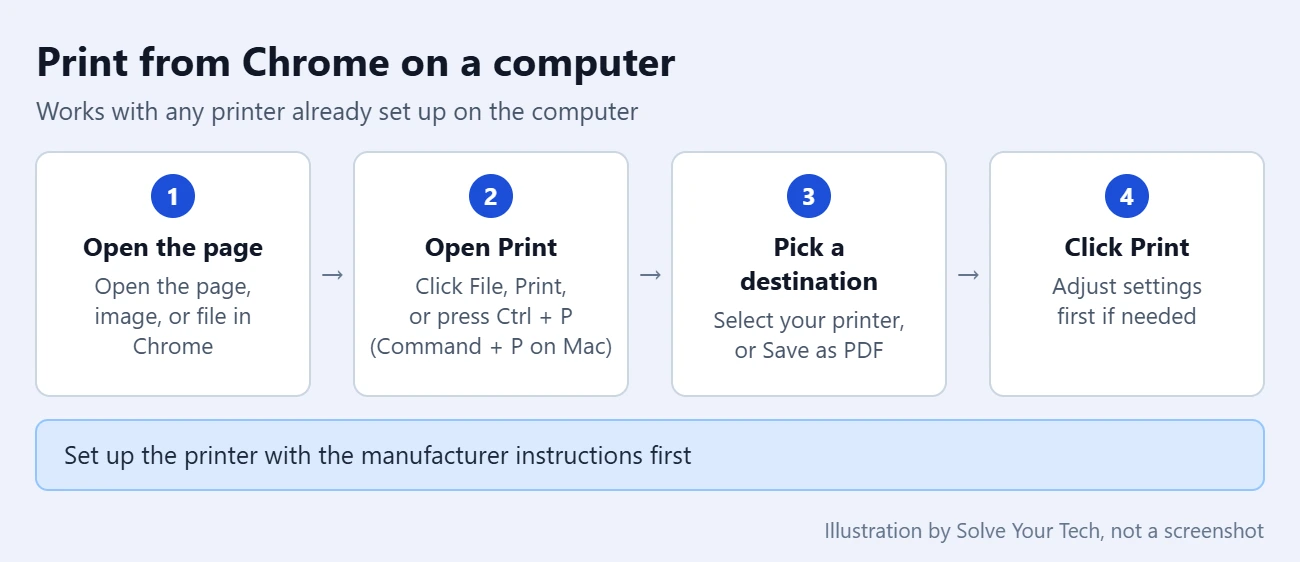
Chrome on a computer prints to any printer that is already set up on that computer. Google’s instructions say to set up the printer by following the directions from the printer manufacturer, so do that first if the printer has never been used with this computer. The steps for adding a printer in Windows 11 and adding a printer to a Mac walk through that part.
- Open Chrome on your computer.
- Open the page, image, or file you want to print.
- Click File, then Print. You can also press Ctrl + P on Windows or Linux, or Command + P on a Mac. A print window opens with a preview of the page.
- Select your printer as the destination, then change any print settings you need, such as the number of copies or which pages to print.
- Click Print.
If the wrong printer is selected, choose a different Destination before you click Print. The same window has other options, such as printing in black and white from Google Chrome.
These steps come from Google’s Print from Chrome help page, which also has separate tabs for Android and for iPhone and iPad.
How to Print From a Chromebook
Chromebooks were the devices that relied on Cloud Print the most. They now print directly to compatible printers over a network connection or a USB cable. Google notes that Chromebooks do not support Bluetooth printing.
- Turn on the printer and connect it to your network. Use the printer manufacturer’s instructions if you need help with this part.
- Sign in to your Chromebook and connect it to the same network as the printer. Google marks this as a requirement.
- Open what you want to print and press Ctrl + P.
- Next to Destination, select the Down arrow, then select See more….

- Choose your printer. The Chromebook runs a compatibility check when you select it, and some printers in the list may not be compatible.
- Select Print.
If you connect the printer with a USB cable instead, a notification appears on the Chromebook. Follow any instructions on the screen, then pick the printer in the print window as described above.
Save the printer so it is always listed
- Select the time in the bottom-right corner, then select Settings.
- Under Device, open Printers and scanners, then select Print.
- Under Other available printers, select Save next to your printer.
The printer moves to Your saved printers, and a saved printer becomes the default.
Add a printer manually
If the printer is on the network but never shows up, you can enter its details yourself. Go to Settings > Printers and scanners > Print, select Add printer manually, and fill in the fields:
- Name: any label you will recognize.
- Address: the printer’s IP address, which you can find in the printer’s own settings menu or its manual.
- Protocol: usually Internet Printing Protocol (IPP).
- Queue: usually ipp/print.
Select Add. A work or school Chromebook may block this, and in that case the administrator has to set up printers for you. Google’s Set up your printer page for Chromebook has the full process, including how to choose a printer model when automatic setup fails.
How to Print From Chrome on Android
On Android, Chrome prints to a printer that can receive data over Wi-Fi or a mobile network. You add the printer on the phone first, then print from the Chrome app.
Add a print service on the phone
On Android, open Settings, go to Connected devices > Connection preferences > Printing, tap Add service, and follow the steps for your printer. Some of these steps only work on Android 9 and later, and menu names can differ a little by phone maker. If your printer maker offers a print service app, it shows up in this same list once installed, and you can switch each service on or off there.
Print the page
- Open the Chrome app.
- Open the page, image, or file you want to print.
- At the top right, tap More, then Share.
- Select Print.
- Tap the Down arrow if you want to change any print settings.
- At the top, select a printer. Choose Save as PDF instead if you want a file rather than a paper copy.

- Tap Print.
How to Print From Chrome on iPhone or iPad
Chrome on iPhone and iPad prints with AirPrint, which is Apple’s built-in wireless printing feature. Apple’s AirPrint article lists two requirements: the printer must support AirPrint, and the iPhone or iPad must be on the same Wi-Fi network as the printer. There is nothing to install on the phone.
- Open the Chrome app.
- Open the page, image, or file you want to print.
- At the top right, tap Share.
- Tap View more, then Print.
- Tap No Printer Selected if no printer is chosen yet, and pick your printer.
- Choose your settings, such as copies and page range.
- Tap Print.
AirPrint does not work with a printer that is connected to a computer over Bluetooth. If you have not used a printer with your phone before, the steps for printing from an iPhone with AirPrint cover the setup side.
To print a document from the Google Docs app rather than Chrome, follow the steps for printing from Google Docs on iPhone or Android.
Save to PDF or Google Drive Instead of Printing
Cloud Print also offered a Save to Google Drive destination. Google’s help pages describe three ways to get the same result on a computer today.
- Save to Google Drive extension. With Google’s Save to Google Drive extension installed in Chrome, open the print window and select Save to Google Drive as the destination. You may have to select See more to find it. Then click Save.
- Drive for desktop. If Google’s Drive for desktop app is installed on the computer, choose Save as PDF in the print window and save the file into your Drive folder.
- The Drive website. Choose Save as PDF, then go to Google Drive in your browser, click +, and select File upload. We have a separate walkthrough on uploading a PDF to Google Drive.
Saving a PDF is also a practical substitute for remote printing. Save the page as a PDF now, and print the file later from a device that is on the same network as the printer.
If you need paper today and no printer is nearby, here’s how to print something urgently without a printer.
Options for Printing When You Are Away From the Printer
Google does not offer a direct replacement for the remote part of Cloud Print. Its migration page recommends two directions: use the printing system that is built into each platform, or work with a printing partner. A printing partner is a company that makes print management software, and Google’s migration page names several of them for organizations that need to manage many users and printers. For schools and businesses with Chromebooks, Google also points administrators to printer setup in the Google Admin console.
For a home printer, these are the realistic choices:
- Use the printer maker’s own service. Many printer makers have an app or online service that can send jobs to a registered printer over the internet, and some give the printer its own email address so you can print by sending an attachment. Whether your model has this, and how it is set up, depends on the manufacturer, so check the support pages for your model. Treat a printer email address like a password and share it only with people you trust, since anyone who has it may be able to send pages to your printer.
- Control your home computer remotely. Google’s Chrome Remote Desktop lets you set up remote access on your own computer at remotedesktop.google.com/access and connect to it later with a PIN. Once connected, you can print from that computer to the printer installed on it. The home computer has to be turned on and connected to the internet.
- Print later. Save a PDF on the go, then print it when you are back on the same network.
If your printer has no Wi-Fi and is plugged into one computer with a USB cable, you can share it with other computers on your home network by following the steps for sharing a printer in Windows 11 or Windows 10. The computer the printer is plugged into has to stay on for this to work.
Troubleshooting Cloud Print Leftovers
My printer has a Google Cloud Print option in its menu
Many printers sold while the service was active have a Cloud Print setting on the control panel or in their web setup page. Turning it on does not make cloud printing work again, since the Google service behind it is no longer supported. It is reasonable to leave it off. The printer manual explains where that setting is for your model.
My printer does not appear in the Chrome print window
On a computer, Chrome shows printers that are set up on that computer, so make sure the printer is installed there and turned on. On a Chromebook, confirm that the printer and the Chromebook are on the same network, then select See more… in the destination list. If it is still missing, add it manually with its IP address as described above. On a phone, check that the phone is on the same Wi-Fi network as the printer and not on a guest network or mobile data.
A Chromebook printer was set up but will not print
On a Chromebook, open Settings > Printers and scanners > Print, select More next to the printer, then Edit, and check each field for typos. If the details are right, select More > Remove and set the printer up again. If it still fails, check the printer maker’s website for a firmware update.
Old Cloud Print printers still show up in a list
Older Chromebooks and Chrome profiles sometimes still list printers from the Cloud Print era. They can’t receive jobs anymore. Pick the same printer from the local list instead, or remove the old entry and add the printer again on the device.
The Save to Drive destination is gone
The old Save to Drive option stopped being available on Windows, Mac, and Linux after December 2020. Use the Save to Google Drive extension or the Save as PDF destination described earlier.
Frequently Asked Questions
Do I need to remove my old Cloud Print printers?
Google’s migration guidance does not ask ordinary users to remove anything. Its advice is to find an alternative print solution. Printers you had shared through Cloud Print still work as normal printers on the devices where they are set up.
Can I print from my phone to my home printer when I am not home?
Not with Chrome alone. Chrome on Android prints to printers you have added to the phone, and Chrome on iPhone or iPad uses AirPrint, which needs the same Wi-Fi network. For printing from another network, check whether your printer maker offers its own remote service, connect to your home computer with Chrome Remote Desktop, or save the page as a PDF and print it when you are back home.
What replaced Google Cloud Print?
There is no single replacement. The recommended path is the built-in printing on each platform, which for Chromebooks means native printing to local and network printers, or a third-party printing partner for organizations.
Why can’t my Chromebook print to my Bluetooth printer?
Chromebooks don’t support Bluetooth printing. Connect the printer to your Wi-Fi network or use a USB cable instead.
Next Step
Set up your printer on the device you print from most often, then press Ctrl + P or Command + P in Chrome and send a single test page. If you print a lot of documents, printing a Google Doc from Chrome is worth a look next.

Matthew Burleigh is the founder, head writer, and editor of Solve Your Tech, which he launched in 2012. He has written technology tutorials since 2008 and worked in IT since 2003, including small-business support, IT management, and consulting. He holds Bachelor’s and Master’s degrees in Computer Science from Arizona State University.
Matthew writes practical guides for Windows, iPhone and iPad, Microsoft Office, Outlook, Google apps, and Android. Solve Your Tech’s guides are checked step by step against the device or app maker’s own documentation and tested on his own devices whenever he has the hardware or software, with clear steps, sources, and update dates.
Read more about Matthew and how Solve Your Tech writes and updates its guides, or report a correction.