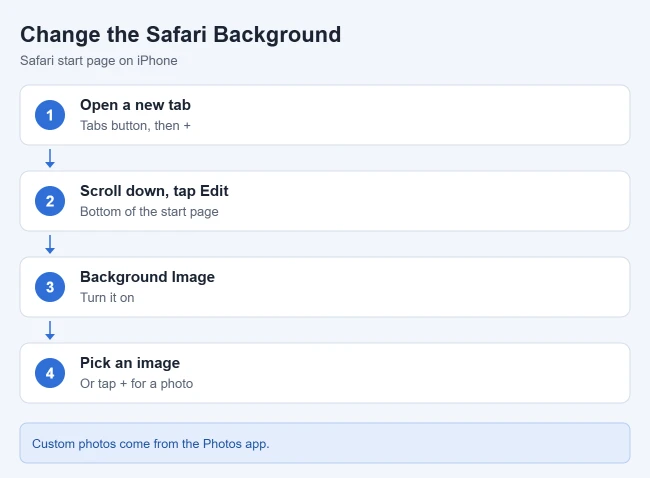
To change the Safari background on an iPhone, open a new tab so you see the start page, scroll to the bottom, tap Edit, turn on Background Image, and tap one of Apple’s images or tap the + tile to use your own photo.
The background only appears on the Safari start page, which is the screen you see when you open a new, empty tab. It does not change how websites look, and it does not change your iPhone wallpaper. These steps follow Apple’s Customize your Safari settings on iPhone guide for iOS 27, with notes for iOS 26 and earlier where the buttons differ.
Before You Start
- iOS version: Apple’s iPhone User Guide has described start page background images since its iOS 15 edition. If you do not see the option, update your iPhone in Settings > General > Software Update.
- Your own picture: Apple’s guide says the + tile is for using a photo as the background, and its label is Select Image from Library. If the picture you want is somewhere else, such as in the Files app or an email, save it to the Photos app first.
- Tab Groups: A Tab Group is a named set of tabs you keep together. Apple says the image appears each time you open a new start page in the current Tab Group, so pick the group you want before you begin.
How to Set a Safari Background Image
- Open Safari.
- Tap the Tabs button (two overlapping squares), then tap the + (Add) button. A new tab opens on the start page.
- Scroll to the bottom of the start page and tap Edit. A panel with a list of start page options opens.
- Turn on Background Image. A row of image tiles appears under the switch.
- Tap one of Apple’s images to use it, or tap the + tile and choose a picture from your photo library.
- Close the panel to go back to the start page.
To confirm it worked, look at the start page behind your Favorites and other sections. The picture you chose should fill the background, and it should be there again the next time you open a new tab in the same Tab Group.
If You Do Not See the Tabs Button (iOS 26 Compact Layout)
Safari on iPhone has three tab bar layouts: Compact, Bottom, and Top. Apple’s iOS 26 version of the guide gives a different second step for the Compact layout:
- Open Safari.
- Tap the More button, then tap New Tab.
- Scroll to the bottom of the start page, tap Edit, and turn on Background Image as described above.
If your layout is Bottom or Top, use the Tabs button and then the + button instead. You can check or change the layout in Settings > Apps > Safari under Tabs, which Apple covers in Change the layout in Safari on iPhone. Our guide to moving the Safari address bar to the top walks through that setting. The bar position and the start page background are separate settings, so changing one does not affect the other.
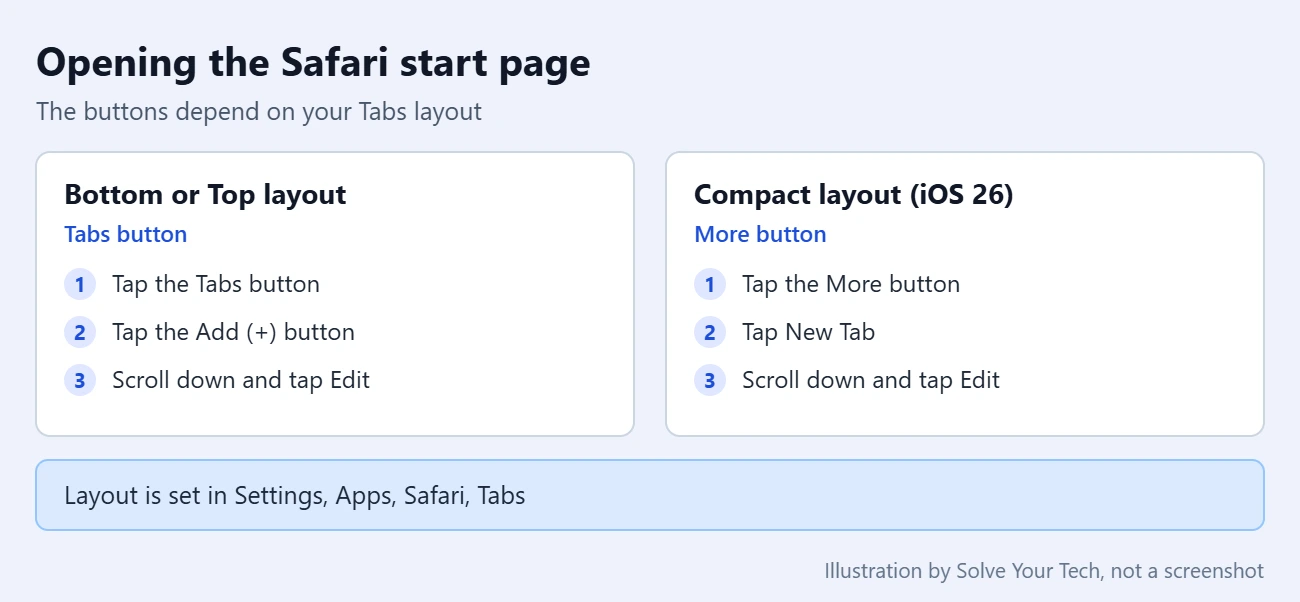
On iOS 18 and earlier, Apple’s steps are the same as the main method: tap the Tabs button, then the New Tab (+) button, then Edit.
How to Change or Remove the Background
Nothing here is permanent. You can switch images or go back to a plain start page at any time from the same Edit panel.
- Pick a different image: Open a new tab, tap Edit, and tap another image tile.
- Go back to a plain background: Open a new tab, tap Edit, and turn off Background Image. The start page returns to its default look, which is light or dark depending on your iPhone’s appearance setting.
Turning the switch off does not delete anything from your photo library. A photo you used as the background stays in the Photos app.
Safari Background vs. Dark Mode
If what you really want is a dark Safari instead of a white one, that is a different setting. Dark Mode changes the color scheme of the whole iPhone, including Safari’s menus and its plain start page. Apple’s steps are to open Settings, tap Display & Brightness, and select Dark or Light. See Adjust the screen brightness and color balance on iPhone for the Control Center shortcut and the automatic schedule.
A background image and Dark Mode can be used together. The image covers the start page either way.
Use the Same Start Page on Your Other Apple Devices
The Edit panel also has a switch named Use Start Page on All Devices. Apple says it applies your start page settings to all your Apple devices where that same switch is turned on and you are signed in to the same Apple Account using two-factor authentication.
Apple’s Mac guide adds that iCloud must be set up for Safari. On an iPhone, Apple’s Use iCloud on iPhone page says to open Settings, tap your name, tap iCloud, tap See All, and turn on the apps you want to sync. Make sure Safari is on in that list.
If you would rather have a different picture on each device, leave Use Start Page on All Devices turned off on the device you want to keep separate. On a Mac, the background is set from Edit in the bottom-right corner of the start page, as described in Customize your start page in Safari on Mac.
Other Start Page Options
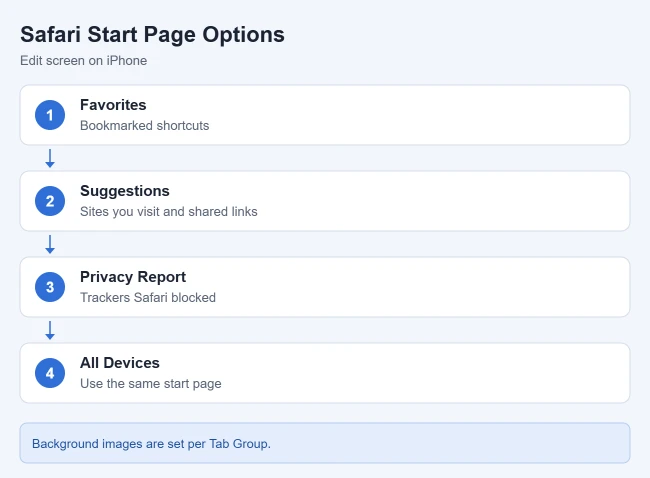
While you are on the Edit panel, you can also choose which sections appear on top of your background. Apple lists these for iOS 27:
- Tab Group Favorites and Favorites: shortcuts to your favorite bookmarked websites.
- Suggestions: websites you visit most and links shared with you in apps such as Messages and Mail.
- Privacy Report: how many trackers Safari blocked.
- Reading List, Recently Closed Tabs, and iCloud Tabs from your other Apple devices.
Turning off sections you do not use leaves more of the picture visible. To fill the Favorites section with sites you actually visit, see how to bookmark or favorite a website in Safari on iPhone.
Background Not Showing?
- You are looking at a website. The image only shows on the start page. Open a new tab to see it.
- You cannot find Edit. It is at the very bottom of the start page. If you have many Favorites or other sections, keep scrolling.
- You switched Tab Groups. Apple ties the image to the start page in the current Tab Group. Open the other group and set a background there too.
- The buttons do not match. Check your tab layout. In the iOS 26 Compact layout, Apple’s steps use More and then New Tab instead of the Tabs button.
- It did not carry over to your iPad or Mac. Confirm that Use Start Page on All Devices is on for each device, that every device uses the same Apple Account with two-factor authentication, and that Safari is turned on in iCloud settings.
- There is no Background Image switch. Your iPhone may be running an older version of iOS. Install the latest update your iPhone supports and check again.
Frequently Asked Questions
Can I use my own photo as the Safari background?
Yes. On the start page, tap Edit, turn on Background Image, and tap the + tile. Apple labels that tile Select Image from Library, and it opens your photo library so you can choose a picture.
Does the Safari background change my iPhone wallpaper?
No. Apple describes it as an image for Safari’s start page, so it only shows when you open a new tab in Safari. Your Lock Screen and Home Screen wallpaper stay the same. To remove one of those instead, see how to delete a wallpaper on iPhone.
Can I change the background color of websites in Safari?
Not with this setting. Background Image only affects the start page. Websites choose their own colors, although many switch to a darker design when your iPhone is in Dark Mode.
How do I make the Safari background white again?
Open a new tab, tap Edit at the bottom of the start page, and turn off Background Image. If the start page is then dark instead of white, your iPhone is in Dark Mode. Go to Settings > Display & Brightness and select Light.
Can I set a different Safari background on my iPhone and my Mac?
Yes. Apple only shares start page settings between devices that have Use Start Page on All Devices turned on. Turn it off on one device and that device keeps its own background.
Related Guides
Once the start page looks the way you want, these Safari guides cover other common changes:

Matthew Burleigh is the founder, head writer, and editor of Solve Your Tech, which he launched in 2012. He has written technology tutorials since 2008 and worked in IT since 2003, including small-business support, IT management, and consulting. He holds Bachelor’s and Master’s degrees in Computer Science from Arizona State University.
Matthew writes practical guides for Windows, iPhone and iPad, Microsoft Office, Outlook, Google apps, and Android. Solve Your Tech’s guides are tested on current devices or checked against official product documentation, with clear steps, sources, and update dates.
Read more about Matthew and how Solve Your Tech writes and updates its guides, or report a correction.