To delete a complication on Apple Watch, touch and hold the watch face, tap Edit, swipe left to the complications screen, tap the complication, and turn the Digital Crown to the top of the list to choose Off. Press the Digital Crown to save. The same steps let you swap in a new complication, like Weather, Activity, or a Monogram.
Complications are the small pieces of information on a watch face, such as the weather, your Activity rings, or the date. These steps follow Apple’s guides to adding complications and changing watch faces, checked in October 2026.
How to Delete or Change a Complication on Apple Watch
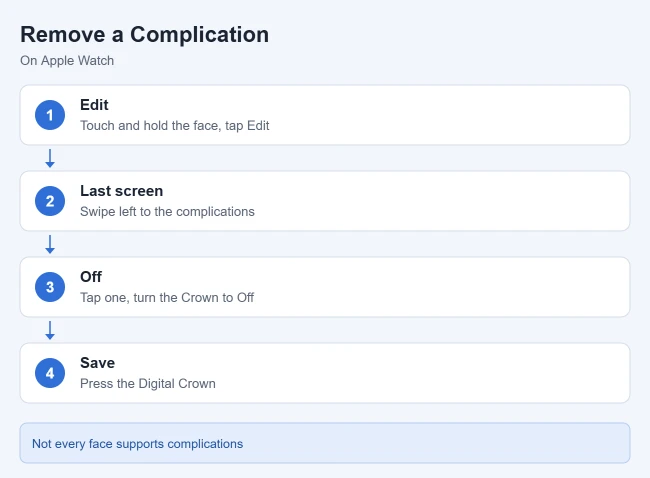
- With the watch face showing, touch and hold the display, then tap Edit. Result: the face enters edit mode.
- Swipe left all the way to the end. If the face offers complications, they are on the last screen. Result: you see the complication spots.
- Tap the complication you want to change. Result: it is highlighted.
- Turn the Digital Crown to pick a new one, or go to the top of the list and choose Off to remove it. Result: the spot shows your choice, or nothing.
- Press the Digital Crown to save, then tap the face. Result: your watch face updates.
How to Change Complications From Your iPhone
A bigger screen makes it easier to see every option:
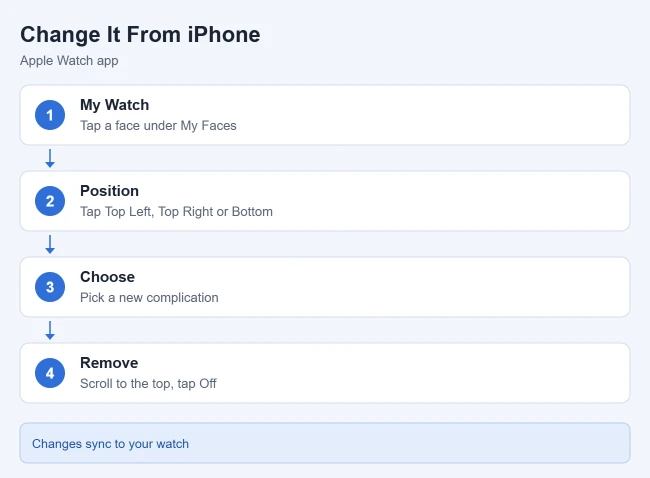
- Open the Apple Watch app on your iPhone and tap My Watch. Result: your watch settings appear.
- Tap the face under My Faces. Result: the face settings open.
- Tap a complication position, such as Top Left, Top Right, or Bottom. Result: the available complications for that spot appear.
- Tap a new complication, or scroll to the top of the list and tap Off. Result: the change syncs to your watch.
You can do the same thing when adding a new face from the Face Gallery: choose complications for each position before you tap Add to Watch.
Which Complications Can You Choose?
Apple notes that many built-in apps offer more than one complication, so you can pick exactly the detail you want. A few examples from Apple’s list:
- Weather: Air Quality, Conditions, Humidity, Rain, Temperature, UV Index, Wind.
- Activity: Rings or Timeline.
- Calendar: Your Schedule, Lunar Date, or Today’s Date.
- Timers: Added Timers or Timer.
- World Clock: Sunrise/Sunset or Added Locations.
Some apps you get from the App Store include their own complications too. You can also open most apps by tapping their complication on the watch face.
How to Add a Monogram to Your Watch Face
Monogram is a complication that shows a few letters, like your initials, on faces that support it.
- Open the Apple Watch app on your iPhone. Result: the app opens.
- Tap My Watch > Clock, then tap Monogram and type your letters. Result: your monogram is saved.
- Edit your watch face and choose Monogram in one of the complication spots. Result: your letters appear on the face.
Want to Remove the Whole Watch Face?
If you would rather get rid of the face entirely, touch and hold the display, swipe to the face, swipe up, and tap Remove. You can add it again later. See how to add, change, or delete a watch face.
Frequently Asked Questions
Why can I not add a complication?
Not every face has complication spots, and each spot only accepts certain complications. Try a different face or spot.
Can third-party apps add complications?
Yes. Apple says some App Store apps include their own complications.
Does removing a complication delete the app?
No. It only removes the shortcut from that watch face. The app stays on your watch.
Related Guides
- How to add, change, or delete a watch face
- How to use 24-hour time on Apple Watch
- How to control your iPhone camera from Apple Watch
- How to set Apple Watch to return to the clock or last used app
Using your watch as a bedside clock? See how to set an alarm on Apple Watch and use Nightstand Mode.
If the app behind a complication stops responding, see how to quit an app on Apple Watch.

Matthew Burleigh is the founder, head writer, and editor of Solve Your Tech, which he launched in 2012. He has written technology tutorials since 2008 and worked in IT since 2003, including small-business support, IT management, and consulting. He holds Bachelor’s and Master’s degrees in Computer Science from Arizona State University.
Matthew writes practical guides for Windows, iPhone and iPad, Microsoft Office, Outlook, Google apps, and Android. Solve Your Tech’s guides are tested on current devices or checked against official product documentation, with clear steps, sources, and update dates.
Read more about Matthew and how Solve Your Tech writes and updates its guides, or report a correction.