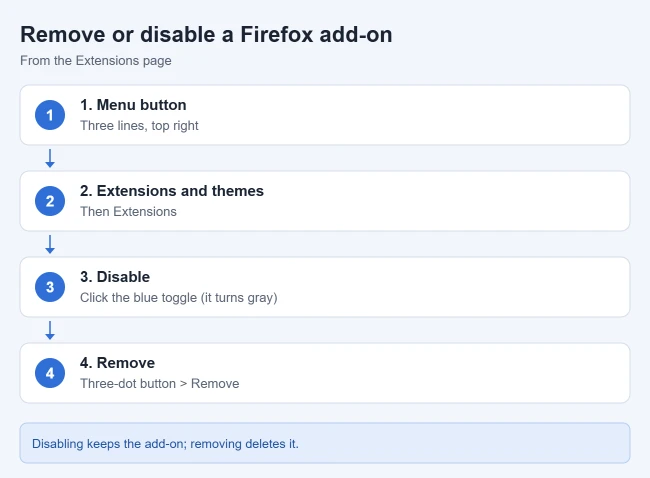
To delete an add-on in Firefox, click the menu button, choose Extensions and themes, select Extensions, then click the three-dot button next to the add-on and choose Remove. To turn one off without deleting it, click its blue toggle instead. Themes are disabled and removed from the Themes page in the same manager.
This guide covers Firefox on Windows, Mac and Linux, with a short section for Firefox on Android. Menu names follow Mozilla’s current Disable or remove Add-ons article, checked October 5, 2026. If your menu says Add-ons and themes instead of Extensions and themes, you are on an older version; the steps are otherwise the same, and you can check for Firefox updates first if you want the labels to match.
Add-Ons, Extensions and Themes: What the Words Mean
Mozilla uses add-on as the general term. An extension is an add-on that adds a feature, such as an ad blocker or a password manager. A theme is an add-on that changes how Firefox looks. Both are managed in one place called the Add-ons Manager, which opens as a tab inside Firefox.
Firefox also includes two plugins, OpenH264 and Google Widevine, which handle certain video content. Mozilla lists them as a separate type of add-on, and they are not part of the steps below.
Should You Disable or Remove It?
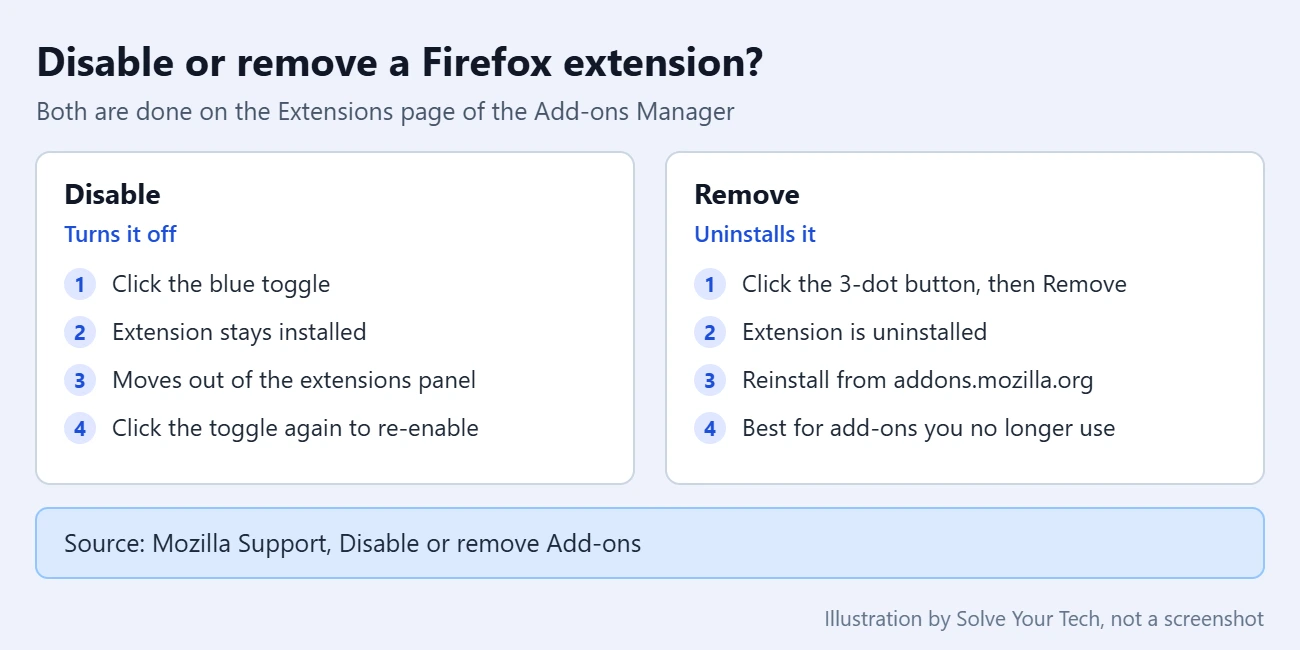
Disabling turns an extension off but leaves it installed, so you can switch it back on with one click. Removing uninstalls it. If you are trying to find out which extension is causing a problem, disable first. If you know you no longer want it, remove it.
How to Remove an Extension in Firefox
Removing an extension uninstalls it, and any settings you made inside it may not come back if you reinstall later. If you might want it again, disable it instead.
- Click the menu button (three horizontal lines) in the top-right corner of the Firefox window.
- Click Extensions and themes, then select Extensions on the left. The Add-ons Manager opens in a new tab on a page titled Manage Your Extensions.
- Scroll through the list to the extension you want to delete.
- Click the three-dot button on the right side of that extension and choose Remove.
- If Firefox asks you to confirm, click Remove again.
You can also open the Add-ons Manager by pressing Ctrl + Shift + A (Command + Shift + A on a Mac), or by typing about:addons in the address bar and pressing Enter.
Remove an Extension From the Toolbar
There is a shorter route that skips the Add-ons Manager. Mozilla describes it in its extensions button article.
- Click the extensions button in the toolbar. It looks like a jigsaw puzzle piece.
- In the panel that opens, click the gear or three-dot button next to the extension. Which icon you see depends on your Firefox version.
- Choose Remove Extension.
If the extension has its own icon pinned to the toolbar, right-click that icon instead to see its options. Pinned extensions and disabled extensions do not appear in the extensions panel, so use the Add-ons Manager if you cannot find the one you want. The same menu has Manage Extension, which takes you to that extension’s page in the Add-ons Manager.
How to Disable an Extension in Firefox
- Click the menu button, click Extensions and themes, and select Extensions.
- Find the extension in the list.
- Click the blue toggle next to it. The toggle is no longer blue and the extension stops running, but it stays installed.
To undo this, come back to the same page and click the toggle again. Mozilla notes that the toggle turns blue when the extension is enabled.
Disabling is a useful test when a website misbehaves. Turn extensions off one at a time, reload the page after each one, and the extension you just disabled when the problem stops is the likely cause.
If you only want an extension kept out of private windows, you do not need to disable it. Click the extension’s name in the Add-ons Manager and set Run in Private Windows to Don’t Allow.
How to Disable or Remove a Theme
Firefox comes with a default System theme plus optional Light, Dark and Alpenglow themes. Mozilla says these built-in themes cannot be removed, but any theme you added can be. If you only want a darker look, see how to switch to the dark theme in Firefox.
- Click the menu button, click Extensions and themes, and select Themes. You will see one Enabled theme and a list of Saved themes.
- To stop using an added theme, click Disable next to the Enabled theme. Firefox switches back to the System theme.
- To delete an added theme, click its three-dot button and choose Remove.
If you remove the theme that is currently enabled, the System theme takes over. The System theme has no Disable button of its own; it turns off when you enable a different theme.
If an Add-On Won’t Uninstall
Sometimes the Remove option is grayed out, missing, or does nothing. Mozilla’s Cannot remove an add-on article lists these fixes, roughly from least to most drastic.
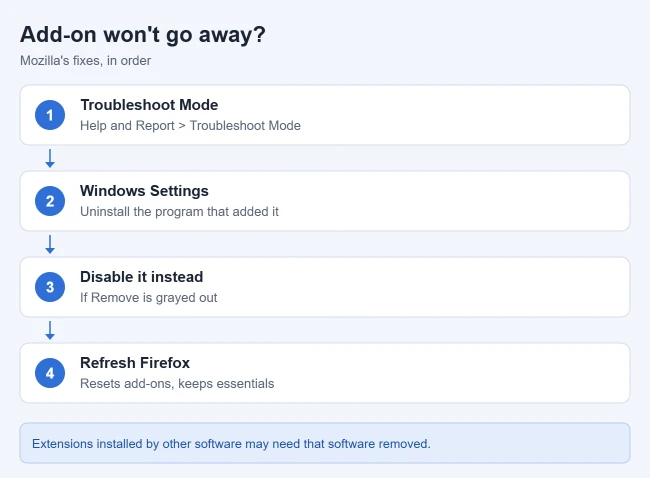
- Use Troubleshoot Mode. This starts Firefox with extensions and themes temporarily turned off. Click the menu button, click Help and Report (shown as Help in some versions), select Troubleshoot Mode, click Restart, then click Open. You can also hold Shift while starting Firefox. Try removing the add-on again, then close and reopen Firefox normally.
- Uninstall the program that added it. Some add-ons are installed by other software, such as a security suite or a download tool. On Windows, look for that program in the Control Panel or in Settings under your installed apps, or check the software maker’s support site for a removal option.
- Disable it instead. If other software added the extension and Remove is unavailable, Mozilla suggests simply clicking the blue toggle so it no longer runs.
- Remove it by hand. Mozilla documents deleting the extension’s folder or XPI file from the
extensionsfolder inside your Firefox profile. This is a last resort, and deleting the wrong file can remove a different add-on, so follow Mozilla’s article step by step.
Refresh Firefox as a last step
Read this before you use it: Refresh Firefox removes every extension and theme stored in your profile, not just the stubborn one. Mozilla says it also removes website permissions, changed preferences, added search engines and toolbar customizations. It keeps bookmarks, browsing and download history, passwords, cookies and autofill information.
To run it, click the menu button, open Help and Report, choose More troubleshooting information, and click Refresh Firefox. Firefox puts your old profile in a desktop folder named Old Firefox Data. Because toolbars are reset, you may need to show the Firefox menu bar and toolbars again afterward. Add-ons stored outside the profile folder are not removed by a refresh.
How to Stop Firefox From Recommending Extensions
Firefox sometimes suggests extensions and features while you browse. Mozilla’s Recommendations from Firefox article gives this way to turn the suggestions off.
- Click the menu button and select Settings.
- Open the Tabs and browsing page and scroll to the Recommendations section. In older versions these options are in the General panel under Browsing.
- Uncheck Recommend extensions as you browse. Uncheck Recommend features as you browse as well if you want no suggestions at all.
When a single suggestion appears, you can also open its dropdown menu and choose Don’t show this recommendation again or Show fewer recommendations.
Remove an Extension in Firefox for Android
The phone and tablet app uses different menus. Mozilla’s Firefox for Android steps are:
- Tap the three-dot menu button.
- Tap Extensions. You may also need to tap Extensions Manager at the end of the list.
- Tap the extension.
- Tap Remove to uninstall it, or turn off the Enabled slider to disable it for now.
Frequently Asked Questions
How do I know the extension is really gone?
Open the Add-ons Manager again with Ctrl + Shift + A and select Extensions. A removed extension is no longer in the list, and its toolbar icon disappears. A disabled extension is still listed, with its toggle switched off.
Can I reinstall an extension after removing it?
Yes. Find it again on Mozilla’s add-ons site, addons.mozilla.org, and select Add to Firefox. Settings you had inside the extension may need to be set up again, and accounts you created with the extension’s developer are separate from Firefox and are not deleted by removing it.
Why is an extension missing from the extensions button panel?
Mozilla says the panel only shows enabled extensions that are not pinned to the toolbar. A disabled or pinned extension will not be listed there. Click Manage extensions at the bottom of the panel to see everything that is installed.
An extension changed my home page. Does removing it fix that?
Disabling or removing the extension stops it from controlling the page. If the old page does not return on its own, set it again by following how to change your home page on Firefox.
Does Troubleshoot Mode delete my extensions?
No. Mozilla describes the changes as temporary: when you leave Troubleshoot Mode and start Firefox normally, your add-ons return to the state they were in before. Only the Refresh Firefox button in that window makes permanent changes.
Next Step
After clearing out add-ons you no longer use, it is a good time to review what else Firefox has stored. See how to delete saved passwords in Firefox if an extension you removed was handling your logins.

Matthew Burleigh is the founder, head writer, and editor of Solve Your Tech, which he launched in 2012. He has written technology tutorials since 2008 and worked in IT since 2003, including small-business support, IT management, and consulting. He holds Bachelor’s and Master’s degrees in Computer Science from Arizona State University.
Matthew writes practical guides for Windows, iPhone and iPad, Microsoft Office, Outlook, Google apps, and Android. Solve Your Tech’s guides are tested on current devices or checked against official product documentation, with clear steps, sources, and update dates.
Read more about Matthew and how Solve Your Tech writes and updates its guides, or report a correction.