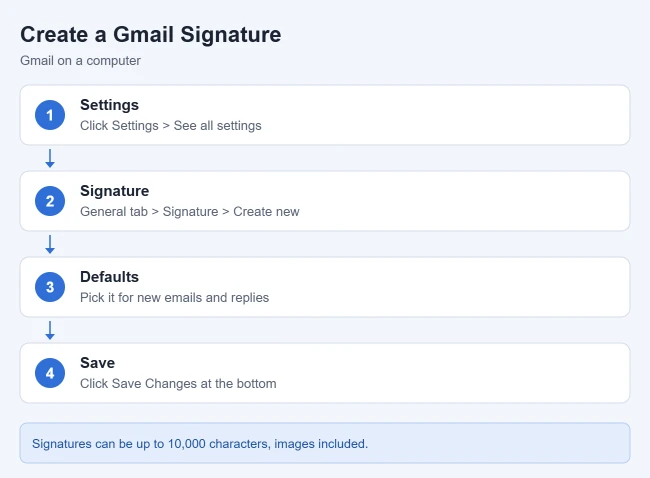
To create a signature in Gmail, click Settings > See all settings, scroll to the Signature section on the General tab, click Create new, and type your signature. Pick it as the default for new emails and replies, then click Save Changes. To remove one, click it in the same section, click Delete, and save.
These steps cover Gmail in a web browser on Windows, Mac, or a Chromebook, plus the Gmail app for iPhone, iPad, and Android, following Google’s Gmail Help article on creating a signature for computer, iPhone and iPad, and Android, and Google’s signature troubleshooting guide. The computer signature and the app signature are separate settings, so you may need to set up both.
Use a Computer for a Full Signature
- Gmail on a computer for a full signature. Images, links, fonts, and multiple signatures are all set in the web version of Gmail. The app has a simpler, text only mobile signature.
- The text you want to use. Most people use their name, plus a job title, company, phone number, or website for work mail. Three or four short lines are easier to read on a phone than a long block.
- An image file, if you want a logo or a scanned handwritten signature. Google recommends an image about 70 to 100 pixels high and 300 to 400 pixels wide. The largest it allows is 100 pixels high by 1,000 pixels wide.
How to Create a Signature in Gmail
- Open Gmail in your web browser and sign in to the account you want to use.
- At the top right, click Settings (the gear icon), then See all settings. The settings page opens on the General tab.
- Scroll down to Signature. Click Create new, type a name such as Work or Personal, and click Create. The name is only for you; recipients never see it.
- Type your signature in the box that appears. Use the toolbar under the box to change the font, size, or color, add a link, or insert an image.
- Under Signature defaults, open the For new emails use menu and choose your signature. Do the same in the On reply/forward use menu if you want it on replies and forwards too.
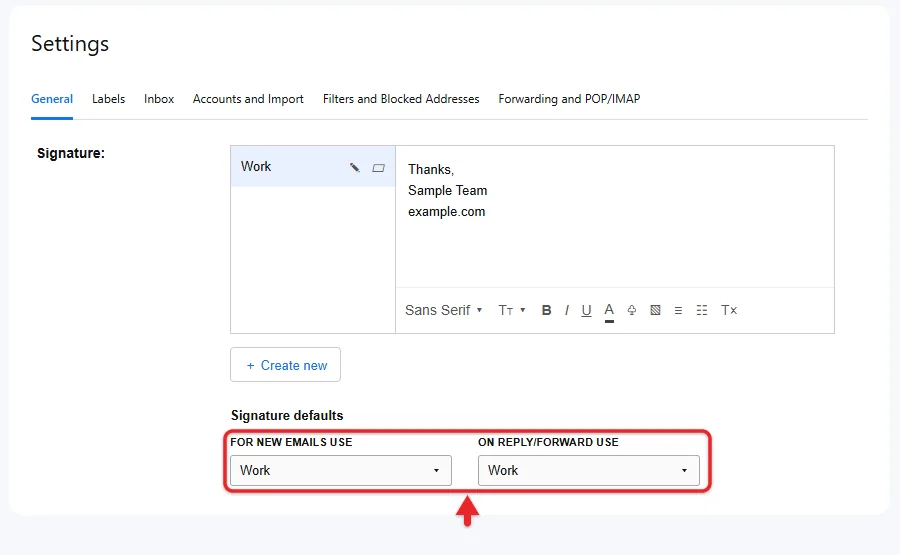
- At the bottom of the page, click Save Changes. If you leave the page without saving, Gmail discards your signature.
Gmail now adds the signature to the end of every message that uses it as a default. To check, click Compose and look at the bottom of the new message. A signature can have up to 10,000 characters, and images count toward that limit. If you get an error, make the image smaller.
Put the Signature Above Quoted Text in Replies
By default, Gmail places your signature below the quoted text of earlier messages in a reply, after a line with two dashes (–). Below the signature defaults there is a checkbox to insert the signature before quoted text in replies and remove that “–” line. Check it and click Save Changes if you want your signature right under what you just typed.
How to Add Links and Images to Your Signature
The toolbar under the signature box handles both.
- Link: highlight the text you want to link, such as your website name, click the Link icon, paste the web address, and click OK. Add links last, because reformatting the text afterward can remove them.
- Image: click where the picture should go, then click the Insert image icon. Choose My Drive, Upload, or Web Address (URL), pick the image, and click Select. Click the image in the box to choose Small, Medium, Large, or Original size.
If you insert an image from Google Drive, its sharing setting matters. The image may not upload or show correctly unless the file is shared with Anyone with the link as a Viewer. On a work or school account, your administrator may need to allow that kind of sharing.
To use a handwritten signature, sign a piece of white paper, scan or photograph it, crop the picture tightly, and insert it as an image. Keep a typed name in the signature as well, since some email apps hide images until the reader allows them.
How to Edit a Signature
- Go to Settings > See all settings.
- Under General, scroll to Signature and click the signature you want to edit.
- Make your changes in the text box. To rename it, click Edit (the pencil icon) next to its name.
- Click Save Changes.
The change applies to new messages. Emails you already sent keep the old signature.
How to Remove Your Signature in Gmail
You have three choices, depending on whether you want the signature gone for good, off by default, or missing from just one email.
Delete a Signature
- Go to Settings > See all settings.
- Under General, scroll to Signature and click the signature you want to remove.
- Click Delete (the trash icon), then Delete again to confirm.
- Click Save Changes.
A deleted signature can’t be restored, so copy its text somewhere first if you might want it back.
Stop Adding It Automatically
To keep a signature but stop Gmail from adding it, set both For new emails use and On reply/forward use to No signature, then click Save Changes. The signature stays saved, and you can still add it by hand.
Leave It Off One Email
In the compose window, click the Insert signature icon (a pen) in the row at the bottom and choose No signature. Only that message changes. You can also select the signature text in the message and delete it.
How to Use Different Signatures
Google lets you keep several signatures. You can set one default for new emails and another for replies, such as a full signature for first contact and a one line version for replies. To switch while you write, click the Insert signature pen icon at the bottom of the compose window and pick a different one. The same menu has Manage signatures, which opens the settings page.
If you use the Send mail as feature to send from other addresses, you can add a different signature for each address. Pick the address from the drop-down menu above the signature box, then set its defaults. If you don’t see the menu, check that your addresses are listed under Send mail as on the Accounts and Import settings page.
For group replies, you can also set Reply all as Gmail’s default; check the actual recipients before sending a message with your signature.
If a message still goes to the wrong people, you have a few seconds to undo a sent email in Gmail.
How to Add a Signature in the Gmail App
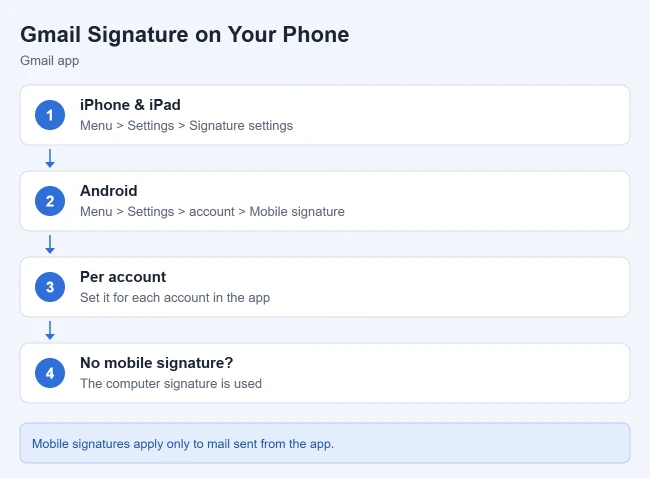
A mobile signature appears only in emails you send from the Gmail app. If you don’t create one, new messages from the app use the signature you set up on your computer. The app signature is plain text, so links stay as typed addresses and images aren’t supported.
iPhone or iPad
- Open the Gmail app and tap Menu (three lines) at the top left.
- Scroll down and tap Settings.
- Under Compose and Reply, tap Signature settings.
- Turn on Mobile Signature and type your signature.
- Tap Back to save.
If you have several accounts in the app, set it for each one. To remove it later, turn off Mobile Signature.
Android
- Open the Gmail app and tap Menu at the top left.
- Scroll to the bottom and tap Settings.
- Choose the Google Account you want to change.
- Tap Mobile signature, type your signature, and tap OK.
To remove it, open Mobile signature again, delete the text, and tap OK.
Other Mail Apps
The Gmail app setting doesn’t change other apps on the same phone. If you send Gmail messages from Apple’s Mail app instead, Mail adds its own line. You can remove Sent from my iPhone in Mail settings, or remove Sent from my iPad on a tablet. Email you write in Mail on an Apple Watch uses a separate signature set in the Watch app; here is how to remove the Apple Watch email signature.
Signature Problems and Fixes
- The signature doesn’t appear at all: make sure you clicked Save Changes, and check that the signature defaults aren’t set to No signature. If it shows on new emails but not replies, set On reply/forward use too.
- It’s missing in emails from your phone: the app uses its own mobile signature. Set it up in the app as described above.
- Formatting looks wrong or shows extra characters: in the Signature section, select your signature and click Remove formatting. Some versions of Gmail don’t support bold or italic text, and a too-large image can also cause display problems.
- You can’t format the text: if Plain Text appears above the signature box, open a new message, click More options at the bottom right of the compose window, and uncheck Plain text mode.
- Your signature is hidden in sent mail: Gmail may trim it behind three dots. Scroll to the bottom of the message and click Show trimmed content.
- The image won’t upload: clear your browser cache, remove cookies for mail.google.com, check the image’s Google Drive sharing permissions, or try an incognito window or another browser.
- The image looks broken or the wrong size: delete it, insert it again with a different method (Upload, My Drive, or Web Address (URL)), and use the recommended size above.
Gmail Signature Questions
How long can a Gmail signature be?
Up to 10,000 characters, according to Google, and any image counts toward that limit. A short signature is also easier to read on a phone.
Can I have more than one Gmail signature?
Yes, on a computer. Create each one with Create new, set the defaults for new emails and replies, and switch between them with the pen icon in the compose window. The Gmail app holds one mobile signature per account.
Why doesn’t my phone use my Gmail signature?
The Gmail app uses its own mobile signature when one is turned on. If you haven’t set one in the app, new messages use your computer signature. If you also send mail from Outlook, you can add a signature in Outlook too.
Does changing my signature update emails I already sent?
No. A new or edited signature only applies to messages you write after you save it.
Does Gmail have signature templates?
No. Gmail has a basic editor with no built-in templates. You can still build a clean signature with the toolbar, a link or two, and a small logo.
More Gmail Guides
- How to set an out of office reply in Gmail
- How to change the default font in Gmail
- How to set your profile picture in Gmail

Matthew Burleigh is the founder, head writer, and editor of Solve Your Tech, which he launched in 2012. He has written technology tutorials since 2008 and worked in IT since 2003, including small-business support, IT management, and consulting. He holds Bachelor’s and Master’s degrees in Computer Science from Arizona State University.
Matthew writes practical guides for Windows, iPhone and iPad, Microsoft Office, Outlook, Google apps, and Android. Solve Your Tech’s guides are checked step by step against the device or app maker’s own documentation and tested on his own devices whenever he has the hardware or software, with clear steps, sources, and update dates.
Read more about Matthew and how Solve Your Tech writes and updates its guides, or report a correction.