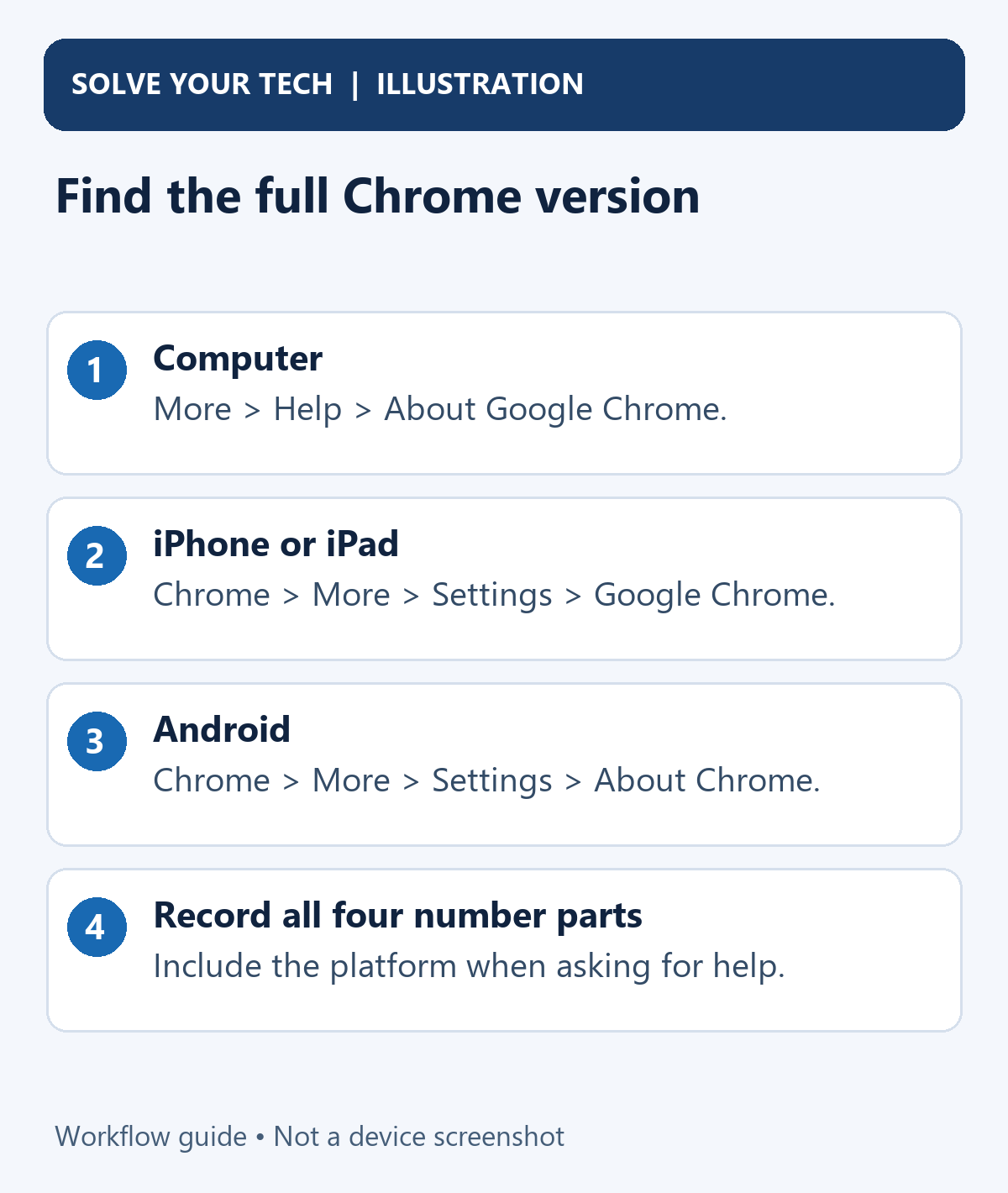
On a computer, open Chrome's three-dot menu and select Help > About Google Chrome. The installed version appears beneath the Google Chrome heading, and Chrome checks for updates on that page. On an iPhone or iPad, open Chrome and go to More > Settings > Google Chrome. On Android, use More > Settings > About Chrome.
Your Chrome version is the browser's software version. It helps when checking whether an update is installed, reporting a website problem, or following instructions that depend on a particular release. The steps below show where to find it on each device, what to record, and how to apply an available update.
Before you check the version
Open the actual Google Chrome app. Searching Google for “Chrome version” tells you about releases on the web; it does not establish which version is installed on your device. A page inside Safari, Edge, or an app's built-in browser also does not identify your Chrome installation.
Look for Chrome's red, yellow, green, and blue circular icon, or search the device's installed apps for Chrome. If you installed Chrome Beta, Dev, or Canary as well, check the particular app you use when the problem occurs. Different release channels can have different versions.
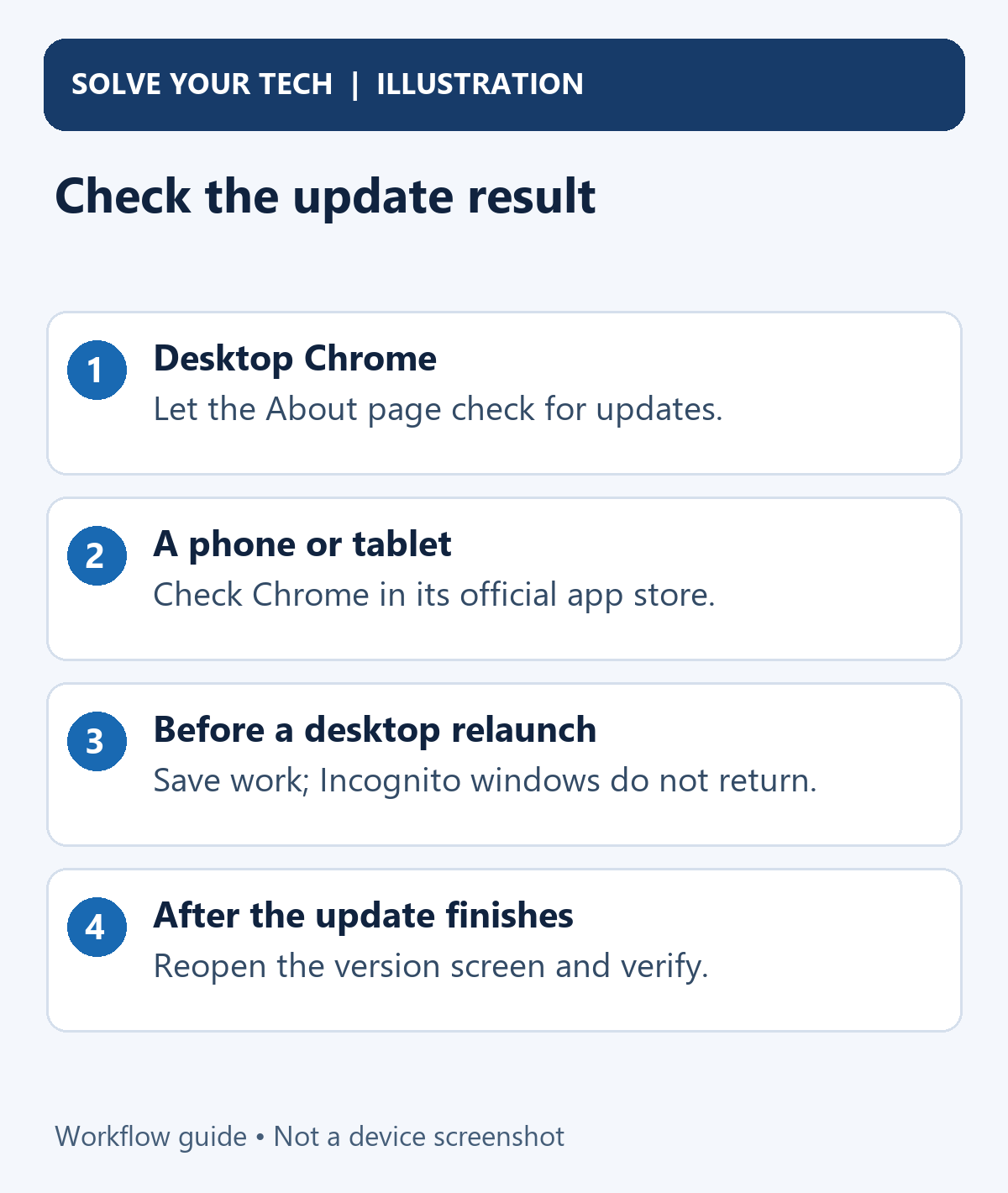
If you plan to update on a computer, save work in web forms and online editors before relaunching the browser. Google says normal tabs and windows reopen after Chrome restarts, but Incognito windows do not. Do not rely on reopening a tab to recover unsaved work inside a webpage.
Check Chrome's version on Windows or Mac
The About page is the best starting point because it shows both the version and the update status.
- Open Google Chrome on the computer you want to check.
- Select the three-dot menu at the top right of the browser window. Google calls this More.
- Point to or select Help, then select About Google Chrome.
- Find the series of numbers beneath the Google Chrome heading. Record the whole version, including the numbers after each dot.
- Read the update message separately. It may report that Chrome is up to date, that it is checking or downloading an update, that a relaunch is needed, or that the update failed.
Google's Chrome update instructions confirm this route. Opening the About page automatically starts an update check; you do not need to find a separate check button on an ordinary Windows or Mac installation.
If Relaunch appears, Chrome needs to restart to apply the update. Save your work, select Relaunch when ready, and return to Help > About Google Chrome afterward. Record the resulting version rather than assuming the update completed because the download finished.
If you choose Not now, Google says the update applies the next time you restart Chrome. Keeping a browser window open for days can leave an available update waiting for that restart.
Use the version page as an alternative
On desktop Chrome, you can type chrome://version into the browser's address bar and press Enter. This is a browser page, so enter it where website addresses normally go rather than in a webpage's search box.
Read the Chrome version at the top of the page. Google's release-channel documentation identifies this page as a way to inspect your version.
The page can also show technical details beyond the version number. If someone asks for your Chrome version, copy that number rather than sharing the whole page or a screenshot containing local paths and other details. The version number is usually enough for an initial support request.
Use About Google Chrome when you also want to check for and apply updates. The version page is useful for reading details; it is not the desktop update button.
Check Chrome's version on iPhone or iPad
Use the settings inside the Chrome app for this check. The iPhone's Settings > General > About screen shows iOS information, which is a different version number.
- Open Chrome on your iPhone or iPad.
- Tap More, the button with three dots. Its position depends on the Chrome layout you use.
- Tap Settings.
- Scroll through Chrome's settings and tap Google Chrome.
- Read the version information on that screen and copy the full number if you need to report it.
Google documents this route in its iPhone and iPad Chrome update guide. It is separate from Apple's system settings for choosing a default browser.
To check for an update, open the App Store, tap your profile at the top right, and look under Available Updates for Chrome. If Chrome appears, tap Update and complete any Apple account prompt. After installation, reopen Chrome and check its version again.
Google currently lists iOS 18 or later as a requirement for the current Chrome app. An older iPhone may have an older Chrome release installed even though it cannot install the current one. Check the App Store compatibility information when an update is unavailable rather than assuming the browser has the newest release.
If your separate goal is to have web links open in Chrome, see our guide to making Chrome the default browser on iPhone. Selecting a default browser does not update its software.
Check Chrome's version on Android
The Android app uses an About Chrome entry within Chrome's own settings.
- Open Chrome on the Android phone or tablet.
- Tap the three-dot More menu at the top right.
- Tap Settings.
- Scroll down and tap About Chrome.
- Read Application version and record the full number.
Google's Android update guide confirms the menu route. Android's phone settings may also show app information, but the exact layout varies by manufacturer. Chrome's own About page avoids mixing instructions for different phone settings apps.
For an update, open the Play Store, tap your profile icon, then tap Manage apps & device. Under Updates available, find Chrome and tap Update. Return to Chrome's About screen after it finishes.
Google currently requires Android 10 or later for current Chrome releases. If a device runs an older Android version, a lack of updates can reflect compatibility limits. A higher version number listed on a website does not mean that release is available for every older phone.
What the Chrome version number means
Chrome uses a number with four parts: MAJOR.MINOR.BUILD.PATCH. The first number is commonly called the major version or milestone. The later parts distinguish more specific builds and fixes.
For example, 123.0.6312.86 is an illustrative format, not a claim about today's latest version. Reporting only “Chrome 123” leaves out information that may matter when two people are troubleshooting different patch releases.
The Chromium project's version number explanation describes this four-part scheme. For everyday support, you do not need to decode every field. Copy the complete number exactly as displayed and include the device platform.
Do not confuse these details:
- Chrome version: the installed browser release.
- Operating system version: Windows, macOS, Android, or iOS on the device.
- Release channel: Stable, Beta, Dev, or Canary.
- Update status: whether the installed browser has a pending update or an update error.
These can all matter, but one does not replace another. A support request saying “Chrome on Windows 11” identifies the platform without identifying the browser release.
How to tell whether your version is current
Start with the update mechanism for your platform: Chrome's About page on a computer, the App Store on iPhone or iPad, or the Play Store on Android. Let the check finish, apply any available update, then reopen the version screen.
If you compare numbers online, compare the same platform and release channel. Google's release-channel documentation explains that updates roll out in stages and that Stable, Beta, Dev, and Canary are different channels. A newer experimental-channel number does not mean that ordinary Stable Chrome on your computer failed to update.
Windows, Mac, Linux, Android, and iOS releases can also have different exact patch numbers. Avoid using one number from a search result as a universal requirement for every device. For everyday browsing, stay with the channel appropriate for your use and use its official update process.
This guide does not list a fixed “latest Chrome version,” because that number changes. The version installed on your device and the update result are the useful facts to record when asking for help.
If you cannot find the version or update Chrome
The menu does not match the instructions
Check the device and app first. Desktop Chrome uses Help > About Google Chrome. Android uses Settings > About Chrome inside Chrome. iPhone and iPad use Settings > Google Chrome inside Chrome. The Chrome menu is different from the device's main Settings app.
If an app opens a link in its own viewer, close that viewer and launch Chrome directly. A browser logo shown inside a website is not evidence that you are using that browser.
Chrome reports an update error
Record the exact error and the version that the About page still shows. Check your internet connection, restart the computer after saving work, and try the update check again. Google's update-error guide discusses server errors, failed downloads, unsupported systems, and administrator restrictions.
If the message says updates are disabled by an administrator, contact the person who manages the computer. Do not change organization policies or disable antivirus and firewall protections merely to make an update check succeed. Ask the administrator to review whether the update service is being blocked.
Google also describes reinstalling Chrome as a possible repair when files are missing. Before taking that broader step, preserve browser data you need and confirm that your operating system meets the current requirements. Finding the version alone does not require uninstalling or resetting Chrome. If you do decide on that broader step, see what changes when you reset Chrome to its default settings.
Chrome will not open
On Windows 11, Settings > Apps > Installed apps may show Chrome's version in the installed-app entry. On Windows 10, look under Settings > Apps > Apps & features and select Chrome. This is a fallback for identifying the installed package when you cannot reach its browser menu.
Another Windows fallback is the Chrome program file's Properties > Details tab, where File version or Product version can identify that file. Installation locations vary, so do not assume that an empty folder or a registry query with no result proves Chrome is absent. When Chrome opens again, confirm the running browser's version through its About page.
What to include when reporting a Chrome problem
Give the person helping you a short, reproducible description:
- The full Chrome version from its version screen.
- The device platform and operating system version.
- Whether you use regular Chrome or a preview channel.
- The exact update or website error message.
- Whether the problem remains after an available update and relaunch.
If a page problem persists on current Chrome, our extension removal and disabling guide explains a reversible way to investigate an add-on. For flickering or blank video, our Chrome graphics acceleration guide describes another specific setting. Neither procedure is needed merely to read the version number.
Frequently asked questions
Is my Chrome version the same as my Google account version?
No. The version belongs to the installed browser app. Signing into a different Google account does not replace reading the app's version screen.
Will changing Chrome's default search engine update it?
No. Search engine selection is a browser preference. Use the desktop update page or your phone's app store to update the browser software.
Do I need Beta or Canary to be up to date?
No. Google's Stable channel is the usual Chrome release. Preview channels are useful for testing developing features, and they can be less reliable. Compare your installation with its own channel.
Can I use these desktop steps on a Chromebook?
Chromebooks update the browser as part of ChromeOS updates. Google treats their update process separately in its Chrome help. If you are troubleshooting a Chromebook, record its ChromeOS information as well and use the Chromebook system update instructions.
Record the full version after the update
Check the appropriate Chrome version screen, let the update process finish, and recheck after any required restart. Keeping the full number together with the platform and error message gives you a useful starting point for troubleshooting without changing unrelated browser settings.

Matthew Burleigh is the founder, head writer, and editor of Solve Your Tech, which he launched in 2012. He has written technology tutorials since 2008 and worked in IT since 2003, including small-business support, IT management, and consulting. He holds Bachelor’s and Master’s degrees in Computer Science from Arizona State University.
Matthew writes practical guides for Windows, iPhone and iPad, Microsoft Office, Outlook, Google apps, and Android. Solve Your Tech’s guides are tested on current devices or checked against official product documentation, with clear steps, sources, and update dates.
Read more about Matthew and how Solve Your Tech writes and updates its guides, or report a correction.