If your typing is delayed in Firefox, the usual causes are hardware acceleration, an extension or theme, a busy tab, or, on Windows, another program using Firefox’s accessibility services. Start Firefox in Troubleshoot Mode to see which group you’re dealing with, then turn off hardware acceleration in Settings > Tabs and browsing > Performance if typing was normal there.
These steps cover Firefox on Windows, Mac, and Linux. In older versions, the Performance settings are in the General panel, and the mobile apps don’t have these settings.
Work through the fixes in order and test your typing after each one; Mozilla’s quick fixes when Firefox slows down covers the same ground.
First, Check Whether It’s Only Firefox
A 10-second test saves a lot of guesswork. Type a sentence in Notepad, TextEdit, or another browser.
- The lag happens everywhere: Firefox isn’t the cause. Check the keyboard itself (a weak battery in a wireless keyboard, a loose USB receiver, or Bluetooth interference). On Windows, also make sure Filter keys is off in Settings > Accessibility > Keyboard, because it tells Windows to ignore or slow down quick keystrokes.
- The lag happens on one website only: The page itself is probably heavy. Busy web apps, such as online document editors and social media feeds, run a lot of code each time you press a key. Try the same site in a private window, or delete the cookies and site data for that one website in Firefox and sign in again.
- The lag happens on every site in Firefox: Keep going with the steps below.
Start With Troubleshoot Mode
Mozilla’s Troubleshoot Mode temporarily turns off your extensions and theme, hardware acceleration and WebGL, the JavaScript just-in-time (JIT) compiler, and custom userChrome and userContent files. Nothing is deleted, so it’s a safe way to find the cause.
- Click the menu button (three horizontal lines) at the top right of Firefox.
- Click Help and Report (or Help), then select Troubleshoot Mode….
- In the Restart Firefox in Troubleshoot Mode? box, click Restart.
- When the Open Firefox in Troubleshoot Mode? window appears, click Open. Don’t click Refresh Firefox in that window unless you mean to reset Firefox.
- Type in the same kind of box where you noticed the delay.
You can also hold Shift (or Option on a Mac) while you start Firefox to open the same window. To leave Troubleshoot Mode, click the menu button and select Exit (Quit Firefox on a Mac, Quit on Linux), then start Firefox the normal way. Your add-ons come back as they were.

| What happened in Troubleshoot Mode | What it points to | Where to go next |
|---|---|---|
| Typing was normal | Hardware acceleration, an extension, or your theme | Turn off hardware acceleration, then check extensions and themes |
| Typing was still slow | A changed preference, accessibility services, a busy page, or something outside Firefox | Check accessibility services, about:processes, and the other fixes |
How to Turn Off Hardware Acceleration in Firefox
Hardware acceleration hands drawing work to your graphics card. Mozilla says some graphics processors and driver setups can cause trouble showing text when it’s on, which can look exactly like delayed typing.
- Click the menu button (three horizontal lines) and select Settings.
- Select the Tabs and browsing panel on the left.
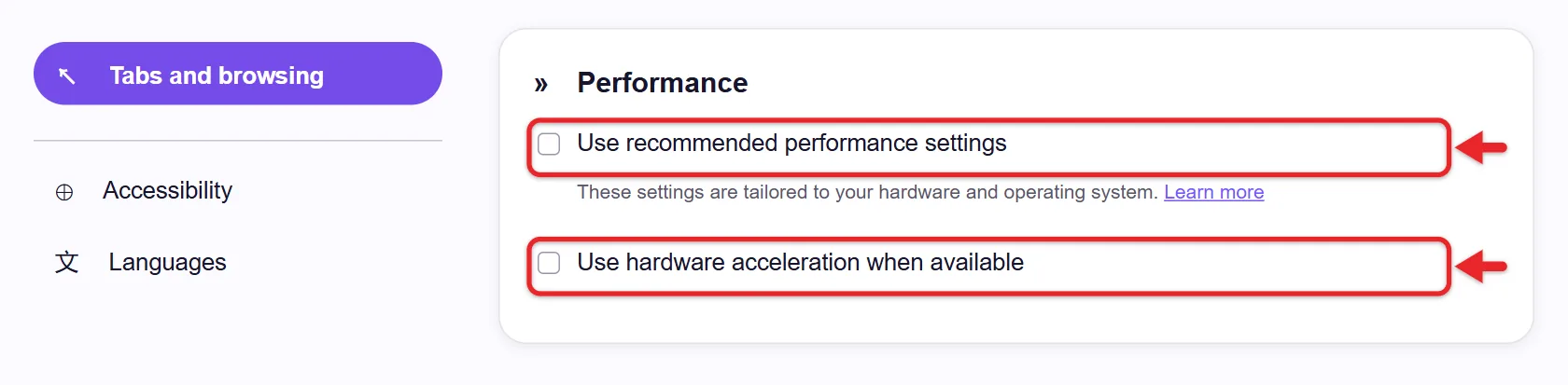
- Under Performance, uncheck Use recommended performance settings. An additional setting appears.
- Uncheck Use hardware acceleration when available.
- Click the menu button and select Exit (Quit Firefox on a Mac).
- Start Firefox the way you normally do and test your typing.

If the delay is gone, hardware acceleration was likely the cause. You can keep it off, or update your graphics drivers and try turning it back on. To undo the change, check both boxes again and restart Firefox.
If you don’t see the hardware acceleration checkbox at all, Mozilla’s performance settings article explains that Firefox hides it when your graphics driver isn’t compatible. In that case acceleration is already limited, so move on to the next section.
How to Check Your Theme and Extensions
- To rule out a theme, click the menu button, click Extensions and themes, select Themes, and click Enable next to System theme.
- To rule out extensions, select Extensions and click the blue toggle for each enabled extension so it turns off.
- Exit and restart Firefox, then test your typing.
- If typing is fixed, turn extensions back on one at a time (restarting each time) until the delay returns.
The extension you turned on just before the lag came back is the likely cause. With many extensions, turn on half of them at a time to save restarts, then split the guilty half again. Extensions that read or change every page, such as grammar checkers, ad blockers, and translation tools, are worth testing first because they run every time you type.
When you find the problem extension:
- Check for a fix. In the Extensions page, click the gear button at the top and select Check for Updates, then Install Updates if any appear.
- Look at its options. Click the three-dot button next to it and choose Options or Preferences. Some extensions let you turn off the feature that watches text boxes.
- Turn it off or remove it. Every method for doing that is in disabling or removing a Firefox add-on.
Find a Busy Tab With about:processes
One runaway tab can slow down typing in all the others, because it competes for the same processor time.
- Type about:processes in the address bar and press Enter. Mozilla calls this page the Firefox Task Manager.
- Click the CPU column heading to sort by processor use, or the Memory heading for memory.
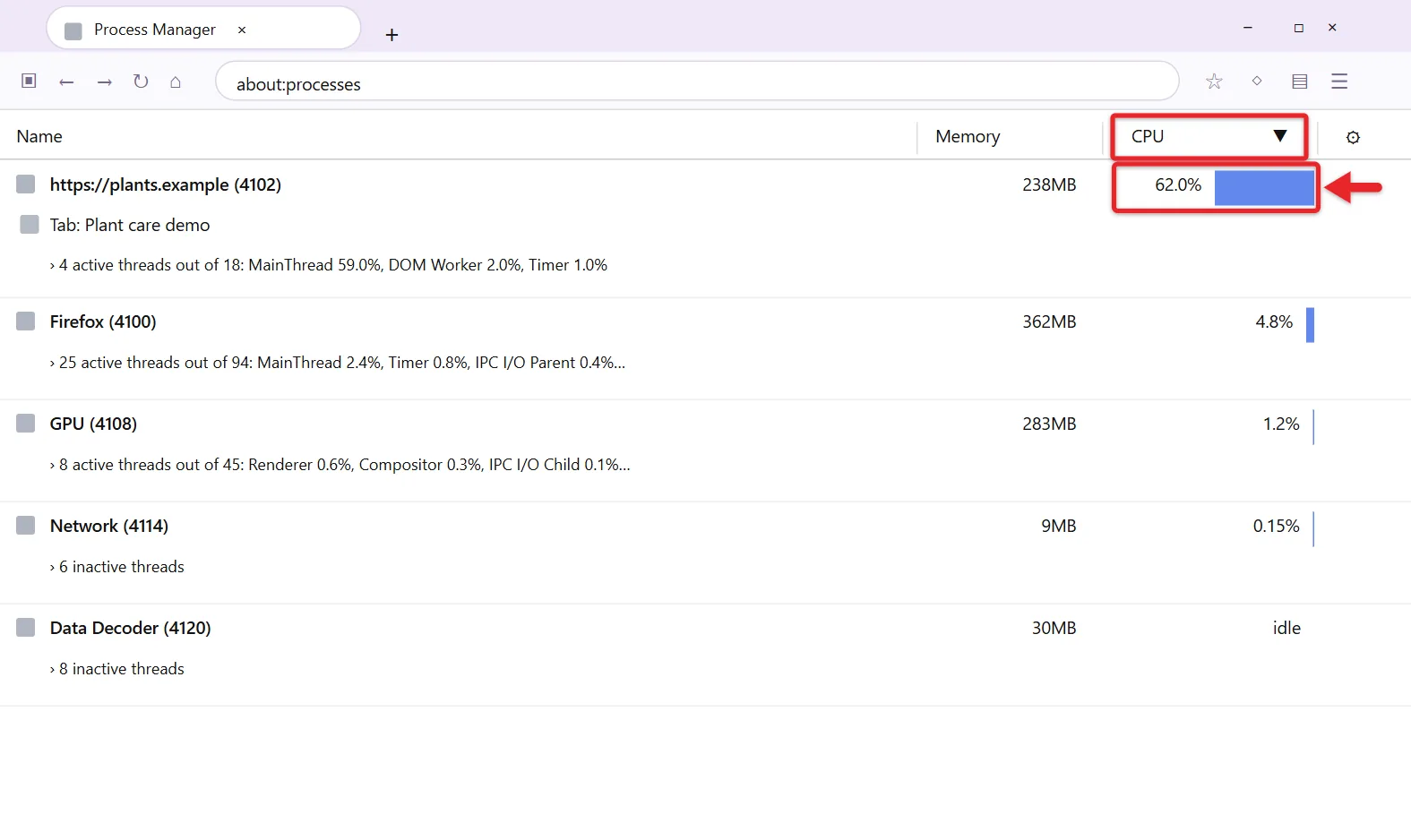
- Note the tabs and extensions at the top of the list.
- Close the tabs you don’t need, then test your typing again.
Mozilla also suggests keeping fewer tabs open. If you often have dozens open, bookmark them as a group and close the ones you aren’t reading. Typing about:memory and clicking Minimize memory usage frees some memory without a restart.
Check for Accessibility Services (Windows)
Accessibility services let other programs on your computer read and change what Firefox shows. Screen readers use them, but so do some password managers, keyboard and touchscreen tools, and other utilities. Mozilla’s accessibility services article says they negatively affect Firefox performance, and they are a common cause of typing lag that continues in Troubleshoot Mode.
To see whether they’re on:
- Type about:support in the address bar and press Enter.
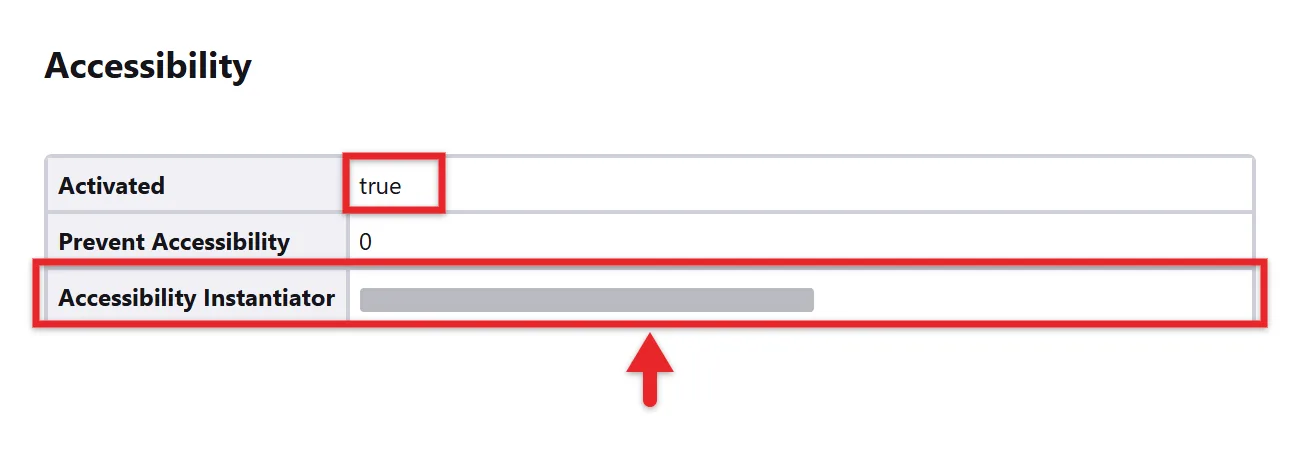
- Scroll to the Accessibility section.
- If Activated says true, look at Accessibility Instantiator. It names the program that turned the services on.
If you recognize that program and don’t need it, close or uninstall it, then restart Firefox. If you can’t remove it, you can block accessibility services inside Firefox. In a thread on Mozilla’s support forum about Firefox lagging while typing on Windows 11, this was the fix that solved the problem:
- Type about:config in the address bar and press Enter, then click Accept the Risk and Continue.
- Search for accessibility.force_disabled.
- Click the pencil (edit) button, change the value to 1, and save it.
- Restart Firefox and test your typing.
Warning: don’t do this if you use a screen reader, magnifier, or other assistive technology, because Firefox will stop working with it. To undo it, set the value back to 0 and restart.
Other Fixes to Try
- Update Firefox. The latest version contains fixes for many problems that could slow Firefox down. Click the menu button, go to Help and Report > About Firefox, and click Restart if an update downloads. You can also check for updates in Firefox by hand, and revisit the automatic update setting if you turned it off.
- Block heavy page content. Enhanced Tracking Protection, which is on by default, stops trackers and other scripts that keep pages busy.
- Use fewer tabs and close other apps. Both free up resources.
- Restart Firefox and your computer. Long sessions can build up resource use, and a pending Windows update can slow everything down.
- Test your security software. Some antivirus web shields, banking protection features, and keystroke encryption tools hook into the keyboard. Turn the browser feature off for a few minutes as a test, then turn it back on whatever the result.
- Scan for malware. Run a full scan when Firefox stays slow and nothing else explains it.
- Reset per-site zoom data. Quit Firefox and delete the content-prefs.sqlite file from your profile folder (find it under Help and Report > More troubleshooting information > Profile Folder). It resets your saved zoom levels.
Last Resort: Refresh Firefox
Refresh Firefox restores Firefox to its default state while keeping your bookmarks, history, passwords, cookies, autofill information, and personal dictionary. It removes extensions and themes, website permissions, modified preferences, added search engines, and toolbar customizations, so try it only after the steps above.
Bookmarks are kept, but if you want an extra copy first, you can back up your Firefox bookmarks to a file in about a minute.
- Click the menu button, then click Help and Report (or Help).
- Choose More troubleshooting information.
- Click Refresh Firefox… on the right side of the page.
- Click Refresh Firefox in the confirmation box. Firefox closes and reopens.
- Click Finish when the list of imported data appears, choose whether to restore your windows and tabs, and click Let’s go!
Firefox moves your old profile to a desktop folder named Old Firefox Data. You can copy files back from it, but delete it once you’re sure you don’t need it, since it holds personal information. Afterward, you can restore the menu bar and toolbars in Firefox if you had them turned on.
How to Tell the Fix Worked
Type a long sentence quickly in the same box where you saw the problem, such as a search box or an email draft. Letters should appear as you press the keys, with no catch-up burst. If you changed several things, turn them back on one at a time so you only keep the change that mattered.
Firefox Typing Lag Questions
Is it bad to leave hardware acceleration off?
Running without it is fine if that fixes your problem. If you’re seeing high CPU use instead of display problems, keeping hardware acceleration on may work better, so test both. If the same delay shows up in another browser, you can also turn off hardware acceleration in Google Chrome.
What if the delay continues in Troubleshoot Mode?
If the problem persists in Troubleshoot Mode, an extension, theme, or hardware acceleration isn’t the cause. Other possible causes include changed Firefox preferences, which Troubleshoot Mode doesn’t disable, accessibility services, or a busy tab. Mozilla also suggests scanning your computer for malware when slowness isn’t explained by anything else.
Why is typing slow on only one website?
Some sites run a lot of code with every keystroke, and that’s outside Firefox’s control. Close other tabs, try the site in a private window to rule out extensions and stored data, and check about:processes to see whether that tab is using a lot of CPU.
Does Troubleshoot Mode delete my extensions?
No. The changes are temporary. When you exit and start Firefox normally, your extensions, theme, and hardware acceleration setting return to how they were. Only the Refresh Firefox button makes permanent changes.
Will reinstalling Firefox fix typing lag?
Usually not on its own, because your profile, with its extensions and settings, stays in place. Refresh Firefox is the step that resets the profile, so try the fixes above first.
More Firefox Guides

Matthew Burleigh is the founder, head writer, and editor of Solve Your Tech, which he launched in 2012. He has written technology tutorials since 2008 and worked in IT since 2003, including small-business support, IT management, and consulting. He holds Bachelor’s and Master’s degrees in Computer Science from Arizona State University.
Matthew writes practical guides for Windows, iPhone and iPad, Microsoft Office, Outlook, Google apps, and Android. Solve Your Tech’s guides are checked step by step against the device or app maker’s own documentation and tested on his own devices whenever he has the hardware or software, with clear steps, sources, and update dates.
Read more about Matthew and how Solve Your Tech writes and updates its guides, or report a correction.