To see how much data text messaging uses on your iPhone, open Settings, tap Cellular, scroll to the list of apps, and look at the number under Messages. That figure is the cellular data the Messages app has sent and received since you last reset your statistics. Regular SMS and MMS texts are billed to your carrier’s text plan, while iMessage and RCS messages travel over Wi-Fi or cellular data, and only the cellular part shows up in this number.
These steps are for iOS 27 and also work in iOS 26 and iOS 18. Apple explains the message types in What is the difference between iMessage, RCS, and SMS/MMS? but doesn’t publish a per-message data figure, so the Settings number is the most reliable measure.
How to See How Much Data Messages Is Using
- Open the Settings app on your iPhone.
- Tap Cellular. The top of the screen shows your cellular switches and plan options.
- Scroll down to the Cellular Data list of apps. Apps are sorted with the heaviest users first. If the list is cut short, tap Show All.
- Find Messages. The amount of cellular data it has used appears under its name, in KB, MB or GB.
The total at the top of the list covers the Current Period, which started the last time someone tapped Reset Statistics at the bottom of this screen. If you have never reset it, the count may go back to when you set up the phone. When you have roamed abroad, you may also see a separate roaming total. Your carrier has the most accurate usage figures for your billing period.
What the Messages Number Includes
- Cellular data only. Messages sent and received over Wi-Fi aren’t counted, and the iPhone doesn’t show per-app Wi-Fi use anywhere in Settings.
- Both directions. Photos and videos people send you count too, not just what you send.
- iMessage and RCS traffic. Both use data when you’re away from Wi-Fi.
- Not SMS texts. Plain SMS texts go through your carrier’s text service, so they show on your bill as texts, not data.
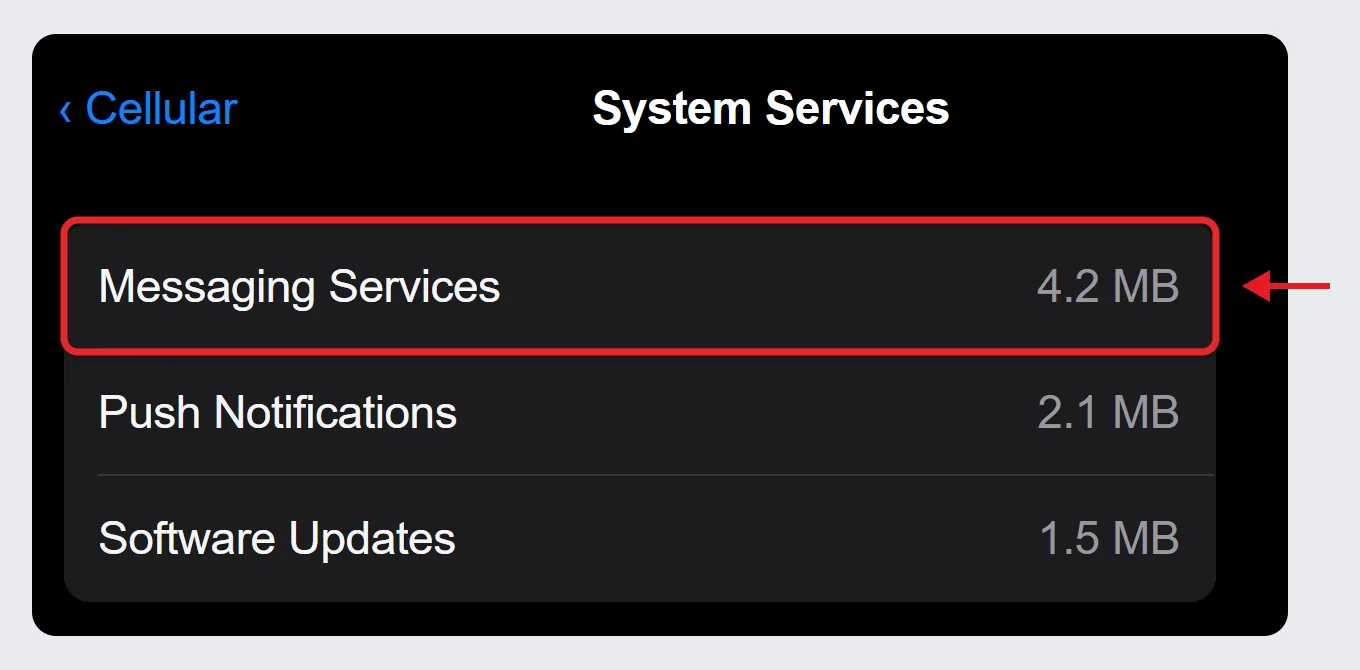
Some iPhones also list Messaging Services when you tap System Services near the top of the app list. If you see it, add it to the Messages figure for a fuller picture. You can view System Services usage but can’t turn cellular data off for individual services.
Which Messages Use Data?
The bubble color tells you how a message was sent.
| Message type | Bubble color | How it is sent |
|---|---|---|
| iMessage | Blue | Over Wi-Fi or cellular data to other Apple devices. Cellular data rates might apply when Wi-Fi is unavailable. |
| RCS | Green | Through your carrier when iMessage isn’t used. RCS can run over Wi-Fi or cellular data, needs iOS 18 or later and a supported carrier, and carrier fees may apply. |
| SMS | Green | Your carrier’s text-messaging plan. Needs a cellular network connection, not data. |
| MMS (picture and group texts) | Green | Billed to your text plan, but MMS needs a cellular data or Wi-Fi connection to send. |
For a fuller explanation of the colors, read about the difference between green and blue texts.
How Much Data Does One Text Use?
Plain text is tiny. A text-only message is measured in kilobytes, so even thousands of them add up to only a few megabytes. Attachments are measured in megabytes: a single photo, voice message or GIF can use more data than a month of plain texting, and a long video can use more than all of them. When Messages shows a large number, it is almost always media, either sent or received.
To clear out those large files, you can delete picture messages on an iPhone.
You can check this on your own phone without resetting anything:
- Note the current number under Messages in Settings > Cellular.
- Turn off Wi-Fi, then send or receive the message you want to measure, such as a short video.
- Go back to Settings > Cellular and compare. The increase is roughly what that message used.
A text with a subject can also be sent as MMS instead of SMS, so if you never use it, remove the subject line in iPhone Messages.
How to Track Messages Data for a Month or a Trip
The iPhone doesn’t reset these numbers on its own, so it won’t match your billing cycle unless you reset it on the right day.
Resetting permanently clears every app’s totals, not just Messages. Write down any numbers you want to keep first.
- Go to Settings > Cellular.
- Scroll to the bottom and tap Reset Statistics.
- Confirm the reset when your iPhone asks. Every total starts again from zero, and the date of the last reset appears at the bottom of the screen.
Do this on the first day of your billing cycle, or the day before a trip, then check Messages at the end. For billing, your carrier’s app or website is the final word, because carriers measure and round usage their own way.
How to Use Less Data in Messages

- Send smaller photo previews: go to Settings > Apps > Messages and turn on Send Low Quality Photo Previews. The recipient gets a smaller preview right away, and when Low Data Mode is on, only the preview is sent. Older iOS versions call this Low Quality Image Mode.
- Turn on Low Data Mode: go to Settings > Cellular > Cellular Data Options. On a 5G plan, tap Data Mode and choose Low Data Mode; on LTE, turn on the Low Data Mode switch. With Dual SIM, tap the line under Settings > Cellular first. Apple’s Use Low Data Mode on your iPhone or iPad lists what it pauses, such as Background App Refresh and iCloud Photos updates.
- Save big files for Wi-Fi: wait until you’re on Wi-Fi to send or open long videos, especially in busy group chats where everyone shares media.
- Turn off Data Roaming when you travel: go to Settings > Cellular > Cellular Data Options and turn off Data Roaming, unless your plan includes international data. iMessage and RCS still work on Wi-Fi.
- Turn off cellular data for Messages: in the Cellular Data app list, turn off Messages. The iPhone then uses only Wi-Fi for that app, so iMessage and RCS messages won’t send or arrive on cellular. Use this with care.
For more ideas that apply to every app, try these 10 ways to reduce cellular data usage on iPhone.
How to Turn iMessage or RCS On or Off
- iMessage: go to Settings > Apps > Messages and turn iMessage on or off.
- RCS: go to Settings > Apps > Messages > RCS Messaging and turn RCS Messaging on or off. There may be a short delay the first time you turn it on. If the option isn’t there, your carrier may not support RCS on iPhone.
Turning these off doesn’t stop texting. Messages fall back to SMS/MMS where your plan allows, which uses your text plan instead of data. To let that fallback happen automatically, keep Send as Text Message on in the same Messages settings.
When Messages Is Missing or Data Keeps Rising
Messages isn’t in the app list
Tap Show All at the bottom of the shortened list, then scroll through every app. The list is sorted by usage, so a Messages app that has used very little data sits near the bottom.
Messages data keeps rising while you’re on Wi-Fi
When Wi-Fi is weak or has no internet, Apple’s Connectivity Assist (called Wi-Fi Assist in iOS 26 and earlier) adds cellular data to keep things working. In iOS 27, turn it off in Settings > Wi-Fi. In iOS 26 and earlier, the Wi-Fi Assist switch is at the bottom of Settings > Cellular.
The number doesn’t match your carrier bill
The iPhone count runs from your last reset, not from your billing date, and your carrier counts data its own way. Reset on your billing day for a closer match, and use the carrier’s figure for billing.
Messages won’t send after you turned off its cellular data
That’s expected for iMessage and RCS away from Wi-Fi. Picture and group texts can fail too, because MMS needs a data connection. Turn the Messages switch back on in Settings > Cellular, then tap the red exclamation point on the failed message and tap Try Again.
You can’t find Send Low Quality Photo Previews
Check for Low Quality Image Mode in the same Messages settings on an older iOS version. On iOS 17 and earlier, Messages settings are at Settings > Messages instead of under Apps.
Messages Data Use Questions
Do iMessages count against my text plan?
No. iMessage goes over Wi-Fi or cellular data rather than your text plan. On cellular, your carrier’s data rates might apply.
Does receiving a message use data?
Yes. An iMessage or RCS message you receive on cellular counts the same way as one you send, and photos and videos in it count at their full size.
Why is Messages using so much data?
Usually because of photos and videos, sent or received. Large group chats with lots of media are the most common cause. Turn on Send Low Quality Photo Previews and save big files for Wi-Fi.
Does iMessage use data when I travel abroad?
Yes. Away from Wi-Fi, iMessage and RCS use cellular data, which can mean roaming charges. Turn off Data Roaming or use Wi-Fi, and SMS texts will follow your carrier’s international texting rates.
Why are my photos blurry when I send them?
Low quality previews, Low Data Mode or an MMS conversation can cause it. The article on why your iPhone is sending blurry pictures has more.
Check the Messages number now, then reset your statistics on your next billing day so you can compare a full month.

Matthew Burleigh is the founder, head writer, and editor of Solve Your Tech, which he launched in 2012. He has written technology tutorials since 2008 and worked in IT since 2003, including small-business support, IT management, and consulting. He holds Bachelor’s and Master’s degrees in Computer Science from Arizona State University.
Matthew writes practical guides for Windows, iPhone and iPad, Microsoft Office, Outlook, Google apps, and Android. Solve Your Tech’s guides are checked step by step against the device or app maker’s own documentation and tested on his own devices whenever he has the hardware or software, with clear steps, sources, and update dates.
Read more about Matthew and how Solve Your Tech writes and updates its guides, or report a correction.