To set a vibration-only alarm on iPhone, open Clock > Alarms, edit or add an alarm, tap Sound, pick a pattern under Haptics, then choose None as the sound and save. The alarm buzzes without playing a ringtone.
These steps cover iPhones running iOS 27, the current version, and match iOS 26, iOS 18 and iOS 17, where older versions may label the pattern list Vibration instead of Haptics. They apply to a regular Clock alarm. A wake-up alarm from a Health sleep schedule has its own settings, covered later.
What You Need to Know First
- Sound and vibration are two separate choices. The Sound screen holds both a Haptics list (the vibration pattern) and a list of tones. Each list has its own None option. For a vibration-only alarm, the tone must be None and the haptic pattern must not be.
- Silent mode doesn’t make an alarm vibrate only. Apple says the Ring/Silent switch, Silent mode (including from the Action button) and Do Not Disturb don’t silence alarms. If a tone is selected, it still plays.
- StandBy turns off alarm haptics. StandBy is the clock-style screen an iPhone shows when it’s charging on its side and locked. Alarm haptics are disabled while it’s in use, so a vibration-only alarm can’t buzz you awake in StandBy.
- iPads can’t vibrate. You can set the sound to None on an iPad, but the alarm only lights up the screen.
How to Set a Vibration-Only Alarm
- Open the Clock app and tap Alarms at the bottom of the screen. Your saved alarms appear in a list.
- Tap + to add a new alarm, or tap the time of an existing alarm to edit it. The alarm editor opens.
- Set the time. Tap Repeat if you want it on certain days, and tap Label to give it a name like “Quiet wake-up” so you can tell it apart from your other alarms.
- Tap Sound. The screen lists the haptic pattern at the top and the tones below it.
- Tap Haptics (or Vibration) and choose a pattern, such as Rapid or Heartbeat. The phone plays a preview of each one as you tap it. Make sure None is not selected here.
- Tap Back to return to the Sound screen, scroll to the bottom of the tone list, and tap None. A check mark appears next to None.
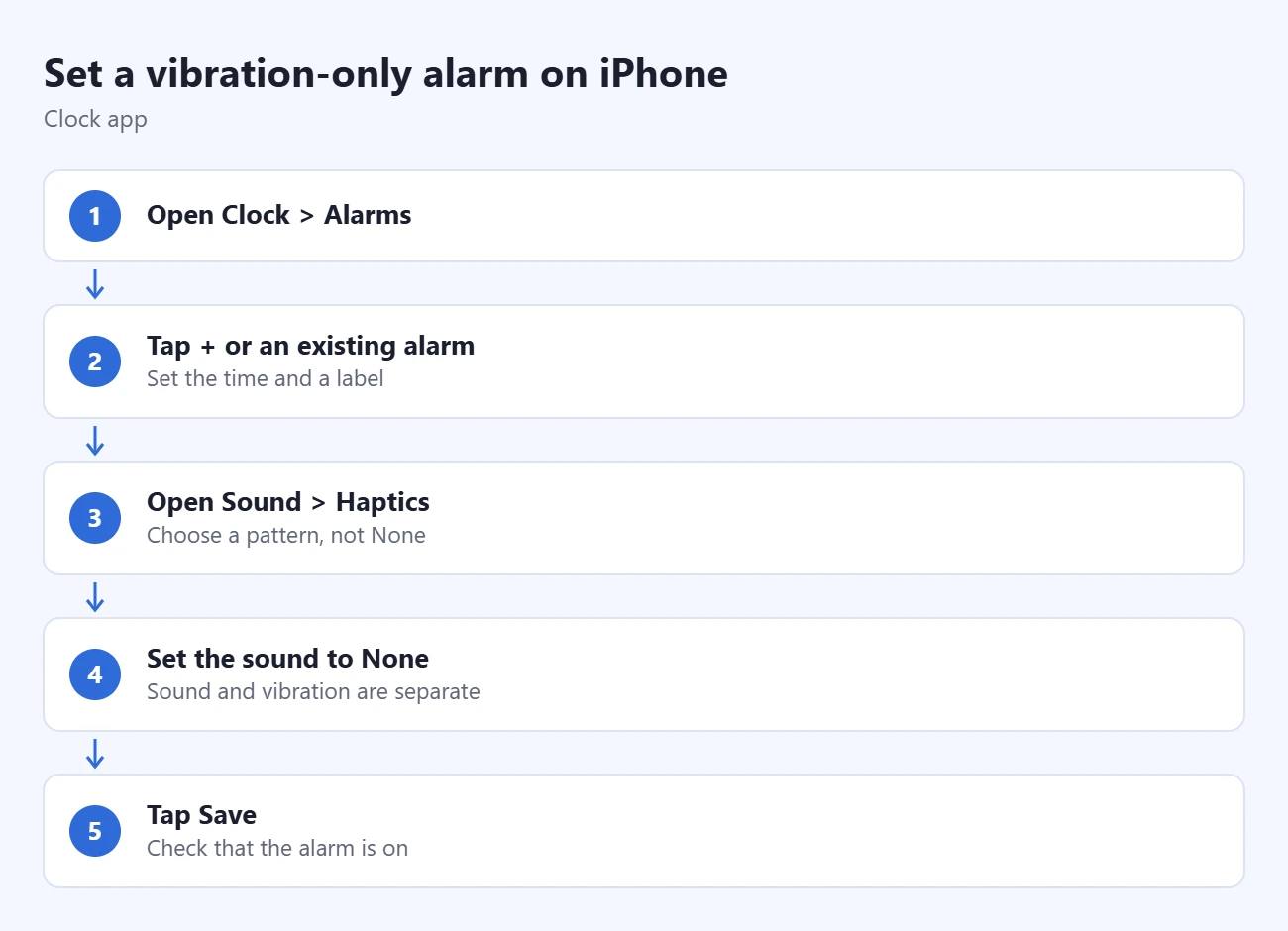
- Tap Back, then tap Save (or the check mark) in the alarm editor.
- Check that the alarm’s switch is green in the Alarms list. A gray switch means it won’t go off.
Apple’s alarm help article confirms the cause when an alarm only vibrates: its sound is set to None. To go the other way and get sound back, see “How to Go Back to an Audible Alarm” below.
Pick a Pattern You’ll Notice
A single soft buzz is easy to miss. A pattern with fast, repeated pulses, like Rapid, is harder to sleep through than a slow one. Tap a few patterns in the Haptics list and keep the one you notice most.
You can also make your own. In Haptics, tap Create New Vibration, tap the screen in the rhythm you want, tap Stop, play it back, then tap Save and name it. Your pattern appears under Custom in the same list.
Test the Alarm While You’re Awake
Set a temporary alarm two or three minutes ahead with the same settings. Put the phone where it will be when you rely on it, such as on the nightstand or the bed, and wait for it.
- You should feel or hear the buzz, but no tone should play.
- On a hard surface, the vibration can rattle loudly. On a soft mattress or under a pillow it’s much quieter, but also easier to miss.
- Delete the test alarm or turn it off afterward.
Waiting for the real alarm, instead of only previewing the pattern, also confirms that the time, AM or PM, and the switch are right. For an important wake-up time, keep an audible backup alarm until you know the vibration alone wakes you.
When the test is over, you can delete the test alarm on iPhone with a swipe in the Alarms list.
Clock timers use a separate sound choice, so if a countdown ends with no sound, here’s how to fix an iPhone timer that isn’t going off.
If the Alarm Doesn’t Vibrate
- No pattern selected. Open the alarm, tap Sound > Haptics, and make sure a pattern is checked, not None.
- StandBy is on. If the phone was charging on its side in StandBy, its alarm haptics were off. Lay the phone flat, or choose a quiet tone instead of None for nights you use StandBy.
- Vibration is turned off for the whole phone. Go to Settings > Accessibility > Touch and make sure Vibration is on. Apple’s vibration guide notes that this switch turns off all vibration, including emergency alerts. This article on turning off vibration explains how it differs from the narrower call, text and keyboard settings.
- The overall haptics setting is limited. On recent versions, Settings > Sounds & Haptics > Haptics lets you choose when the phone vibrates (for example Always Play or Never Play). Apple doesn’t say whether this setting applies to Clock alarms. If yours is set to Never Play or to play only in one mode and your alarm stays still, choose Always Play and test again.
- The alarm is turned off or set for the wrong day. Check the switch, the AM or PM setting and the Repeat days. An alarm without repeat days turns off after it goes off once.
- You’re editing the wrong alarm. If you have several alarms at similar times, open each one and check its Sound screen.
Sleep Schedule Wake-Up Alarms
The alarm at the top of the Alarms list, under Sleep | Wake Up, comes from a sleep schedule in the Health app, not from the regular alarm list. To change how it sounds, tap Change next to it, then look under Alarm Options for Sounds & Haptics and the alarm volume.
Apple’s wake-up alarm settings offer Change Next Alarm Only, which affects one morning, and Change This Schedule, which changes the recurring schedule. If you want a vibration-only alarm that doesn’t touch your sleep schedule, create a regular alarm with the steps above instead.
Other Ways to Wake Up Without Sound
- Apple Watch. An alarm on your watch can tap your wrist silently when the watch is in Silent mode. Here’s how to set an alarm on Apple Watch, including Nightstand mode.
- A short countdown. If you need a silent reminder in a few minutes rather than a timer tone, set a vibration-only alarm for the end time. If the When Timer Ends list in the Timer tab offers no vibration-only choice on your phone, this is the easiest built-in workaround.
How to Go Back to an Audible Alarm
- Open Clock > Alarms and tap the alarm’s time.
- Tap Sound and choose any tone from the list. You can keep the haptic pattern selected so it vibrates and rings.
- Tap Back, then Save.
Alarm volume follows the Ringtone and Alerts slider in Settings > Sounds & Haptics, so check that slider if the alarm sounds too quiet. This article on setting alarms on iPhone covers snooze, labels and repeating alarms in more detail.
Vibrate-Only Alarm Questions
Does putting my iPhone on silent make the alarm vibrate only?
No. Silent mode, the Ring/Silent switch and Do Not Disturb don’t silence alarms. Set the alarm’s sound to None for a vibration-only alarm.
Will a vibration-only alarm wake someone sleeping next to me?
It’s much quieter than a tone, but a phone buzzing on a hard nightstand can still be heard. Keeping the phone on the bed near you, or using an Apple Watch on your wrist, is quieter.
Can I make every alarm vibrate only?
Not with one setting. Each alarm has its own Sound screen, so repeat the steps for each alarm you want to change.
Why does my alarm vibrate but make no sound?
Its sound is set to None. Open the alarm, tap Sound, choose a tone and save.
Does snooze work with a vibration-only alarm?
Yes. If Snooze is on in the alarm editor, tapping Snooze delays the alarm, and it vibrates again with the same pattern.

Matthew Burleigh is the founder, head writer, and editor of Solve Your Tech, which he launched in 2012. He has written technology tutorials since 2008 and worked in IT since 2003, including small-business support, IT management, and consulting. He holds Bachelor’s and Master’s degrees in Computer Science from Arizona State University.
Matthew writes practical guides for Windows, iPhone and iPad, Microsoft Office, Outlook, Google apps, and Android. Solve Your Tech’s guides are checked step by step against the device or app maker’s own documentation and tested on his own devices whenever he has the hardware or software, with clear steps, sources, and update dates.
Read more about Matthew and how Solve Your Tech writes and updates its guides, or report a correction.