To set an alarm on your Apple Watch, open the Alarms app, tap the Add (+) button, pick AM or PM, set the hour and minutes with the Digital Crown, and tap the check mark. To use your watch as a bedside clock, turn on Nightstand Mode in Settings > General and connect the watch to its charger.
These steps follow Apple’s guide to alarms on Apple Watch, checked in October 2026. You can also ask Siri something like “Set repeating alarm for 6 a.m.”
How to Set an Alarm on Apple Watch
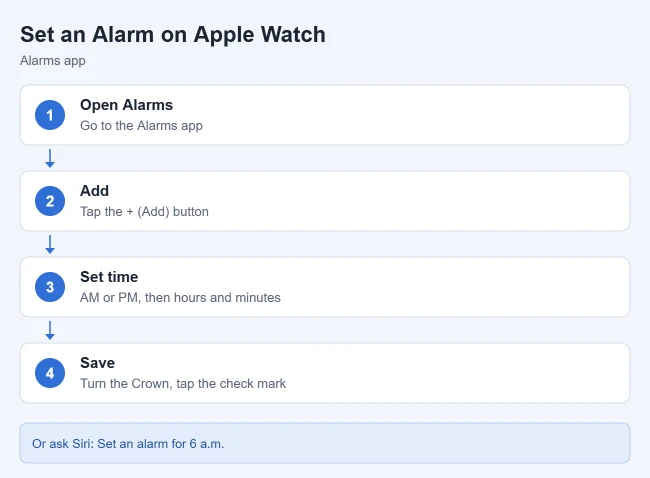
- Open the Alarms app on your Apple Watch. Result: your list of alarms appears.
- Tap the Add button. Result: the time picker opens.
- Tap AM or PM, then tap the hours or minutes. Result: the part you tapped is selected.
- Turn the Digital Crown to adjust, then tap the check mark. Result: the new alarm is saved and turned on.
To turn an alarm on or off later, tap its switch in the list. If you prefer 24-hour time on the watch, see how to use 24-hour time on Apple Watch.
How to Edit an Alarm
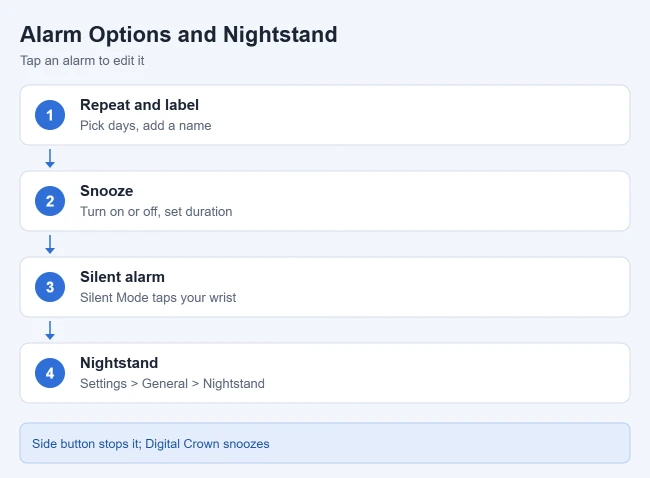
Open the Alarms app and tap the alarm time. Apple lists these options:
- Change time: pick a new time.
- Repeat: choose the days of the week the alarm repeats.
- Label: give it a name, like “Water the plants.”
- Snooze: turn on to show a Snooze button when the alarm goes off.
- Snooze Duration: choose how long the alarm pauses when you snooze.
- Break Through Silent Mode: turn on to have sound always play while you wear the watch.
Make a Silent Alarm That Taps Your Wrist
Apple’s tip: turn on Silent Mode, and the alarm taps your wrist without making a sound. This is handy if you share a room and do not want to wake anyone else. Leave Break Through Silent Mode off for that alarm.
Turn Off Snooze
If you tend to hit Snooze too often, open the Alarms app, tap the alarm, and turn off Snooze. The Snooze button will not appear when that alarm sounds.
How to Delete or Skip an Alarm
- Delete: in the Alarms app, swipe left on an alarm, then tap Delete.
- Skip a wake-up alarm: if the alarm is part of your sleep schedule, tap it below Alarms and choose Skip for Tonight.
Get iPhone Alarms on Your Watch
Set the alarm on your iPhone, then open the Apple Watch app on your iPhone, tap My Watch > Clock, and turn on Push Alerts from iPhone. Your watch alerts you when the iPhone alarm goes off, so you can snooze or dismiss it from your wrist. Apple notes it does not work the other way: your iPhone does not alert you when a watch alarm goes off.
How to Use Nightstand Mode
- Open Settings on your Apple Watch. Result: Settings opens.
- Tap General, then Nightstand Mode. Result: the Nightstand Mode setting appears.
- Turn on Nightstand Mode. Result: the feature is on.
- Connect your watch to its charger and set it on its side, facing up. Result: it shows charging status, the time and date, and your next alarm.
To see the time, tap the display or nudge the watch. Apple says even tapping the table might work. When an alarm from the Alarms app goes off in Nightstand Mode, the watch wakes you gently with a unique alarm sound. Press the side button to turn it off, or press the Digital Crown to snooze.
Frequently Asked Questions
Why did my alarm not make a sound?
Your watch was probably in Silent Mode. Turn on Break Through Silent Mode for that alarm if you want sound to always play while you wear the watch.
Can I set an alarm with my voice?
Yes. Ask Siri, for example, “Set an alarm for 7 a.m.” or “Set repeating alarm for 6 a.m.”
Will the alarm go off if the watch is charging?
With Nightstand Mode on, Apple says the watch shows your next alarm while it charges and wakes you with a gentle alarm sound.
Related Guides
- How to turn off an Apple Watch
- How to stop taking screenshots on Apple Watch
- How to send an audio message from Apple Watch
- How to delete or change a complication on Apple Watch

Matthew Burleigh is the founder, head writer, and editor of Solve Your Tech, which he launched in 2012. He has written technology tutorials since 2008 and worked in IT since 2003, including small-business support, IT management, and consulting. He holds Bachelor’s and Master’s degrees in Computer Science from Arizona State University.
Matthew writes practical guides for Windows, iPhone and iPad, Microsoft Office, Outlook, Google apps, and Android. Solve Your Tech’s guides are tested on current devices or checked against official product documentation, with clear steps, sources, and update dates.
Read more about Matthew and how Solve Your Tech writes and updates its guides, or report a correction.