International CDMA is a roaming setting on older Verizon iPhones that let the phone connect to CDMA cellular networks in other countries. Verizon says turning it off while you’re abroad may improve poor messaging or data performance. Verizon shut down its 3G CDMA network on December 31, 2022, and its instructions only list the iPhone 6 through iPhone X, so most people today will manage roaming with Data Roaming instead.
This guide explains what the setting did, where to find it on an older iPhone, and which settings to use for travel on a current iPhone. It’s based on Verizon’s International CDMA instructions and 3G CDMA shutdown notice, plus Apple’s articles on cellular data settings and data roaming.
What CDMA Means
CDMA and GSM were the two main types of older cellular networks. In the US, Verizon and Sprint used CDMA, while AT&T and T-Mobile used GSM. Most of the world used GSM, which is why CDMA phones needed a special setting for using CDMA networks abroad. Today, phones rely mainly on 4G LTE and 5G, and Verizon says more than 99% of its customers had already moved to those networks before it turned off 3G CDMA.
Where the International CDMA Setting Is on Older iPhones
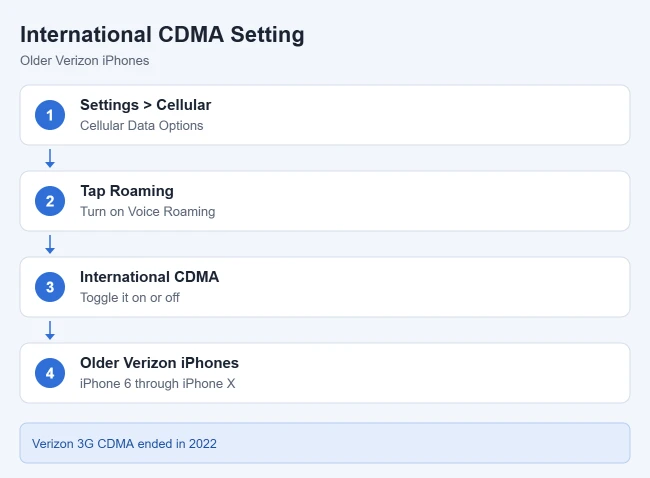
Verizon lists these steps for the iPhone X, iPhone 8 and 8 Plus, iPhone 7 and 7 Plus, iPhone SE, and iPhone 6 series:
- Open Settings.
- Tap Cellular, then Cellular Data Options.
- Tap Roaming.
- Turn on Voice Roaming. The International CDMA option appears only after this is on.
- Turn International CDMA on or off.
Result: With International CDMA off, the phone won’t use CDMA networks abroad. Verizon notes the steps apply only when traveling outside the US and can vary by international network.
Roaming Settings on Current iPhones
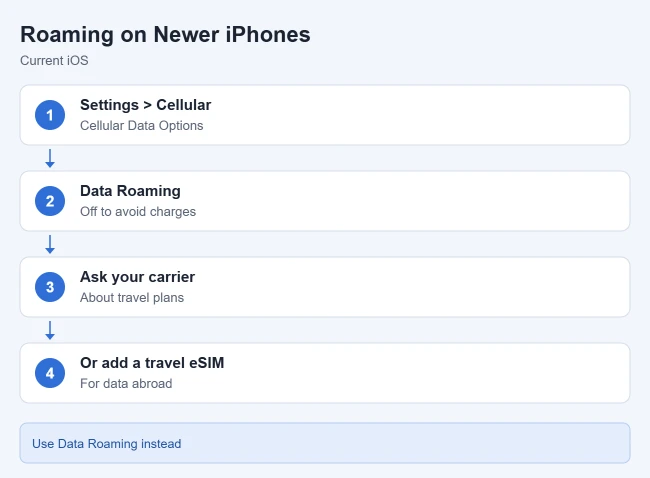
On current iPhones, Apple’s roaming options are under Settings > Cellular > Cellular Data Options:
- Data Roaming: Lets the iPhone use cellular data in regions your carrier doesn’t cover. Apple suggests turning it off while traveling to avoid roaming charges, unless you have a travel plan.
- Voice Roaming (CDMA): On some models and carriers, turning this off stops the iPhone from using other carriers’ networks, which avoids charges but means no service when your carrier isn’t available.
- Low Data Mode: Under Data Mode, this pauses automatic updates and background tasks off Wi-Fi.
To stay connected abroad, Apple recommends asking your carrier about an international plan or adding a travel eSIM. If calls to saved numbers fail while you are abroad, you can also turn off Dial Assist on your iPhone and dial the full number yourself.
If Data or Messages Don’t Work Abroad
Apple’s roaming troubleshooting steps include checking that your date and time are correct, turning Airplane Mode on and off, making sure Data Roaming is on if you have a roaming plan, and contacting your carrier if the problem continues. On an older Verizon iPhone that still shows the option, Verizon suggests turning off International CDMA if messaging or data is poor.
Frequently Asked Questions
Why don’t I see International CDMA on my iPhone?
Verizon’s instructions only cover the iPhone 6 through iPhone X, and the option only appears after you turn on Voice Roaming. Verizon’s 3G CDMA network also shut down at the end of 2022, so newer iPhones use Data Roaming and your carrier’s travel options instead.
Should I turn International CDMA on or off?
If you have an older iPhone that still shows it and you have trouble with texts or data while traveling, Verizon suggests turning it off.
How do I keep data costs down while traveling?
Turn off Data Roaming unless you have a plan, and use Wi-Fi when you can. Our list of ways to reduce cellular data usage on an iPhone has more tips. To call home, see how to dial a number on an iPhone.

Matthew Burleigh is the founder, head writer, and editor of Solve Your Tech, which he launched in 2012. He has written technology tutorials since 2008 and worked in IT since 2003, including small-business support, IT management, and consulting. He holds Bachelor’s and Master’s degrees in Computer Science from Arizona State University.
Matthew writes practical guides for Windows, iPhone and iPad, Microsoft Office, Outlook, Google apps, and Android. Solve Your Tech’s guides are tested on current devices or checked against official product documentation, with clear steps, sources, and update dates.
Read more about Matthew and how Solve Your Tech writes and updates its guides, or report a correction.